How to bet on elections legally, what the biggest upsets revealed about market inefficiency, the insider risks nobody mentions clearly enough, and a strategy framework for betting on political events in 2026 and beyond.
Political betting has a reputation problem. On one side, people think it’s just gambling with a newspaper open. On the other, boosters claim prediction markets are the future of democracy — smarter than polls, faster than analysts, infallible. Neither version is right, and the gap between them is where the real money gets made and lost.
This guide is for the person who reads the news seriously and wants to know whether that actually translates into an edge — and if so, what kind, under what conditions, and at what risk. It also covers the things most guides skip: the structural disadvantages built into these exchanges, the cases where someone with nonpublic information is on the other side of your bet, and the specific situations where genuine knowledge helps versus the ones where it’s noise.
Editor’s pick
Want the best conditions for betting on political events?
We’ve reviewed the platforms that cover election markets, offer fair odds, and actually pay out. Here’s what we recommend:
BetPortal Amunbet Fortunica VegasNova West Ace Highspin











Disclaimer: Political betting involves real financial risk. Odds can move quickly and outcomes are uncertain by nature. Only use funds you can afford to lose. Platform availability varies by jurisdiction — verify local regulations before registering. This page may contain affiliate links; we may earn a commission if you sign up through them, at no extra cost to you.
How Political Betting and Prediction Markets Actually Work
There are two distinct structures here, and they behave differently enough that treating them as the same thing will cost you money. Understanding how each works is the first requirement before you look at a single election betting line.
Traditional UK bookmakers — Betfair, William Hill, Paddy Power — have run political betting markets for two decades and remain the default option for UK bettors, who don’t face the same regulatory restrictions as their US counterparts. The sportsbook model means you’re betting against the house rather than other participants, which removes the most direct form of insider risk, but the margin sits higher on each bet than on prediction exchanges.
Prediction exchanges — Polymarket, Kalshi, PredictIt — work like financial exchanges, and understanding how they operate is what separates casual participants from those who make money consistently. Participants buy and sell shares in outcomes, priced between 0 and 100 cents (or 0% and 100%), where the price reflects the collective probability estimate. If you buy a contract for “Democrat wins Senate seat in Arizona” at 42 cents and it resolves Yes, you collect $1 — a 58-cent profit. If it resolves No, you lose your 42 cents. The platform charges a small transaction fee rather than embedding a margin in the odds, which makes these exchanges cheaper to use for serious volume, but exposes you to a different problem: the person on the other side of your trade may know something you don’t.
How to Read Political Betting Odds: What the Number Actually Means
A candidate trading at 65 cents on Polymarket, or at 4/6 on Betfair, is not a guarantee or even a strong prediction — it’s a weighted average of what all current participants are willing to put money on, adjusted for how much each has staked. Reading these odds correctly means understanding one thing: you’re reading collective opinion priced in real money, not a model output. Large, well-capitalised traders move prices more than small ones. Someone who bets $200,000 on a 70% favourite is expressing both a belief and the confidence to back it at that size. The price moves accordingly.
This matters because the number you see is a consensus, not the truth. Consensus can be systematically wrong in the same direction for the same reasons across thousands of participants — which is exactly what happened in 2016.
The Biggest Political Betting Upsets: Brexit, Trump, and What the Markets Missed
Three events turned election betting from a niche hobby into a serious industry: Brexit, Trump in 2016, and the 2024 US presidential cycle. Each revealed a different kind of failure in how these exchanges price outcomes, and understanding what went wrong is more useful than any abstract strategy guide.
Case Study · June 2016
Brexit: The Market Priced Remain at 76% on Polling Day
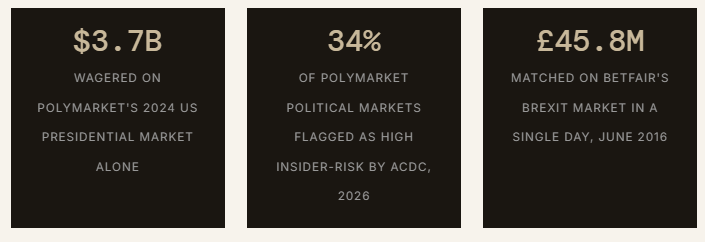
Betfair took £45.8 million in Brexit wagers and closed with Remain at roughly 76% implied probability — meaning the market was confident enough to price Leave as a 3/1 longshot. Anyone backing Leave at those prices that morning collected nearly three times their stake by the following afternoon.
The structural failure was demographic. The people who bet on these exchanges — educated, globally connected, financially literate — were not representative of the people who were going to vote. Remain voters were overrepresented among bettors; Leave voters were underrepresented. The platform was, in effect, polling its own participants rather than the electorate. One punter who backed Leave at the bookmakers made enough to buy a used car from a small stake. Several institutional traders who had shorted Remain made considerably more.
What savvier participants had noticed was that street-level sentiment, door-to-door canvassing data, and social media activity in non-metropolitan England was pointing somewhere different from the polling averages. The price wasn’t incorporating that signal. It was incorporating London Twitter.
Case Study · November 2016
Trump at 25/1 in 2015, Then 3/1 to 5/1 on Election Night
One documented bet placed three days after Trump announced his candidacy in June 2015 was at 150/1. By the final weeks, Trump was trading between 3/1 and 5/1 on most platforms, with Betfair showing Clinton at around 80% implied probability heading into election night. People who had backed Trump at any of those prices — even the later ones — collected heavily.
The miss followed the same pattern as Brexit. Professional bettors were systematically underestimating a movement they didn’t fully understand. The voters who put Trump in the White House were not the same people pricing the contracts. That gap — between who bets and who votes — is the structural inefficiency that paid out twice in the same year.
Case Study · July 2024
Biden’s Withdrawal and the Speed Problem
When Biden stepped back from the 2024 race, Kamala Harris was trading above 50/1 as a potential Democratic nominee on some platforms, then moved to frontrunner within hours. The people who held Harris contracts through the chaos made extraordinary returns. But the speed of the move also illustrated what makes late-breaking political events different from almost any other market: the gap between the event happening and the odds updating can be seconds. By the time most retail participants saw the news and tried to trade, the price had already moved most of the way.
The lesson wasn’t “back longshots on candidates who might benefit from sudden developments.” It was more specific: the initial odds on any newly opened or dramatically reopened market tend to be set conservatively by platforms, and there can be a brief window before the crowd reprices them accurately. That window is measured in minutes, not hours.
Types of Political Betting Markets: Elections, Primaries, Policy Outcomes and More
Election betting isn’t one thing. It’s a cluster of very different contracts that happen to involve politicians, and they require completely different analytical approaches.
| Market Type | Time Horizon | Volatility | What Drives the Price | Edge Available to Serious Participants |
|---|---|---|---|---|
| Presidential / National Elections | 1–4 years | Low early, spikes near the date | Polling averages, economic data, incumbency, scandal | Moderate — markets tend to correct over time, but slowly |
| Primary / Leadership Contests | Weeks to months | High, especially on personnel news | Individual candidate news, endorsements, donor shifts | Higher — upsets are frequent; markets often underreact to insurgents |
| When Will a Leader Resign / Leave Office | Open-ended | Very high around political crises | Scandal, party confidence votes, health, parliamentary arithmetic | High but dangerous — outcome depends on individual decisions |
| Specific Policy Outcomes | Weeks to months | Medium, often illiquid | Legislative calendars, vote counts, lobbying pressure | High for those with genuine inside knowledge of the process |
| Approval Ratings / Polling Thresholds | Specific dates | Low to medium | Economic conditions, news cycle, partisanship stability | Low — these are highly correlated with information already priced in |
| Geopolitical / Military Events | Variable | Extreme | Intelligence, diplomatic signals, classified information | Negative for retail — this is where insider risk is highest |
The pattern worth noting: contracts where the outcome depends on what one or a few individuals decide — a president’s choice, a party leader’s resignation — are the ones where insider knowledge is most dangerous to trade against. Events where the outcome aggregates millions of votes are somewhat safer, because it’s harder for any single actor to have decisive nonpublic information.
Insider Trading in Political Prediction Markets: The Risk No One Mentions Clearly Enough
In April 2026, the Anti-Corruption Data Collective published an analysis of all settled Polymarket contracts and found that 34% of them showed patterns consistent with high insider risk, including unusual clustering of winning bets in the final hour before resolution and a statistically implausible rate of successful longshot wagers from a small number of wallets.
Earlier in 2026, a member of the US military was charged with insider trading after allegedly using classified information to place bets on election outcomes. In spring 2026, NPR documented campaign staffers admitting to using internal polling data to buy contracts on their own candidates before favourable numbers went public. The White House lawyers reportedly questioned staff about whether administration officials were trading on privileged information.
This isn’t a hypothetical problem. It’s happening right now, and it’s structural, not incidental. The nature of these exchanges is that the most valuable information — what a leader will decide, what a classified operation will produce, what an unpublished poll shows — is exactly the kind of information that some participants legally or illegally possess and others don’t.
Which Contract Types Carry the Highest Insider Risk
The ACDC analysis found that contracts where a single individual or small group makes the determining decision — a president’s word choices, an administration’s appointment choices, a military action — show the clearest statistical signatures of insider activity. Events where the outcome aggregates public decisions (actual election results, publicly announced approval ratings) show much lower rates of anomalous trading patterns. This makes intuitive sense: it’s hard to insider-trade an election involving 130 million votes.
Where Political Knowledge Gives You a Real Edge in Betting Markets
The honest answer is: in a narrower range of situations than most people think, but in those situations it helps more than in almost any other wagering domain.
Polling aggregation is already done by professionals who are better at it than most individuals. National electoral averages are efficiently priced. But there are specific situations where a careful reader of the news can hold a genuine edge:
1. Betting on State and Local Races: Where Thin Markets Pay Off
Contract prices on a state senate race or a regional primary are often set by a small number of participants using national-level information. A person who actually follows local races in that state — reads the local paper, knows the candidates’ histories, understands the district dynamics — can identify mispricing that an outsider simply doesn’t have the information to correct. Betfair and Kalshi both cover this level, and the volume is thin enough that even modest information advantages move the probability significantly. Down-ballot races are where genuine knowledge translates to edge most reliably.
2. How to Bet on Leadership Contests and Primary Elections
When a party is choosing a new leader, the market often prices early frontrunners based on name recognition rather than on how the actual voting membership or parliamentary party is likely to behave. In the UK Conservative leadership contest of 2022, for example, the sequence of who entered, who dropped out, and who the remaining candidates were likely to send to the membership round was genuinely knowable from public information about parliamentary maths — but the early prices didn’t reflect it accurately. The people who understood the process well enough to model the vote transfers made money. The people betting on polling favourites did not.
3. Trading the News-to-Price Lag in Political Prediction Markets
These exchanges update more slowly than financial markets after news breaks. A significant poll, a resignation letter, a party defection — these can take twenty minutes to fully reprice on less liquid contracts. Someone monitoring the news and the exchange simultaneously can trade the lag, though this window has compressed considerably as volume has grown.
Political Betting Strategy: Three Approaches, What Each Requires, and What Each Costs You
There’s no universal approach that works across all contract types. The choice depends on what kind of information you have, how much risk you can absorb, and which platform structure you’re using. Here are three distinct approaches with an honest accounting of what each gives up.
| Approach | Core Logic | What It Requires | What It Costs | Best Market Type |
|---|---|---|---|---|
| Favourite-backing with exit | Back the market favourite early; exit the position when price moves to your target, rather than waiting for resolution | A prediction market with liquidity; patience; willingness to accept smaller gains | Misses the big payout if you exit too early; transaction costs eat into small moves | Presidential and national elections; multi-year timeframes |
| Structural mispricing on secondaries | Identify markets where the process mechanics are mispriced — vote transfer logic, runoff rules, parliamentary math — rather than trying to predict opinions | Genuine knowledge of the rules of the process you’re betting on; often requires country or institution-specific expertise | These windows close quickly once volume enters; requires constant monitoring | Leadership contests; primaries; parliamentary confidence votes |
| Counter-consensus on margin | Identify cases where the market is pricing a result as more certain than the evidence warrants, and back the underdog at a price that compensates for the extra variance | Strong conviction that the consensus is wrong for identifiable reasons, not just a feeling; enough stake to make the payout meaningful if correct | Most of the time the consensus is right; this approach loses frequently and wins rarely but large | Any market where you have a specific identified reason the crowd is wrong — not just hope |
The first approach is the most conservative and the most boring. The second requires real expertise in the specific political system. The third is the one people find most appealing and lose the most money trying to apply without the specific identified reason.
The Brexit and Trump trades worked not because the bettors involved had a general feeling that polls were wrong. They worked because specific participants identified a structural gap between who was pricing the contracts and who was going to vote, and that gap was large enough and specific enough to act on. Doing the same thing based on a general sense that “the polls could be wrong” is not the same trade.
Bankroll Management and Risk Rules for Election Betting
Election outcomes resolve on fixed timelines, which creates a specific financial risk that sports bettors don’t face in the same way: your capital can be locked up for months or years while a contract resolves. The principles below account for that.
| Rule | What It Means in Practice | Why It Matters Specifically for Political Markets |
|---|---|---|
| Separate your political betting stake from all other money | Set an amount you could lose completely without it affecting your life, and never add to it from outside that allocation | A presidential market can tie up your stake for 18 months. You cannot predict what you’ll need that money for during that period. |
| No single position above 20% of your political stake | Even if you are highly confident, cap any individual market at 20% of your total political betting allocation | Political markets have a category of risk — legal ambiguity, platform shutdowns, market rule changes — that sports markets don’t carry. PredictIt operated under a CFTC no-action letter that was withdrawn in 2022. Platforms can suspend or modify markets mid-resolution. |
| Treat your position as illiquid until six weeks before resolution | Plan your finances as though money in a prediction market position cannot be accessed until near the resolution date | Liquidity in political markets drops sharply between major news events, and trying to exit a position at an off-peak moment can cost several percentage points in slippage. |
| Keep records of every trade and your stated reason at the time | Before placing a bet, write one sentence: “I am buying/selling this because [specific reason].” Read it back when you exit. | Post-hoc rationalisation is especially tempting in political markets, where you can always find a news story to justify what you wanted to believe anyway. The written record holds you accountable to what you actually knew at the time. |
| Check platform legal status in your jurisdiction before depositing | Prediction markets operate under different regulatory frameworks in the US, UK, EU, and elsewhere. Status changes — Polymarket restored full US access in May 2026 after restrictions. | A platform restriction can prevent you from withdrawing funds or resolving positions. Check the current status before placing a position you plan to hold for months. |
The Bias Problem Specific to Election Betting
There is one risk here that has no equivalent in sports: you probably have strong opinions about the candidates or parties involved, and those opinions will make you overestimate the probability of outcomes you want to happen. Research consistently shows that sports fans overestimate their team’s chances, but the effect is considerably stronger with elections, where belief and identity are more deeply involved. The practical implication isn’t “be aware of your bias” — everyone says that and it doesn’t help. The practical implication is: whenever you’re excited about a position, apply an automatic discount. If your honest estimate is 60%, price it as 50%. If you can’t find a reason to take the other side at all, don’t bet.
Polymarket vs Kalshi vs PredictIt vs Sportsbooks: Where to Bet on Politics in 2026
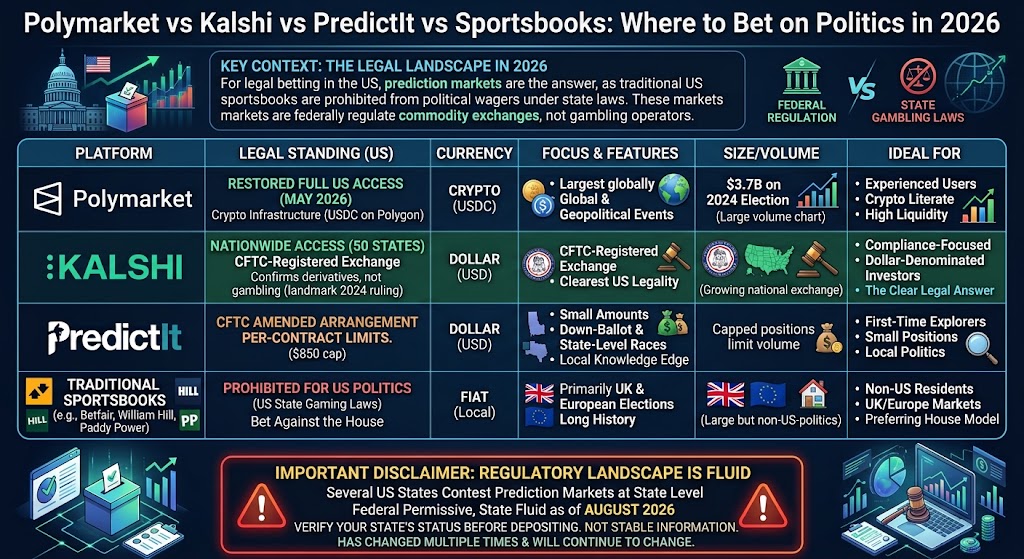
If you want to bet on politics legally in the US, the answer as of 2026 is prediction markets rather than traditional sportsbooks, which are generally prohibited from taking political wagers under state gaming laws. The main platforms are federally regulated as commodity exchanges, not gambling operators, which gives them a different legal standing.
Polymarket handled $3.7 billion on the 2024 US presidential election and is the largest prediction market globally by volume. It operates on cryptocurrency infrastructure (USDC stablecoin on Polygon), which means deposits and withdrawals require basic crypto literacy. Polymarket restored full US access in May 2026 after a period of restriction — it’s now the most liquid option for betting on international elections and geopolitical events.
Kalshi won a landmark 2024 court ruling against the CFTC that confirmed political event contracts are derivatives rather than gambling under US federal law, which means it operates nationally across all 50 states. It’s denominated in dollars rather than crypto, making it more accessible to participants who don’t want cryptocurrency exposure. For anyone asking “is political betting legal in the US,” Kalshi is the clearest answer: yes, on CFTC-registered exchanges.
PredictIt operates under an amended CFTC arrangement with per-contract investment limits capped at $850, which limits the size of any position. This makes it better suited to participants exploring political markets for the first time with small amounts — it also has the widest selection of down-ballot and state-level races, where the local-knowledge edge discussed above is most useful.
Traditional UK bookmakers — Betfair, William Hill, Paddy Power — have run political betting markets for two decades. The sportsbook model means you’re betting against the house rather than other participants, which removes the most direct form of insider risk, but the margin cost is higher on each bet and the product is primarily designed for UK and European elections.
What Political Betting Odds Can’t Tell You: A Final Honest Assessment
The honest assessment of where these exchanges currently stand is this: they are better than polls at aggregating publicly available information quickly, and they were better than polls at predicting the 2024 presidential result. They are worse than polls — or rather, structurally compromised — in any contract where participants with nonpublic information can trade without detection, and that category is larger than the platforms would prefer to acknowledge.
For the retail participant, the practical position is one of selective engagement. National elections with high volume are reasonably fairly priced; the edge available is real but small, and requires either a genuine informational advantage or a long-term position with patience to ride out volatility. Leadership contests and primaries are where process knowledge and local information generate clearer edges, at the cost of higher variance. Geopolitical and military-adjacent contracts are where the insider risk is highest, the information asymmetry most severe, and where a retail participant is most likely to be the least-informed person in a trade — which is exactly the position you don’t want to be in.
The punters who made money on Brexit and Trump had something the rest of the crowd didn’t: not a prediction, but a specific identified gap between what the price was measuring and what was going to determine the outcome. Finding that gap, on a contract where the outcome genuinely aggregates public decisions, on a platform with sufficient liquidity — that’s the version of this that works. Everything else is just having an opinion in a room full of people with opinions.
Start with the question of who’s going to vote, rather than who the other bettors think will win.
Frequently Asked Questions About Political Betting
Is political betting legal in the United States?
Betting on political events through CFTC-registered prediction markets — Kalshi, Polymarket, PredictIt — is legal in all 50 US states. These platforms are regulated as commodity exchanges under federal law, not as gambling operators. Traditional sportsbooks are generally prohibited from taking political wagers. Some states have tried to challenge prediction markets at the state level, but federal court rulings have so far upheld their legal standing nationwide.
Are prediction markets more accurate than polls for predicting elections?
On aggregate, yes — though the gap is smaller than prediction market advocates claim. Research comparing Polymarket data to traditional polling during the 2024 US presidential election found that markets produced probability estimates that tracked closely with final results, outperforming polling averages particularly in the final weeks before the vote. The key advantage is speed: markets update in real time as news breaks, while polls take days or weeks to reflect new information. However, markets have their own failure mode — they reflect the views of their participants, who may be systematically unrepresentative of actual voters, as Brexit and Trump 2016 demonstrated.
What is the difference between Polymarket and Kalshi?
Both are CFTC-regulated prediction markets where you can bet on political outcomes, but they differ in two practical ways. Polymarket uses cryptocurrency (USDC stablecoin), making deposits and withdrawals contingent on basic crypto knowledge; it’s the larger global platform by volume, with better coverage of international elections. Kalshi uses US dollars and is available across all 50 states with no crypto requirement; it tends to have deeper liquidity on US political events specifically. PredictIt is a third option with the widest range of state and local race markets, but caps positions at $850 per contract.
How do you read political betting odds?
On prediction markets like Polymarket and Kalshi, prices are expressed as cents per contract, where $1.00 is the maximum payout for a winning position. A contract priced at 68 cents represents a 68% implied probability of that outcome occurring. If you buy it and the event resolves Yes, you collect $1.00 — a 32-cent profit. On traditional sportsbooks, political betting odds use standard formats: decimal odds (2.50 means you get $2.50 back per $1 staked, including your stake), fractional odds (6/4), or American moneyline odds (+150 or -200).
What happened to political betting after Brexit and Trump 2016?
Both results were priced as unlikely by the markets: Remain had around 76% implied probability on Betfair on Brexit polling day, and Clinton was priced around 80% on most platforms heading into election night 2016. Bettors who backed Leave or Trump at those prices collected at 3/1 or better. The common factor in both misses was demographic — the people pricing the markets were systematically unrepresentative of the people who voted. Since 2018, national election results have been considerably more predictable, though the structural gap between bettor demographics and voter demographics remains.
Can you make money betting on politics?
Yes, but under specific conditions. The strongest edge comes from genuine informational advantages in thin markets — local and state-level races where you follow local politics and the market is priced by national-level participants who don’t. The weakest approach is backing gut feelings on major national elections, which are efficiently priced by sophisticated participants. The structural risks are also different from sports betting: political markets carry insider trading risk, platform regulatory risk, and the tendency for participants to overestimate outcomes they want to happen.