Trump SAVE America Act Explained – The Voting Bill That Could Block Millions From the 2026 Midterms
President Trump has drawn a line in the sand. He will not sign any legislation into law until Congress passes the SAVE America Act – a sweeping federal elections overhaul that would fundamentally change how Americans register and vote. The bill passed the House in February. It faces near-insurmountable obstacles in the Senate. And the President is now demanding that Republicans load it with additional provisions that make passage even less likely.
The political logic is straightforward even if the legislative arithmetic is not. The 2026 midterm elections take place in November. Incumbent parties historically lose seats in midterms. Trump wants new voting rules in place before those elections. Democrats want to block them. The filibuster – which requires 60 votes to overcome – stands in the way.
Senate Majority Leader John Thune acknowledged the reality on March 11: as a “clear-eyed realist,” he said Republicans do not have the 50 votes needed to abolish the filibuster. The SAVE America Act, in its current form, cannot become law without it.
The smart money is already moving on political outcomes. Here are the top-rated bookmakers offering political betting:

BetPortal
- Lucky Friday: 50% Friday Reload Bonus
- Wild Wednesday: 250 Free Spins
- Riskfree Weekend: 10% Cashback

Amunbet
- Lucky Amun Monday: 50% up to £450
- First Deposit Highroller Bonus: 250% up to £4,500 + 250 FS
- Pharaoh’s Wins Weekend: Up to £450

Fortunica
- 5,000+ games from 40+ providers
- Fast payouts available via Visa and Mastercard, e-wallets (PayPal, Skrill, Neteller), bank transfers, and cryptocurrencies

VegasNova
- Promo Code - WELCOME200
- Sports Welcome Bonus - 150% up to €200–$200

Highspin
- Tuesday Reload Bonus 50% Up To £250
- Secial Bonus - HIGHSPIN LOTTERY
- Weekly Cashback - Every Monday Up To £500

West Ace
- Crypto Casino Bonus - 200% up to 3,000 USDT
- Crypto Sports Bonus - 100% up to 200 USDT






What Is Actually in the Bill
The core of the SAVE America Act requires documentary proof of citizenship to register to vote – a US passport, or a driver’s licence paired with a birth certificate, certificate of naturalisation or adoption paperwork. This would apply immediately to new voters and retroactively to existing registered voters whose citizenship is flagged during federal database reviews.
The practical implications are significant. Women who changed their name after marriage would need additional documentation. Voters whose records contain database errors could be purged from rolls. The system that would verify citizenship – revamped by the Trump administration – has already incorrectly flagged legitimate voters as suspected non-citizens during state audits.
Beyond proof of citizenship the bill mandates photo ID at polling stations. Currently, 36 states and the District of Columbia allow no-excuse mail voting or conduct elections entirely by mail. Trump wants to ban most mail-in voting, restricting it to military personnel, the disabled and those travelling. Given that mail voting is widely used in both red and blue states, this provision creates divisions within the Republican caucus itself.
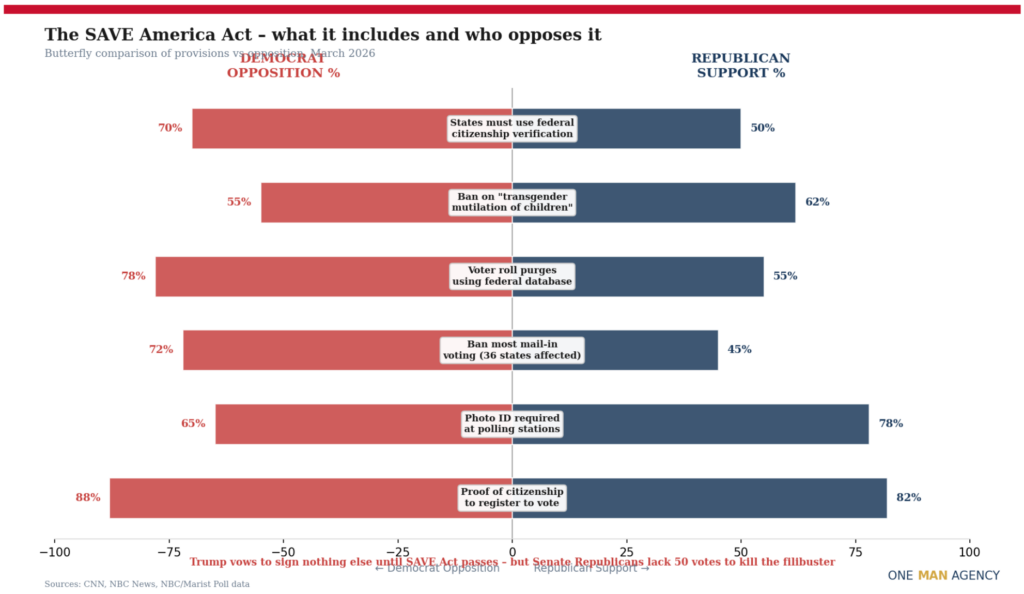
The Additions That Complicate Everything
Trump has used the legislation as a vehicle for unrelated policy priorities. He wants language banning “transgender mutilation of our children” – a provision targeting surgical procedures associated with transgender care for minors. Such surgeries are already extremely rare, but the provision serves as a culture war signal that energises the Republican base while alienating moderate senators whose votes are needed.
The combination of election law, mail voting restrictions and transgender policy in a single bill creates a legislative Frankenstein that satisfies no faction completely. Conservative Republicans who support voter ID may balk at ending mail voting in their own states. Moderate Republicans who might accept proof of citizenship requirements will not vote to abolish the filibuster over transgender provisions.
The Midterm Stakes
The timing is critical. If the SAVE America Act were to pass in its current form, proof of citizenship requirements would take effect immediately – months before the November 2026 midterms. Voter registration drives would be disrupted. Millions of currently registered voters could face challenges to their eligibility. Election officials in all 50 states would need to implement new systems on an emergency timeline.
Democrats argue this is the point. By creating chaos in voter registration ahead of midterms where Republicans are expected to lose seats, the bill would suppress voter turnout in demographics that lean Democratic. Republicans counter that proof of citizenship is a common-sense measure to prevent non-citizen voting – which is already illegal and documented cases are extremely rare.
NPR’s reporting from swing districts in Pennsylvania found a notable disconnect: nearly every Republican voter interviewed disagreed with Trump’s claim that Democrats can only win by cheating. The President’s own supporters do not share his premise for the legislation he considers his top priority.
Frequently Asked Questions
What is the SAVE America Act? The SAVE America Act is a federal elections bill that would require documentary proof of citizenship to register to vote, mandate photo ID at polling stations, and restrict mail-in voting. It passed the House in February 2026 but faces obstacles in the Senate.
Will the SAVE America Act pass the Senate? Senate Majority Leader John Thune has said Republicans lack the 50 votes needed to eliminate the filibuster. Without abolishing the 60-vote threshold, Democrats can block the bill.
Would the SAVE America Act affect the 2026 midterms? If passed, its voter registration requirements would take effect immediately, potentially disrupting registration ahead of the November 2026 midterm elections.