Benedict Spence: Age, Partner, Career and What the Journalist Actually Writes
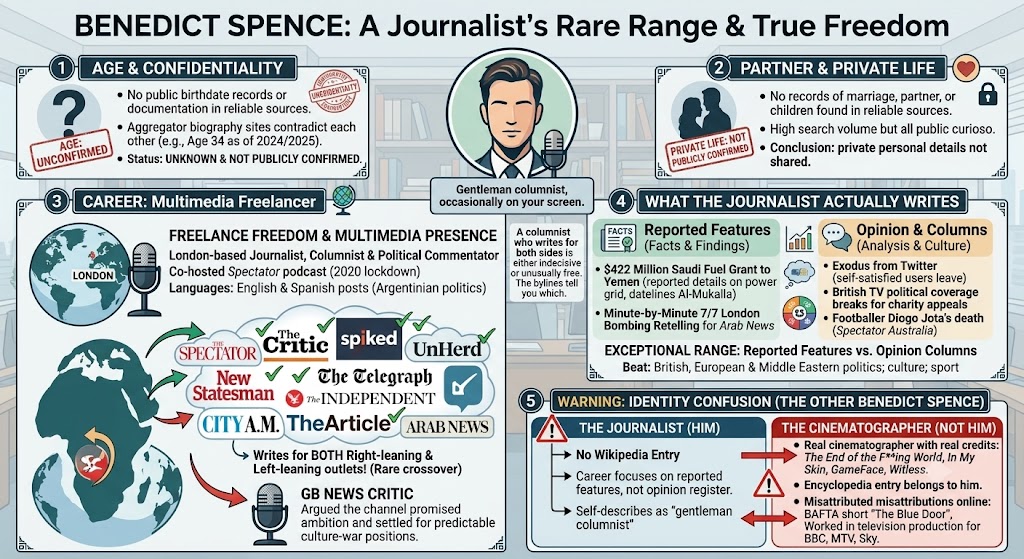
A columnist who writes for both sides is either indecisive or unusually free. The bylines tell you which.
At 8:49am on 7 July 2005, Shehzad Tanweer detonated a bomb on a Circle Line train between Liverpool Street and Aldgate. Twenty years on, Benedict Spence retold that morning minute by minute for Arab News – reported feature writing, not opinion, filed by a commentator most people know from television panels.
Two weeks earlier he had written on a $422 million Saudi fuel grant to Yemen and what it would do to power cuts in a country where the lights go out for most of the day. Two weeks later, a piece on the death of the footballer Diogo Jota. That range is the story of his career, and it is why he is difficult to place – and why no encyclopedia has bothered to try.
Benedict Spence: quick facts
| Full name | Benedict Spence |
| Occupation | Freelance journalist, columnist and political commentator |
| Based in | London |
| Beat | British, European and Middle Eastern politics; culture; sport |
| Writes for | The Telegraph, The Independent, The Spectator, The Spectator Australia, City A.M., The Critic, Spiked, New Statesman, UnHerd, TheArticle, Arab News |
| Broadcast | Sky News, BBC, TalkRadio |
| Podcast | Co-hosted a Spectator podcast through the 2020 lockdown |
| X (Twitter) | @BenedictSpence |
| Languages | Posts in English and Spanish |
| Age / date of birth | Not publicly confirmed |
| Partner, wife, children | Not publicly confirmed |
| Net worth | No published figure; freelance income is not disclosed |
| Wikipedia page | None. The entry under that name belongs to a cinematographer |
The Middle East work most people miss
Ask anyone who has seen him on Sky News what he does and you will hear “commentator”. The Arab News byline says something different.
His work there is reported rather than argued: the Saudi fuel donation to Yemen, priced at $422 million, and what officials said it would mean for power stations and the length of daily outages. Datelines from Al-Mukalla. Sourced quotes from officials rather than reactions to a headline.
That is the half of his output that never reaches British television, and it is the part that explains the description he gives himself on his professional profile – British, European and Middle Eastern politics, in that order.
Culture, sport, and the columns people argue about
The other half is opinion, and it lands in a wide spread of titles.
For The Critic he has written on the exodus from Twitter and what the platform loses when its self-satisfied users leave, and on the way British television political coverage keeps breaking for charity appeals. For The Spectator Australia he wrote about Diogo Jota’s death at 28 – the Lamborghini that left the road in Spain, the brother who died with him, the wedding to his childhood sweetheart in Porto days earlier.
He does not stay inside one register. A column on internet culture in the morning, a Yemeni power grid in the afternoon, a footballer’s funeral by the weekend.
Right, left, and the titles that will run him
Here is the fact that separates him from most commentators with his profile: he writes for The Spectator and The Critic, and he writes for the New Statesman.
That combination is rare. British political journalism sorts people quickly, and most freelancers find one side of the aisle commissions them and the other does not. Spence appears in Spiked and UnHerd, in the Telegraph and the Independent, in City A.M. and TheArticle.
His New Statesman piece on GB News is the clearest example of what that independence buys. He argued the channel promised ambition and settled for predictable culture-war positions – a criticism of the broadcaster whose politics his other outlets are usually assumed to share. About eighty people a month search “benedict spence gb news” expecting to find a presenter. What they find is a critic.
Calling him a conservative commentator is the standard shorthand. The byline list does not support it cleanly.
Television, radio and the lockdown podcast
He appears as a commentator on Sky News, the BBC and TalkRadio, usually on politics and media.
Through the first coronavirus lockdown in 2020 he co-hosted a Spectator podcast, with guests including Toby Young, Andrew Doyle, Julia Hartley-Brewer and Leo Kearse. Recorded remotely, in the period when everyone in British media was suddenly available and nobody could go anywhere.
His own summary of the job, from his professional profile, is four words long and funnier than anything written about him: gentleman columnist, occasionally on your screen.
The other Benedict Spence
Search his name and you will meet a cinematographer.
He is a real person with a real career – an English director of photography whose credits include The End of the F**ing World*, In My Skin, GameFace and Witless. He has an encyclopedia entry. The journalist does not, and the search engine attaches the name to the man it can verify.
The consequence is worse than confusion. At least two biography sites now credit the journalist with The Blue Door, a BAFTA-nominated short from 2019, and with beginning his career in factual entertainment for the BBC, MTV and Sky. Those are the cinematographer’s credits, copied from site to site until they read like fact. If you have read that Benedict Spence the commentator once worked in television production, that is where it came from, and it is wrong.
Age, partner and money
None of the three is on the record, and the gap is real rather than coy.
He has not written about a marriage, a partner or children, and no reliable source documents any of it. Around 480 searches a month go to those questions in five different phrasings, which is a lot of demand for information that does not exist publicly.
His age is unconfirmed. Two biography sites state 34 – one “as of 2024”, the other “as of 2025”, which cannot both be true of the same person, and neither cites anything.
Income is the least knowable of all. Freelance journalists are paid per commission, rates vary by title and are not published, and no filing exists for a self-employed writer’s earnings. One site nonetheless carries a figure of roughly $800,000, attributed to nothing. Given the same site handed him someone else’s film career, the number is worth exactly what its sourcing suggests.
He is on X as @BenedictSpence, where he posts in English and, on Argentinian politics, in Spanish.
Frequently asked questions
Who is Benedict Spence? A London-based freelance journalist and political commentator covering British, European and Middle Eastern politics, plus culture and sport. He writes for The Telegraph, The Spectator, City A.M., The Critic, Spiked, UnHerd, the New Statesman and Arab News, and appears on Sky News, the BBC and TalkRadio.
Is Benedict Spence married? Who is his partner? Not publicly confirmed. No marriage, partner or children are documented in any reliable source.
How old is Benedict Spence? Unknown. Two aggregator sites claim 34 in contradictory years, without sourcing. No date of birth is published anywhere reliable.
Is Benedict Spence a conservative commentator? He writes for right-leaning titles including The Spectator and The Critic, and for the left-leaning New Statesman. Freelance commentator fits the byline list better than any party label.
Does Benedict Spence work for GB News? No. He wrote a New Statesman piece criticising the channel. His broadcast appearances are on Sky News, the BBC and TalkRadio.
Does Benedict Spence have a Wikipedia page? Not the journalist. The Wikipedia entry under that name belongs to an English cinematographer with credits including The End of the F**ing World*.
What is Benedict Spence’s net worth? No verified figure. Freelance journalism income is not published, and the numbers circulating online are unsourced.
He has filed on Yemeni power stations, the 7/7 anniversary, a dead footballer and the etiquette of leaving Twitter, for eleven different mastheads.
The internet still thinks he shot a BAFTA-nominated short film in 2019.