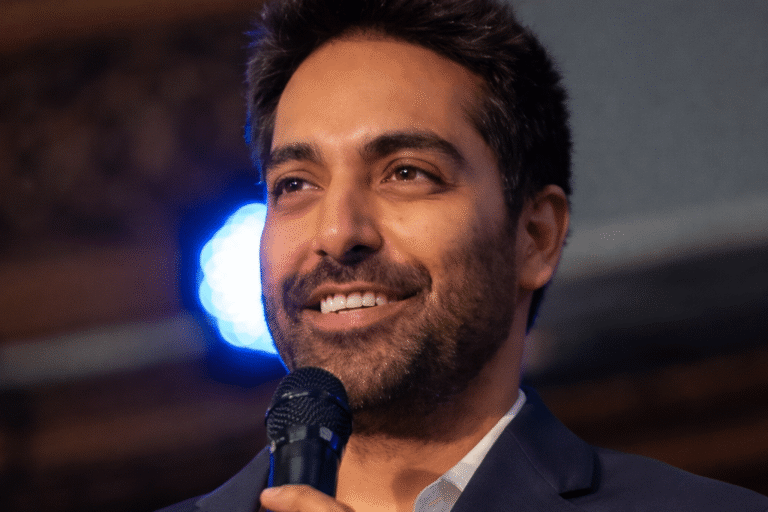
Andrii Sybiha: the Ukrainian minister Whitehall actually rings
Andrii Sybiha has spent thirty years inside the same diplomatic service, has never been a television personality, and is the man whose signature now goes on everything London agrees with Kyiv.
There is a kind of official who never becomes the story. No documentary, no memoir, no viral clip. He arrives at the building, the meeting happens, a communiqué appears, and by the following week nobody outside the trade could tell you who was in the room. The man who has run Ukrainian diplomacy since September 2024 is exactly that kind of official, and his predecessor was exactly the opposite.
If you work in an organisation of any size you already know both types, and you know which one actually moves the paperwork.
Who is Ukraine’s foreign minister, and how did he get there?
Andrii Sybiha, born on 1 February 1975 in Zboriv in the Ternopil region, has held the post since 5 September 2024 and was confirmed in it again on 19 August 2026. He joined the diplomatic service in 1997 and has stayed inside the state machine ever since, which in Ukrainian politics is unusual enough to be a defining fact about him.
His career has one visible loop. Three decades of ministry work, then five years running the embassy in Turkey between 2016 and 2021, then three years as deputy head of the President’s Office from May 2021, then back to the ministry as first deputy in April 2024 and to the top of it five months later. He left the building, learned how power actually gets exercised next door, and returned to run the place.
That loop through the President’s Office is the part that matters. A minister who has worked on the president’s staff knows precisely how far a position can be pushed before someone on the other side of the road objects, and that knowledge is worth more than any amount of charisma.
| Office | Head of Ukrainian diplomacy, since 5 September 2024 |
| Born | 1 February 1975, Zboriv, Ternopil region |
| In the service since | 1997 |
| Ambassador to Turkey | 2016 to 2021 |
| President’s Office | Deputy head, May 2021 to April 2024 |
| Reconfirmed | 19 August 2026, with 266 votes |
How many counterparts has Ukraine had to learn?
Far fewer than Britain has given it. Since the current Ukrainian government took office in August 2019 there have been three ministers in the post, against five foreign secretaries here, and the asymmetry is the single most useful thing a British reader can understand about how Kyiv organises its diplomacy.
Every change at this end resets a relationship. Briefings get rewritten, priorities get re-explained, and the new occupant arrives with their own view of how much time Ukraine deserves. At the other end the same official is still there, with the same files, having watched the whole carousel.
Read the right-hand column downwards and you can see why Kyiv built the parliamentary and embassy channels described elsewhere in this series. When the person opposite you changes every eighteen months, you stop relying on the person.
Institutional memory is a weapon in a long negotiation. The side that remembers what was agreed in 2022 has an advantage over the side that has to look it up.
How was Sybiha confirmed, and what do the numbers mean?
Twice, and by comfortable margins in a chamber of 450 seats. In September 2024 he took the post with 258 votes, replacing Dmytro Kuleba in a wider reshuffle. In August 2026 the chamber confirmed him again with 266, eight more than the first time.
Eight votes is not a landslide and it is not noise either. A wartime legislature reconfirming a minister with a slightly larger majority after two years in the job is saying something quite specific: the work has not made him enemies. Ministers who irritate a parliament do not improve their numbers.
The empty seats on those diagrams deserve a word of caution. A Ukrainian vote total does not split neatly into for, against and abstain in the way a British division does, and some members are serving, abroad or otherwise unavailable. Treat the grey as unrecorded rather than opposed.
votes at the second time of asking, eight more than the first
In a chamber that has spent four years under martial law and has every reason to be short-tempered, a minister whose support goes up rather than down has done something right in a quiet way.
Source: Verkhovna Rada vote records, August 2026.
What are Sybiha’s stated priorities?
He names a just peace as the objective and three institutional routes towards it: the European Union accession track, the argument for NATO membership, and bilateral treaties of the kind Britain signed in January 2025. None of that is surprising for a Ukrainian foreign minister, and none of it separates him from his predecessor.
What does distinguish him is the second half of the programme, which he calls global Ukrainianism. It covers the diaspora, the embassy network and the practical rights of Ukrainians living outside the country, and it treats several million people abroad as a standing national asset rather than a temporary problem.
That lower half of the diagram is where Britain sits, whether anyone here has noticed or not. A substantial Ukrainian population lives in this country, with questions about schooling, recognition of qualifications, pensions and eventual return, and those questions land on his desk rather than on a defence ministry’s.
What does Ukraine’s top diplomat actually do with Britain?
He is the working counterpart for the Foreign, Commonwealth and Development Office, which means the routine traffic: calls, joint statements, co-ordination before multilateral meetings, the negotiation of texts that later get signed by someone more senior. It is unglamorous and it is most of what a bilateral relationship consists of.
The division of labour with the ambassador in London is worth noticing. The embassy handles presence, industry and the parliamentary estate. The ministry handles the state-to-state channel and the multilateral positions. They overlap deliberately, because a country at war cannot afford a relationship with a single point of failure.
Knows the file before the meeting starts
Survives changes of government at both ends
Writes texts that hold up two years later
No independent public profile to spend
Little appetite for a fight in the open
Harder to sell to a foreign audience
Why did Sybiha replace Dmytro Kuleba?
He came in during a broader reshuffle in September 2024, and the change of style was immediate and obvious. Kuleba had been the most visible Ukrainian diplomat of the war, fluent on British broadcast media, comfortable in an argument, and useful precisely because he could hold an audience. Sybiha does none of that and was not brought in to.
The charitable reading is that the two jobs are genuinely different. The first years of an invasion require somebody who can persuade foreign publics. The later years require somebody who can grind through accession chapters and treaty annexes. Both readings circulate in Kyiv and neither has been settled in public.
Swapping a communicator for an administrator is a statement about what a country expects the next phase to be. If the assessment is wrong, Ukraine has quietly given up its best public voice at the moment it most needs one, and nobody would find out until it was too late to reverse.
Sybiha’s career, post by post
| Period | Post | Where | Why it matters |
|---|---|---|---|
| From 1997 | Enters the diplomatic service | Kyiv and abroad | Three decades of institutional memory |
| 2016–2021 | Ambassador | Ankara | Runs a mission in a country central to Black Sea questions |
| May 2021 – Apr 2024 | Deputy head of the President’s Office | Kyiv | Learns how decisions are actually taken |
| Feb 2022 | Among those presenting the EU application | Kyiv | Present at the founding moment of the accession track |
| From Apr 2024 | First deputy foreign minister | Kyiv | Five months of preparation for the top job |
| From Sep 2024 | Foreign minister, 258 votes | Kyiv | Becomes the FCDO’s working counterpart |
| Aug 2026 | Reconfirmed, 266 votes | Kyiv | Support improves after two years in post |
Sources: Ukrainian government appointment records and Verkhovna Rada vote records, 1997–2026.
Six of those seven rows happened inside the same state apparatus. That is the whole argument for him, and also the whole argument against him.
What to watch at the ministry on Mykhailivska
The accession chapters are the first thing. European Union negotiations proceed subject by subject and produce documents with dates, which makes them the only part of the programme where progress can actually be measured from the outside.
The second is the diaspora work. If a bilateral instrument appears covering qualifications, schooling or return for Ukrainians living in Britain, that is the lower half of the fishbone becoming real, and it will affect more people in this country than any weapons package.
The third is whether he stays. Two confirmations in two years suggest stability, and Ukrainian ministerial stability has not been a safe bet at any point since 2022.
Think again about the official nobody can name. Every diplomatic service in Europe has one, and every serious relationship runs through them rather than through the figure on the news. Britain has now had five foreign secretaries in the time Ukraine has had three ministers, and the person on the other end of that line has been the same since 2024. When the next reshuffle happens in London, the file will already be open in Kyiv, and somebody will have read it.
Figures reflect information published up to 2026. Polling readings refer to hypothetical scenarios; no national election has been held in Ukraine since February 2022.