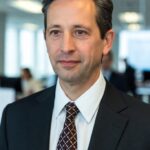
Kyrylo Budanov: from spy chief to the president’s gatekeeper
Kyrylo Budanov spent five years as the most photographed spymaster in Europe. In January 2026 he moved to the desk that controls access to the president, and the polling says roughly seven Ukrainians in ten trust him.
Spymasters are not supposed to be recognisable. The job has a long tradition of grey men whose names appear once in an obituary, and most Western services still work hard to keep it that way. Ukraine took the opposite approach, and by 2023 the head of its military spy directorate was giving interviews to foreign broadcasters, appearing in profile pieces, and becoming the sort of figure a British reader could pick out of a line-up.
Then in January 2026 he stopped being a spy chief and became something considerably more powerful, and much less visible.
Who is Kyrylo Budanov?
Born in Kyiv on 4 January 1986, he led the Main Directorate of Intelligence, known as the GUR, from 5 August 2020 until 2 January 2026, and has run the Office of the President since that date. He was named a Hero of Ukraine in February 2024, the country’s highest distinction, which in his case was awarded while he was still very much in the job.
He took the post at thirty-four and held it through the invasion, which makes his five and a half years in charge one of the longer continuous tenures at the top of any Ukrainian institution since 2022. Commanders changed three times in that period. He did not.
For a British reader the closest structural comparison is not the head of MI6, who does not give interviews of this kind, but something that does not really exist here: a spymaster with a public profile, who then becomes the prime minister’s chief of staff without anyone treating the move as strange.
| Born | 4 January 1986, Kyiv |
| Military intelligence | 5 August 2020 to 2 January 2026 |
| Current role | Head of the Office of the President, since January 2026 |
| Predecessor in that role | Andriy Yermak |
| Honour | Hero of Ukraine, February 2024 |
| Public themes | The information front, deepfakes, resilience |
What does the head of the President’s Office actually do?
Everything that does not have its own ministry, and a good deal that does. The office is not a department with a portfolio. It is the filter: the body that decides which papers reach the president, which appointments get made, how the regions are handled, and who speaks to which foreign capital. In a country where wartime decision-making has concentrated heavily around one building, it is arguably the second most powerful position in the state.
His predecessor Andriy Yermak held it for years and became a byword for that concentration. Replacing him with a career operator rather than a politician was a choice, and the reading circulating in Kyiv is that the president wanted an operator rather than a courtier.
Compare the two positions on that diagram. The directorate is a specialised agency with a defined task. The office is a junction, and the difference between them is the difference between doing something and deciding what gets done.
Britain has no direct equivalent. The nearest thing is a Downing Street chief of staff, but with control over appointments, regional administration and the foreign channel folded into the same desk.
How much do Ukrainians trust Budanov?
A good deal, and consistently. Readings published through 2026 put him near the top on trust, with one poll at around 70 per cent, sitting alongside the ambassador in London and the former digital minister in a band comfortably above conventional politicians.
What makes that unusual is the job he held while earning it. Secret services are normally the least trusted arm of any state, and in most of Europe a serving spymaster polling at seventy per cent would be an alarming sentence rather than an interesting one. In Ukraine it reflects five years of an agency that was seen to be doing something visible during an invasion.
Read the four petals together and notice what they have in common. Three of the four never stood for election to anything.
Would Budanov beat Zelenskyy in an election?
Nobody knows, and the two numbers usually quoted point in opposite directions. A trust figure of around 70 per cent sits beside hypothetical party support of 12.3 per cent, and the distance between those figures is the most honest thing in this article.
Trust measures whether people think you are competent and straight. Voting measures whether they want you in charge of schools, pensions and the tax code. Ukrainians have been asked the first question about a wartime intelligence chief and have answered warmly. They have not been asked the second in any meaningful way, because there has been no campaign, no programme and no vote.
Reporting a 70 per cent trust reading as though it were an electoral threat misreads both numbers. There is no party, no declared candidacy and no scheduled election, and the one figure that does attempt to measure voting sits at a sixth of the trust number.
What does Budanov mean by the information war?
He returns publicly to three linked subjects: manufactured media, the speed at which a claim travels, and what he calls resilience, meaning the capacity of a population to absorb a false story without acting on it. Deepfaked video and audio feature heavily, for the obvious reason that a convincing forgery of a general giving an order is a weapon rather than a nuisance.
The structural point he makes is the one worth taking seriously. There is no endgame in this domain. Every successful countermeasure teaches the other side what failed, and every adaptation on one side produces an adaptation on the other, which is why treating it as a campaign to be won rather than a condition to be managed leads to bad policy.
If you have worked in security, fraud prevention or content moderation you have seen this exact diagram before under a different name. The Ukrainian version simply runs faster and has physical consequences at the end of it.
stages on that loop that represent a conclusion
A cycle with no terminal state cannot be won. It can only be resourced permanently, which is a much harder argument to make to a treasury than a request for a one-off capability.
Source: themes raised publicly by the head of the GUR since 2024.
Why was Budanov talking to Ukrainian students in Britain?
In September 2026 he spoke with Ukrainian students at British universities about promoting their country abroad, which sounds like a soft engagement and is not. A large student population in a friendly country is a distributed communications asset: several thousand people who are fluent, credible to their peers, and already embedded in the institutions that shape opinion here.
It also fits the loop above. The most effective correction to a false claim is rarely an official statement. It is somebody the audience already knows saying the same thing, and a Ukrainian postgraduate in a British seminar room is closer to that audience than any embassy.
Credibility that no official statement carries
Coverage in rooms diplomats never enter
Speed, because no clearance is needed
Message discipline, by definition
Its own reputation if something goes wrong
Whether anyone is actually listening
Budanov, post by post
| Date | Post or event | Where | Why it matters here |
|---|---|---|---|
| Jan 1986 | Born | Kyiv | Takes the top spy job before his thirty-fifth birthday |
| 5 Aug 2020 | Heads the GUR | Kyiv | Begins five and a half years at the top of the agency |
| 2022–2025 | The most visible spymaster in Europe | Kyiv and foreign media | Becomes a recognisable figure to British audiences |
| Feb 2024 | Named a Hero of Ukraine | Kyiv | The state’s highest honour, awarded in post |
| 2 Jan 2026 | Takes the Office of the President | Kyiv | Replaces Andriy Yermak at the centre of the state |
| Sep 2026 | Meets Ukrainian students in Britain | UK universities | Builds a distributed channel into British institutions |
Sources: Ukrainian government appointment records and published reporting, 2020–2026.
The fifth row is the one that changed his life and the one least covered outside Ukraine. Moving from an agency to the centre is a bigger promotion than any medal.
What to watch at the Office of the President
The first thing is whether the concentration of decision-making loosens. An operator running the building could either widen the funnel or tighten it, and the early signals are the sort of thing only Ukrainian reporters will spot.
The second is the foreign channel. If bilateral business with London starts routing through the office rather than the ministry, that is a visible shift in how Kyiv handles Britain and it will show up in who signs what.
The third is silence. He built a public profile in a job that did not require one. Whether he keeps it in a job that actively punishes one will tell you what he thinks comes next.
Think back to the interviews. For four years a foreign audience was invited to know the face of a Ukrainian secret service, which no comparable country would allow, and the strategy worked well enough that a British reader recognises the name. He has now taken a post where visibility is a liability rather than an asset. The interesting question is not whether he wants to be president. It is whether a man who spent five years being seen can go back to not being seen, and whether the country still needs him to.
Figures reflect information published up to 2026. Polling readings refer to hypothetical scenarios; no national election has been held in Ukraine since February 2022.