Tom Slater Spiked: Age, Wife, Career & Bio
In 2015 he built a league table that graded every university in Britain on free speech. Six years later he was running the magazine that published it.
Tom Slater is the editor of spiked, the British online magazine. He has held the job since 27 September 2021, and he is only the third person to hold it in the publication’s twenty-five year history.
His career is unusually easy to trace, which makes him unusual among the people covered by pages like this one. The dates are documented, the projects have published numbers attached, and his own biography line changed on the cover of a book as he was promoted. His private life is a different matter, and no amount of searching changes that. There is exactly one source that ever published his age, and almost nobody has noticed it.
Tom Slater: quick facts
| Role | Editor, spiked |
| Editor since | 27 September 2021 |
| Previously | Assistant editor (2015), then deputy editor (by 2016) |
| Predecessor | Brendan O’Neill, editor 2007 to 2021 |
| Known for | Free Speech University Rankings, 2015 to 2018 |
| Book | Unsafe Space: The Crisis of Free Speech on Campus, editor, Palgrave Macmillan, 23 March 2016 |
| Podcasts | Co-host, Last Orders; weekly on the spiked podcast |
| Bylines elsewhere | The Spectator, The Telegraph, The Times, Times Higher Education, The Independent, Time Out |
| Based in | London |
| X (Twitter) | @Tom_Slater_, 50,100 followers, joined August 2011 |
| Joined June 2026 | |
| Age | Described as 25 by Fox News in 2017, implying he is around 34 or 35 now. Never confirmed by him |
| Wife, partner, children | Not publicly confirmed |
| Net worth | No verified figure exists |
| Wikipedia page | None of his own; named on the spiked entry |
How old is Tom Slater?
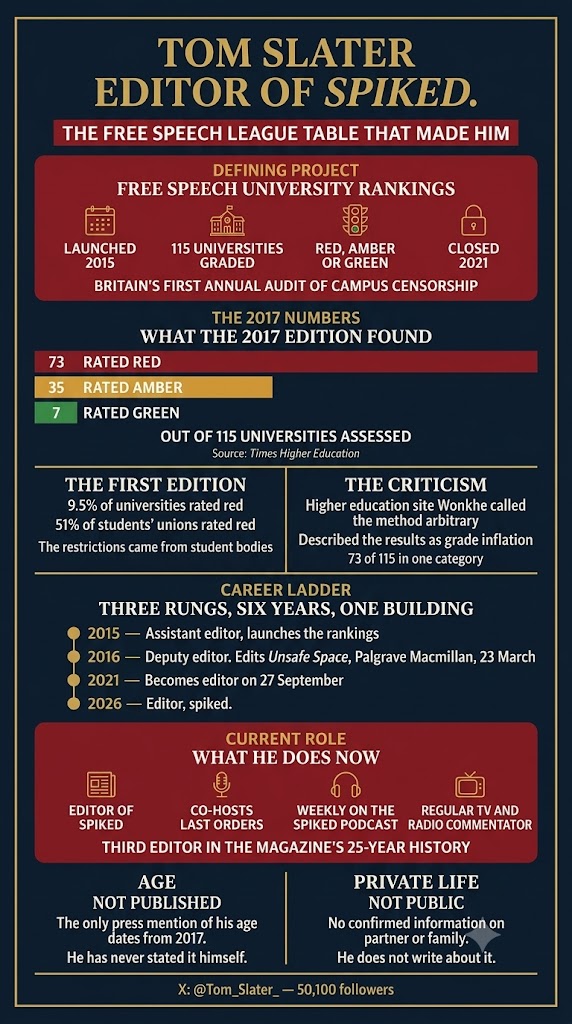
Every profile page says his age is unknown. One source published it, and it has sat in plain sight since 2017.
Reporting on that year’s Free Speech University Rankings, Fox News described him as 25-year-old Tom Slater, coordinator of the Free Speech University Rankings at spiked, and quoted him directly on the findings. The rankings were released early in 2017, which puts his birth year around 1991 or 1992 and makes him roughly 34 or 35 in 2026.
Treat that as one data point rather than a settled fact. It is a single mention in a foreign outlet writing about someone else’s research, he has never stated his age himself, and no British publication has printed a date of birth. But it is real, it is attributable, and it is more than the aggregator sites claiming to know have ever produced.
Why it matters beyond trivia. If the number is right, he was around 23 when he launched the ranking that made his name, and around 29 when he took over the magazine. That is young for a national editor, and it reframes the whole career.
Who runs spiked, and what is it?
Spiked is a British online magazine covering politics, culture and society, launched in 2001. It has had three editors: Mick Hume until January 2007, Brendan O’Neill until September 2021, and Tom Slater since.
The handover was announced by O’Neill himself. After nearly fifteen years in the chair he wrote that it was time for a change, called Slater his brilliant deputy editor, and said Slater became editor that day. O’Neill stayed on as the magazine’s first chief political writer.
The origins matter because they are the first thing critics raise. Spiked emerged from Living Marxism, the magazine of the Revolutionary Communist Party, founded in 1988 and rebranded as LM in 1999. It closed in 2000 after losing a libel case brought by ITN, and spiked launched the following year with the same editor and many of the same contributors. Writers associated with what is sometimes called the spiked network later stood as Brexit Party candidates or publicised it, while disagreeing with Nigel Farage on plenty else.
That is the magazine’s history rather than Slater’s. Hume and O’Neill both came out of the Living Marxism circle. Slater did not, and his route in was entirely different.
The publication runs on reader donations rather than advertising. By its own account only about 0.1% of its regular readers pay anything, which is the economic reality behind a magazine that employs a small masthead: Slater as editor, Fraser Myers as deputy, Viv Regan as managing editor.
The Free Speech University Rankings: the project that made him
This is the part of his record that has actual numbers attached, and it is the part every profile skips.
Slater launched the Free Speech University Rankings at spiked in 2015, the first annual analysis of campus censorship in Britain. The model came from the Foundation for Individual Rights in Education, which had been ranking American colleges since 2006. The method was a traffic light: assess the policies and the actions of both the university and its students’ union, score each red, amber or green, then combine them.
The definitions were published and specific. Red meant explicit restrictions, including bans on particular ideologies, parties, books, speakers or words. Amber meant guidance that chills speech by policing tone rather than content, including vetting of speakers or literature. Green meant no restrictions beyond what the law already required.
The first edition produced the finding that drove the coverage: only 9.5% of universities were graded red, against 51% of students’ unions. The censorship was coming from the student bodies rather than the administrations.
By 2017, the third edition covered 115 universities and found that 108 of them censored or chilled speech to some degree. Seventy-three were red, thirty-five amber, and seven green. In Fox News’s framing of the same data, 63.5% actively censored, 30.5% chilled speech through regulation, and about 6% were free.
That is the figure worth sitting with. Out of 115 institutions, seven placed no restriction on speech beyond the law. Whether you accept the scoring or not, that number is what put campus censorship into British political debate.
The impact was real and traceable. Cardiff University was graded red, and its vice chancellor Colin Riordan publicly defended the institution’s record. Spiked’s write-up said Cardiff and its students’ union together created a hostile environment for free speech, citing an outright ban on homophobic speech and the 2015 opposition to Germaine Greer speaking. Riordan then appeared alongside figures linked to the magazine before Parliament’s Joint Committee on Human Rights, which was investigating free speech in universities.
The criticism was also real. The higher education site Wonkhe attacked the methodology directly, calling the league table arbitrary in what it selected and describing the results as grade inflation, noting that 73 of 115 institutions landing in a single category tells you something about the scoring rather than the sector. The weighting system was unusual: three red actions could drag an otherwise amber university to red, and two could push a green one to amber.
Spiked closed the rankings in 2021, saying the job was done, that politicians had launched inquiries and issued guidance and students had won real victories, and that the team was moving on to other projects. It ran for four years on volunteers and funding from the Joseph Rowntree Reform Trust. The format was later revived elsewhere by the think tank Civitas.
Unsafe Space and the promotion
In March 2016 Palgrave Macmillan published Unsafe Space: The Crisis of Free Speech on Campus, edited by Slater. He wrote the introduction and a chapter on the campaign against so-called lad culture, and brought in contributors from Britain and the United States, including Brendan O’Neill and Joanna Williams.
The author biography on that book is a small piece of evidence about his career. In February 2015, writing up the first rankings, spiked listed him as assistant editor. On the 2016 book jacket he is deputy editor. Five years after that he had the top job. Three rungs, six years, all inside the same building.
What Tom Slater writes about now
Free speech, British politics and culture, argued from a position he does not disguise.
The range shows in recent work. He wrote on media regulation after Culture Secretary Lisa Nandy set out proposals, arguing that Labour wants the state’s thumb on the algorithmic scale. In July 2026 he defended Ann Widdecombe after her death against those celebrating it, framing it as a question about whether it is acceptable to cheer an elderly woman’s death provided she was right wing. He has written on antisemitism in Britain, including after the Manchester synagogue murders.
He also writes against type often enough to be worth noting. He opposes the death penalty, and his stated reasons are that innocent people get killed and that execution releases the guilty from lifelong imprisonment, which he considers the worse punishment.
His pieces syndicate widely through the Daily Mail, the Telegraph, the Express, Yahoo and MSN, which is why his byline appears attached to outlets he has never worked for.
Tom Slater on television, podcasts and stage
He appears weekly on the spiked podcast and co-hosts Last Orders, the magazine’s show on lifestyle regulation and the nanny state. He is booked regularly on British television and radio whenever a censorship row breaks, which is what put his name in front of people who have never read the magazine.
He also runs the magazine’s live events. Slater announced the spiked summit at the Emmanuel Centre in Westminster, a one-day conference featuring Konstantin Kisin, Lionel Shriver, Katharine Birbalsingh, Toby Young and Allison Pearson alongside himself, O’Neill and Hume.
Tom Slater’s wife, family and net worth
Nothing is confirmed, and several sites will tell you otherwise.
There is no publicly confirmed information about a wife, partner or children. He does not write about his private life, and no established outlet has reported on it. Aggregator biographies that assert a marital status name no source, and family details on those pages are routinely lifted from other people who share the name.
Net worth is the same problem with a currency symbol attached. He draws a salary from a magazine funded by reader donations that does not publish accounts of that kind, plus freelance fees and a book from 2016. No filing exists that would show any of it. Every figure online is invented.
One practical warning if you are searching: Tom Slater is a common name, and bylines get mixed up. Check the outlet before attributing anything.
Frequently asked questions
Who is Tom Slater?
The editor of spiked, a British online magazine covering politics and culture. He took over on 27 September 2021 and had previously been the magazine’s assistant editor and deputy editor.
How old is Tom Slater?
He has never stated it. Fox News described him as 25 in a 2017 report on the Free Speech University Rankings, which would make him around 34 or 35 in 2026. No British outlet has published a date of birth and he has not confirmed the figure.
Is Tom Slater married?
There is no publicly confirmed information about his marital status, partner or children.
What are the Free Speech University Rankings?
A league table Slater created at spiked in 2015, grading British universities and their students’ unions red, amber or green on free speech. The 2017 edition covered 115 universities and found 108 restricted or chilled speech to some degree, with only seven rated green. It closed in 2021.
What book did Tom Slater write?
He edited Unsafe Space: The Crisis of Free Speech on Campus, published by Palgrave Macmillan on 23 March 2016. He contributed the introduction and a chapter on the campaign against lad culture.
Who was editor of spiked before Tom Slater?
Brendan O’Neill, from 2007 until September 2021. Before him, Mick Hume, who founded the magazine. O’Neill announced the handover himself and remained at spiked as its chief political writer.
Is spiked left wing or right wing?
It came out of Living Marxism, the magazine of the Revolutionary Communist Party, and is now usually described as libertarian and anti-woke rather than left or right in the conventional sense. Some sources call it right-libertarian, others left-libertarian.
Does Tom Slater have a Wikipedia page?
No. He is named as editor on the Wikipedia entry for spiked, but has no entry of his own.
He runs a national magazine, built the league table that put campus censorship into British politics, and appears on two podcasts a week.
The only person who ever published his age worked for Fox News, and it was nine years ago.