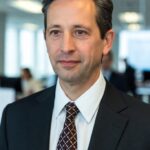
Vitali Klitschko: the boxer Britain knew before it knew Ukraine
A WBC heavyweight champion took charge of a capital of three million, then stayed in it under fire. He polls at 0.3 per cent for president, and that number is the least interesting thing about him.
If you watched heavyweight boxing in Britain in the 2000s you have already met him. Saturday night, a Sky or BoxNation subscription, a very tall man from a country most viewers here could not place, throwing a jab from somewhere near the ceiling. Two decades later the same face turned up on the evening news standing in a bombed street with a crater behind him, and a good number of people had the same reaction: I know him, he used to fight.
That recognition is a diplomatic asset nobody in Ukraine planned for, and it is the reason a municipal official gets airtime here that municipal officials never get. Audiences here do not follow foreign municipal government. They do remember a champion.
Who is Vitali Klitschko?
He runs Ukraine’s capital, in office since 2014 and re-elected since, and before that he was world heavyweight champion under the WBC. His younger brother Wladimir held titles at the same time, which is why the surname in Britain is plural: for most of a decade the phrase was not a person but a pair.
The unusual thing is not the career change, which happens often enough in sport. It is that none of the three roles closed when the next opened. The champion became a politician without losing the recognition, the politician became a wartime administrator without leaving the office, and all three versions are still in play whenever he appears on a screen in this country.
Read the stack from the bottom and you get the reason a municipal official gets a hearing in Westminster. The bottom slab is the one viewers here own a memory of, and it is doing quiet work under everything above it.
| Current office | Mayor of Ukraine’s capital, since 2014 |
| Born | 19 July 1971, aged 55 in 2026 |
| Before politics | WBC world heavyweight champion |
| Family in the sport | Brother Wladimir, also a world champion |
| Where he was in 2022 | In the capital, and stayed |
| Standing for president | Polling at roughly 0.3 per cent in 2026 |
Why did Klitschko stay in Kyiv?
Because the job he holds is attached to a place, and because leaving would have ended it. Anyone who evacuates that office is a former office-holder within a week. He remained through the assault on the outskirts, and the decision turned a municipal office into something closer to a garrison command: shelters, generators, water distribution points, the mechanics of keeping three million people alive while the power grid was being aimed at.
Coverage in Britain framed this as bravery, which it partly was. The less romantic reading is that it was also the only move that kept him relevant, and both things can be true at once without either cancelling the other.
A city boss is the only Ukrainian official most foreign audiences can map onto their own system. Everyone understands what such a job involves, which is why his interviews travel further than a deputy minister’s and why he keeps being asked.
What did Klitschko ask Britain for?
Anti-tank weapons, and he asked through the shortest available route rather than the correct one. The request travelled from the city hall through the Ukrainian embassy in London and on to Sadiq Khan, which is to say from one mayor to another, skipping the entire machinery of defence procurement on both sides.
Strictly speaking the holder of that London office cannot supply anti-tank rockets, and everyone involved knew it. The point was never the delivery. A request made mayor to mayor is a request that cannot be filed as routine diplomatic traffic, and it produces a conversation in a city hall rather than a note in a ministry.
Follow the arcs and you can see how thin the formal channel actually is. Two of the routes into Britain run through institutions. The rest run through recognition.
Has Klitschko spoken to the UK Parliament?
He has appeared before the Foreign Affairs Committee, including remotely in 2026, and he has taken British MPs in person in Kyiv, among them a delegation around the anniversary of the invasion. That is a different kind of parliamentary contact from a set-piece address in Westminster Hall. A committee session is longer, less scripted and considerably harder, because members ask follow-up questions and there is no applause to hide in.
For a British reader this is the most useful thing he does. Select committees produce transcripts, transcripts produce reports, and reports get cited in debates years later. A speech is an event. A committee appearance is a document.
What does running a capital under fire involve?
Very little of it looks like foreign policy. A war administration spends its days on power substations, on whether the water pressure will hold on the upper floors of Soviet-era tower blocks, on where to put generators when the grid goes down in December, and on burying people. None of that produces an interview request.
The part that does travel is the shelter network. Metro stations doubling as overnight accommodation is an image the world recognised immediately, partly because London did exactly the same thing eighty years earlier and the photographs are in every school textbook here. That accidental rhyme has done more for Ukrainian sympathy in this country than any speech, and it costs nothing to invoke.
There is a harder edge to this too. Running a wartime administration means rationing attention as well as electricity, and officials in that position are routinely accused at home of prioritising the visible over the essential. Those arguments are real and they are had in public, which is itself worth noticing: a capital under missile fire has not stopped holding its own administration to account.
Municipal government is the layer of the Ukrainian state that foreign donors find easiest to fund, because the outputs are countable: shelters built, pipes replaced, schools reopened. That makes the office a natural counterparty for reconstruction money long before any ministry becomes one.
Is Vitali Klitschko running for president?
On current numbers there would be no point. His standing on the 2026 first-round question sits at roughly 0.3 per cent, which is not a weak position so much as an absence of one, and it sits alongside a municipal record of winning a city twice.
The gap between those two facts is the most instructive thing in this article. Fame transfers across borders easily and across offices badly. Politics in this country has its own version of this, and anyone who has watched a well-known local figure discover that national polling is a different animal will recognise the shape of it.
A number this small is often reported as a collapse. It is not. He has never mounted a national campaign, has no party built for one, and holds an office that rewards competence over profile. Three voters in a thousand is what an untested national brand looks like, not what a defeated one looks like.
What the Klitschko name means in Britain
It means two brothers, a long run of title fights, and a particular kind of technical, unhurried heavyweight boxing that commentators here spent a decade describing as hard to watch and impossible to beat. Wladimir carried the longer reign; Vitali carried the harder chin and the doctorate, which is where the ring name came from.
None of that is politics, and all of it is why the politics travels. When a documentary about the family reached audiences in Britain it did not need to explain who they were, and a Ukrainian official who needs no introduction is worth more to Ukraine than several who do.
Instant recognition with a British audience
Access to broadcast slots an administrator would never get
A story editors already know how to tell
Being read as a personality rather than an administrator
Questions about the city that never get asked
A national ceiling he has not tested
Klitschko from the ring to the city, year by year
| Period | Role | Where | Why it matters to a British reader |
|---|---|---|---|
| 1996–2013 | Professional boxer, WBC champion | Germany, Britain, the United States | The years British viewers actually watched him |
| 2014 | Elected mayor of the capital | Kyiv | A sportsman takes a municipal office in a country in crisis |
| 2020 | Re-elected | Kyiv | Confirms the city brand is real, not a novelty vote |
| Feb 2022 | Stays as the capital is attacked | Kyiv | The images that reintroduced him to Britain |
| 2022 | Anti-tank request routed to the Mayor of London | Kyiv to London | Mayor-to-mayor diplomacy, outside the usual channel |
| 2022–2026 | Appears before the Foreign Affairs Committee | Westminster, and remotely | Evidence on the record, not a speech |
| 2026 | Receives British MPs in Kyiv | Kyiv | The visit runs in the other direction for once |
Sources: municipal records of the capital, UK parliamentary committee records and published reporting, 1996–2026.
The last column is the honest summary of his usefulness. Four of those seven rows are things a British institution took part in.
What to watch with the man who runs Kyiv
The first thing is the committee track. If he keeps appearing before select committees rather than at podium events, it means Ukraine has decided that evidence sessions are worth more than headlines, and that is a considered choice rather than a fallback.
The second is the city itself. Reconstruction money for the capital will be argued over in rooms where British contractors and British funds are present, and an official who can speak to those rooms without a translator has a structural advantage over every other Ukrainian official involved.
The third is whether the 0.3 per cent ever gets tested. It will not be while martial law holds, and there is no sign he wants it to be.
Think back to the Saturday night fights. The reason his name still opens doors in this country has nothing to do with his record on transport or heating, and everyone involved knows it. He has spent twelve years converting an accident of fame into a working channel between a Ukrainian city and a British parliament, and the conversion is nearly complete. The part that has not converted is the one the polls keep measuring, and he has never given any sign of minding.
Figures reflect information published up to 2026. Polling readings refer to hypothetical scenarios; no national election has been held in Ukraine since February 2022.