Yulia Tymoshenko: Ukraine’s Most Durable Political Force
January 2025. A conference hall in Lviv. Most of the Ukrainian political figures who arrive for this kind of event speak carefully, choosing words that leave room to retreat. Yulia Tymoshenko does not do that. She walks in, takes the podium, and tells the room that Ukraine’s post-war political order needs to be rebuilt from the ground up. No hedging. No soft language for the cameras. The same delivery she had when she stood on the Maidan stage in 2004, when she negotiated gas contracts that defined a decade of Ukrainian-Russian relations, when she addressed the court that sentenced her to seven years in prison. Yulia Tymoshenko has been in Ukrainian public life for thirty years, and she still speaks like someone who expects to be in it for thirty more.
Who Is Yulia Tymoshenko?
Yulia Tymoshenko was born in 1960 in Dnipropetrovsk, then part of the Soviet Union. She grew up in a working-class family, studied economics, and entered business in the chaos of post-Soviet Ukraine. That chaos was her opportunity. She built a corporate energy empire in the 1990s through United Energy Systems of Ukraine, becoming one of the wealthiest people in the country at a time when fortunes were made or lost on access to the right people in government. Her critics have never let her forget how those fortunes were made.
She entered politics in the late 1990s and quickly demonstrated a talent that transcended her business background: she could speak to ordinary Ukrainians in their own language about their own frustrations. In a political environment full of figures who treated voters as obstacles to manage, she treated them as an audience to persuade. That skill made her dangerous to everyone who saw politics as a closed system.
Her signature look, the braided hair wrapped around her head like a crown, became one of the most recognisable images in European politics. She did not choose it accidentally. It was a reference to traditional Ukrainian dress, a visual argument that she was rooted in something authentic at a time when Ukraine’s politicians were mostly performing for oligarchic audiences.
The “Gas Princess” nickname followed her everywhere. She did not love it. But she understood that in Ukrainian politics, a nickname means you have power.
The Orange Revolution and Prime Minister Tymoshenko
The Orange Revolution of 2004 made Yulia Tymoshenko an international figure. When Viktor Yanukovych’s fraudulent election victory triggered massive street protests in Kyiv, she was on the Maidan stage alongside Viktor Yushchenko, the opposition candidate. The revolution succeeded. Yushchenko became president. Tymoshenko became Prime Minister.
She served two terms as Prime Minister, 2005 and 2007-2010, and her time in office was defined by conflict as much as by achievement. She fought with Yushchenko. She negotiated controversial gas deals with Russia that her opponents used against her for years. She was a skilled communicator in a role that requires grinding administrative work, and the mismatch showed.
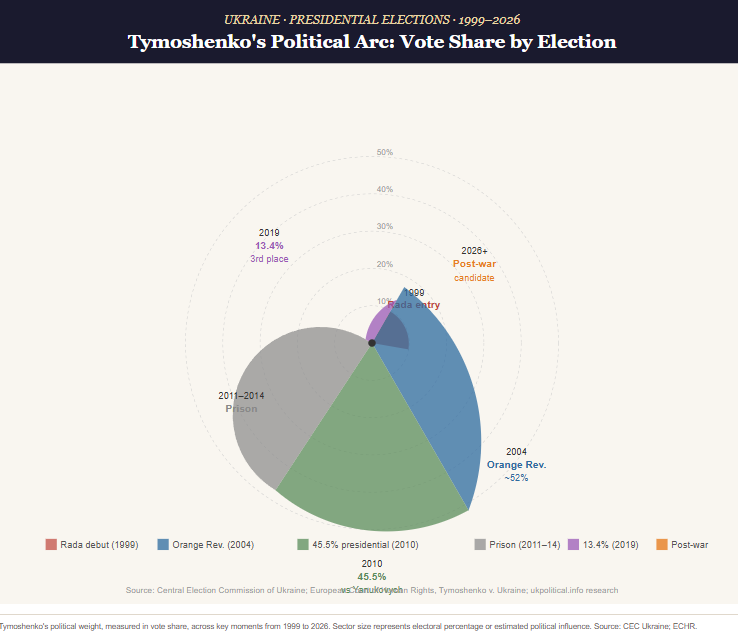
She ran for president in 2010 and lost to Yanukovych by 3.5 percentage points. A narrow defeat. A different night and she would have been president rather than his most prominent opponent.
The Prison Years That Changed Everything
In October 2011, the Yanukovych government had Yulia Tymoshenko convicted of abuse of office in connection with the 2009 gas deal with Russia. The charge was politically motivated. The European Union said so clearly. The European Court of Human Rights later ruled that her detention was arbitrary and violated her rights.
She served two and a half years in prison before the Maidan revolution changed everything.
When Yanukovych fled Ukraine in February 2014, one of the first acts of the new parliament was to vote to release Tymoshenko. She walked out of the Kharkiv prison where she had been held and was taken directly to Kyiv. She addressed the Maidan crowd from a wheelchair, having developed spinal problems during her imprisonment. The crowd was enormous. The moment was extraordinary.
The prison years did something to her political standing that cannot be fully quantified. In Ukraine, where imprisonment by a corrupt government is a credential rather than a mark of shame, she came out of Kharkiv as a figure who had been tested and had not broken.
Here’s What the Standard Account Gets Wrong
Standard biographies of Yulia Tymoshenko treat her as a figure of the past — someone who matters because of what happened in 2004 or 2010 or 2014, a name from an earlier chapter of Ukrainian history. That reading is comfortable for her opponents and for analysts who prefer clean timelines.
It is also wrong.
1,600 searches a month in the UK alone. That is what “yulia tymoshenko” gets in October 2026. Not nostalgic searches. Not people looking her up because they vaguely remember her. People looking her up because she is doing and saying things that are newsworthy right now.
She ran for president in 2019 and finished third with 13.4%. Zelensky won in the first round with 73%. The gap looks definitive. But consider the political conditions: Zelensky was a television phenomenon running against a discredited political class. Tymoshenko’s 13.4% was earned, not gifted. It held a base.
Since 2022, wartime Ukraine has not held elections. When elections return, the board resets. Tymoshenko knows this. She has been positioning herself as a post-war political voice since the full-scale invasion began.
Tymoshenko in 2026: Reading the Board
Yulia Tymoshenko’s Batkivshchyna (Fatherland) party has stayed active throughout the war. She has been vocal on reconstruction policy, anti-corruption reform, and Ukraine’s path to EU membership. These are not accidental topic choices. They are the issues that will define post-war Ukrainian politics and the election campaign she is quietly preparing.
Her relationship with Zelensky is formal and cold. They are not enemies in the way she was an enemy of Yanukovych; the war makes open political warfare between Ukrainian politicians domestically problematic. But they are not allies. She represents an older political tradition that Zelensky’s movement explicitly positioned itself against. That tension does not disappear under wartime unity.
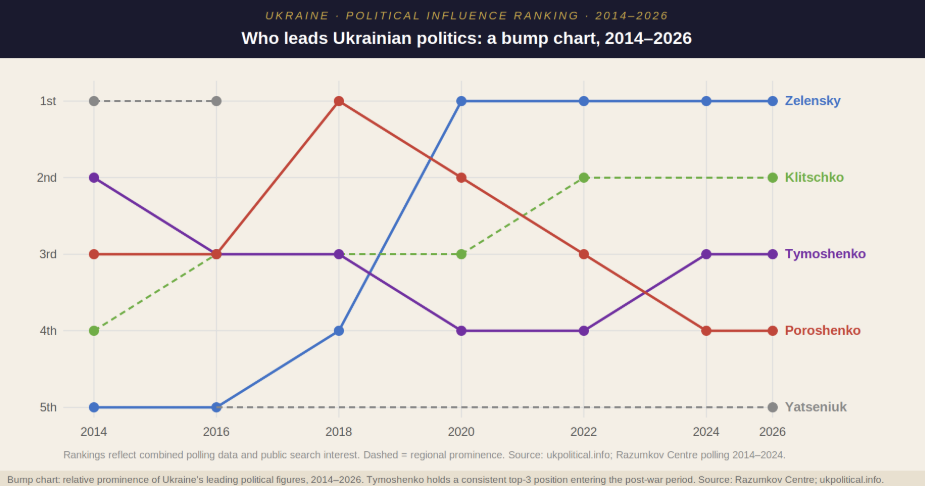
The honest read is that Tymoshenko is a ukraine opposition leader in a context where formal opposition is limited by the war and by genuine national pressure for unity. She plays within those limits more carefully than younger critics of Zelensky. But she is playing. Anyone who describes her as retired is wrong.
She is the most experienced politician in Ukraine’s top tier. That experience is both her argument for leadership and the thing her opponents use against her: she is the past, they say. She would answer, correctly, that the past is what tells you how to survive.
What She Believes (And What She’s Willing to Do)
Tymoshenko has consistently supported Ukraine’s NATO and EU aspirations. She was a European integrationist before it was the consensus position of Ukrainian politics. On Russia, she speaks without ambiguity: the war must be won, the territory must be recovered, and any settlement that legitimises Russian occupation is unacceptable.
On domestic policy, she has pushed hard on anti-corruption reform, knowing that it is both genuinely important and also a weapon against the current government. The EU accession process requires anti-corruption progress. If Zelensky’s government is seen to be failing on that benchmark, Tymoshenko benefits.
She is willing to do what most politicians who have been jailed, defeated twice in presidential races, and written off multiple times would not do: she keeps going. That persistence is either a character quality or an inability to leave, depending on which Ukrainian you ask.
We think it’s both. And in the political conditions of post-war Ukraine, it may be exactly what is required.
FAQ
Is Yulia Tymoshenko still active in Ukrainian politics? Yes. As of 2026, Yulia Tymoshenko leads the Batkivshchyna (Fatherland) party and remains one of the most prominent opposition voices in Ukrainian political life. She is widely expected to contest any presidential election held after the war.
Has Yulia Tymoshenko run for president? She has run twice. In 2010 she lost to Viktor Yanukovych by 3.5 percentage points in a result the EU described as flawed. In 2019 she finished third with 13.4%, behind Volodymyr Zelensky and Petro Poroshenko.
What is Yulia Tymoshenko’s net worth? Accurate figures are not publicly verified. She built significant wealth through United Energy Systems of Ukraine in the 1990s. Her assets were subject to legal proceedings under the Yanukovych government. Published estimates vary widely and should be treated with caution.
What happened to Yulia Tymoshenko in prison? She was convicted in October 2011 of abuse of office in connection with a 2009 gas deal with Russia. The European Court of Human Rights later ruled the detention arbitrary and a violation of her rights. She served approximately two and a half years before her release in February 2014, following the Maidan revolution. She developed spinal problems during imprisonment.
Sources: European Court of Human Rights ruling, Tymoshenko v. Ukraine; Verkhovna Rada official records; Reuters and BBC coverage of 2010 and 2019 presidential elections; Razumkov Centre polling data 2014–2024; Kyiv Independent political reporting 2024–2026.