Isabel Oakeshott: The Journalist Who Leaked Her Own Source, 52
She went from the East Lothian Courier to political editor of the Sunday Times, co-wrote books with a Cameron, a Hancock, and an Arron Banks — and then did something Fleet Street hadn’t seen before: she passed her own source’s private messages to a rival newspaper. At 52, she’s engaged to a Reform MP and broadcasting from Dubai. The question about her method has been the same for thirty years. The answers keep getting bigger.
Who is Isabel Oakeshott?
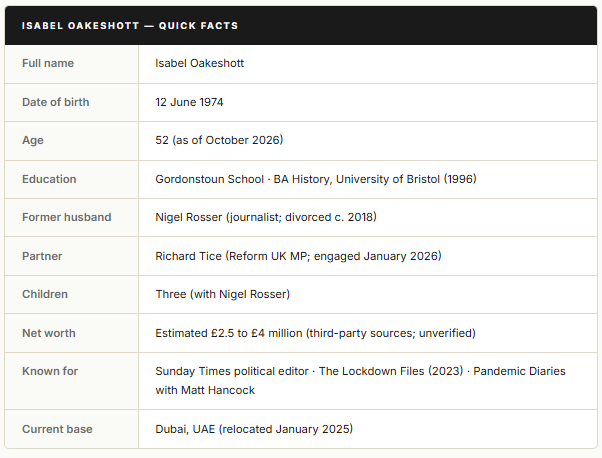
Isabel Oakeshott was born on 12 June 1974. She attended St George’s School in Edinburgh, then Gordonstoun in Moray — the Scottish boarding school perhaps best known for educating members of the royal family and for a programme that involves cold water and early mornings. From there she went to the University of Bristol, read History, and graduated in 1996.
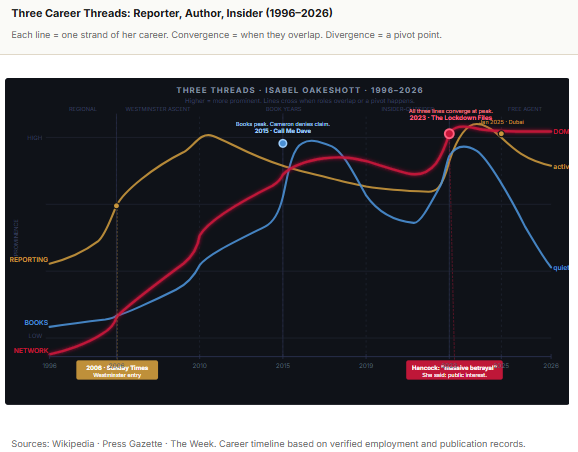
Her first jobs were in Scottish regional journalism: the East Lothian Courier, then the Edinburgh Evening News. Provincial weekly and daily reporting in the mid-1990s meant council meetings, court lists, and writing to deadlines set by people who had been doing it for thirty years before she arrived. It wasn’t glamorous. It was also where she built the habit that would carry her through two decades at Westminster: get the story, get it right, and get it before anyone else does.
She moved to the Daily Record and Sunday Mirror, then south to the Evening Standard as health correspondent — an unusual entry route to political journalism, but it gave her something useful. By the time she got to Westminster, she was already comfortable with institutional complexity: the NHS, ministerial accountability, decisions made in closed rooms that affect large numbers of people. The skill set transferred almost exactly.
We noticed
The health correspondent posting gets glossed over in most retrospectives, but it matters. Oakeshott arrived at political journalism already fluent in the gap between what officials say publicly and what the paperwork shows. That’s a specific skill, and it explains a lot about how she works — and why she goes after source material, not just source quotes.
What did Isabel Oakeshott do at the Sunday Times?
She joined the Sunday Times in 2006 as deputy political editor and was promoted to political editor in 2010. She held that role until 2014 — four years running Westminster coverage at one of Britain’s most consequential Sunday titles, across the formation of the Conservative-Liberal Democrat coalition and the rise of UKIP. Political editor of the Sunday Times is not a title you hold by being careful. It requires managing sources who are managing you, breaking stories your rivals can’t reach, and doing it on a weekly deadline that gives you one shot to get it right.
She won Political Journalist of the Year at The Press Awards in 2011. The judges cited her coverage of Conservative infighting and her ability to land stories other political correspondents couldn’t get near.
What books has Isabel Oakeshott written?
The book career tells you more about her method than the newspaper career does. She doesn’t compile her own journalism into a book. She embeds. She finds a subject with a contested story — someone whose memoir no mainstream publisher would commission without a co-writer who can manage them — and she goes inside. Then she writes it.
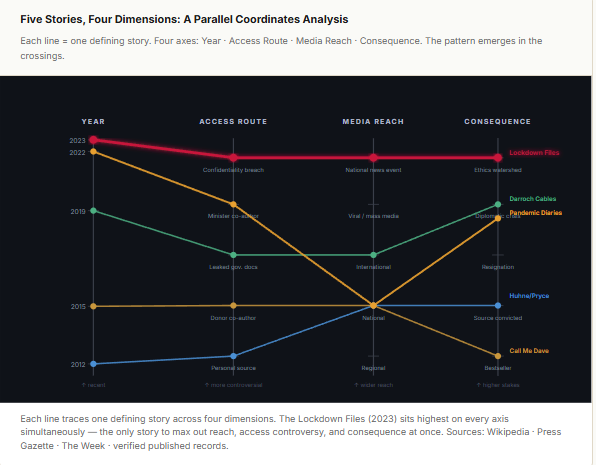
Inside Out (2010), with former Labour general secretary Peter Watt, was the first. Then Farmageddon (2014), a book about industrial farming co-written with Philip Lymbery. Then the book that set her reputation in Westminster circles: Call Me Dave (2015), the unauthorised biography of David Cameron, co-written with Conservative peer Lord Michael Ashcroft. The book contained a specific claim about Cameron’s student years at Oxford. Cameron denied it. Oakeshott later said the single anonymous source behind it “could have been deranged.” The book sold widely; the ethics of the sourcing were discussed for months.
In 2016 she ghostwrote The Bad Boys of Brexit for Arron Banks, the millionaire who bankrolled the Leave.EU campaign. To write it she spent significant time inside Banks’s operation. That access later raised questions when The Observer and Channel 4 reported on Russian embassy meetings and investment deals offered to Banks during the referendum period. Oakeshott had been inside that circle during the months in question. Why she didn’t report what she had seen became a persistent line of criticism in the years that followed.
What happened with Vicky Pryce and Chris Huhne?
Before the Hancock leak, there was Vicky Pryce. In 2012, while still political editor of the Sunday Times, Oakeshott persuaded Pryce — the estranged wife of Liberal Democrat Cabinet minister Chris Huhne — to go on the record about Huhne having asked her to take his speeding penalty points. Huhne pleaded guilty to perverting the course of justice and resigned from Cabinet. Pryce was tried, convicted, and also went to prison. Oakeshott gave evidence in court. She described herself as having fulfilled a “moral obligation” to her source.
The episode was debated extensively in journalism ethics circles — not because Oakeshott had done something illegal, but because the line from a Sunday Times investigation to a criminal prosecution and a prison sentence for the person who had agreed to speak was unusually direct. The question was never whether it was legal. It was whether she had guided a source into a position they might not have chosen alone.
Why did Isabel Oakeshott leak Matt Hancock’s WhatsApp messages?
In 2022, Matt Hancock — former Health Secretary, recently departed from Cabinet after a tabloid exposé of his affair with a colleague — commissioned Oakeshott to co-write his memoir of the pandemic. The arrangement gave her access to more than 100,000 of his private WhatsApp messages, covering decisions made at the highest levels of British government during Covid-19. There was a confidentiality agreement. Pandemic Diaries was published in December 2022.
In February and March 2023, Oakeshott passed the full set of messages to The Daily Telegraph, which published them as a multi-week series called The Lockdown Files. The series ran exchanges showing how ministers had discussed mask mandates, school closures, and the care home death toll. It was one of the biggest British political stories of the decade — published in a newspaper that had not conducted the original interviews, by a journalist who had obtained the material under a confidentiality agreement with the person the messages were about.
“This is a massive betrayal. There is absolutely no public interest case.”— Matt Hancock, February 2023, responding to The Lockdown Files
Oakeshott’s position was that the public interest in knowing how pandemic decisions were actually made outweighed the confidentiality agreement she had signed. Hancock called it a betrayal and considered legal action. He did not pursue it. The episode inverted the usual journalism ethics debate: this time it was the journalist who had disclosed rather than protected.
On the public interest argument
Oakeshott has never denied the breach. Her defence is consistent: citizens had a right to see how their government made decisions during a national emergency, and that right outweighed the agreement she had signed. We’d note that this argument works better the more the source was hiding something. If Hancock had been a model of transparency, “public interest” carries less weight. He wasn’t, which is part of why the argument landed where it did.
Who is Isabel Oakeshott’s partner, and where does she live now?
Oakeshott and Richard Tice have been together since approximately 2018, the same year her marriage to journalist Nigel Rosser ended. Tice is a businessman, co-founder of Leave.EU, and at the time of writing Reform UK’s MP for Boston and Skegness. He had previously chaired and then led Reform UK before the 2024 general election returned him to Parliament.
In January 2026, Tice announced their engagement on social media with a photograph taken outside The Royal Oak pub in Ramsden, Oxfordshire. British media covered it widely — partly because of their combined public profiles, partly because the engagement placed Oakeshott more explicitly in the orbit of a party whose sympathies she had already been associated with in her work.
In January 2025, Oakeshott relocated to Dubai with her three children. She cited Labour’s decision to add VAT to private school fees as the reason. She has continued to broadcast for TalkTV and write for The Daily Telegraph from the UAE. Some commentators framed the move as consistent with the libertarian, low-tax politics she has increasingly aligned with. Others noted that Dubai has no income tax and good international schools, and left it there.
What is Isabel Oakeshott’s net worth?
Third-party estimates put her net worth somewhere between £2.5 million and £4 million. There is no primary financial disclosure that confirms either figure. We looked for one and didn’t find it. Her reported TalkTV salary as International Editor has been cited at approximately £250,000 a year in several UK outlets — also unverified from primary sources. Additional income comes from royalties on six co-authored books, Daily Telegraph columns, BBC and Sky News punditry, and speaking engagements.
You can get a rough sense of the range from the income streams alone. Fourteen years of senior newspaper work, six books over fifteen years, a weekly broadcasting contract, and regular column fees across major titles add up. But the specific numbers remain third-party estimates, and we’re reporting them as such.
What actually happened to Isabel Oakeshott’s career?
Most senior political journalists in Britain build a career through newspaper jobs, some broadcasting, and a reputation assembled from scoops that establish them as someone sources will call. Oakeshott has done all of that. What sets her apart is the embedded co-author model: she has spent more time inside the minds of her subjects — Banks, Hancock, Ashcroft, Cameron — than almost anyone else of her generation. The question her critics ask is whether that closeness has, on more than one occasion, produced results that a more detached reporter would have handled differently.
She started out writing up council meetings in East Lothian, filing copy to a deadline for a local weekly, learning the job from people who’d been doing it since before she could vote. Thirty years later she’s engaged to a Reform MP, living in Dubai without an income tax bill, and still one of the most widely-read political commentators in Britain. The question about how she operates has stayed the same throughout. What’s changed is the scale of the answers.
Whether the Lockdown Files were an act of journalism or a betrayal of trust depends entirely on what you think journalism is for. Isabel Oakeshott has been clear about her answer to that question across her whole career. The cost of that clarity, and who bears it, is the part that changes each time.