Neil Oliver: BBC Historian, GB News Controversialist, 59
For ten years he walked the coastline of the British Isles for the BBC and nobody much argued with him. Then he joined GB News, said that lockdown was “the biggest single mistake in world history,” suggested a “silent war” was being waged by generations of politicians for total control of the people, and claimed that young and healthy people were being “harvested” by turbo cancer linked to Covid vaccines. Ofcom investigated and cleared him. He is still on air every Sunday, and showing no sign of changing the subject.
Who is Neil Oliver?
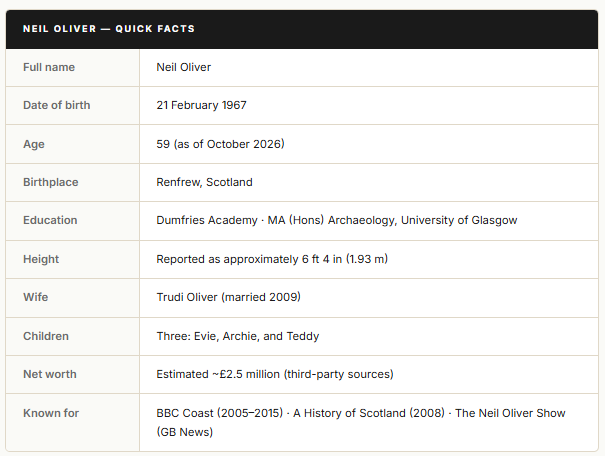
Neil Oliver was born on 21 February 1967 in Renfrew, a town on the south bank of the Clyde. He studied at Dumfries Academy and then at the University of Glasgow, where he graduated with an MA (Hons) in Archaeology — not history, not media studies, but the actual discipline of digging in the ground and building a story from what you find there.
He worked as a freelance archaeologist after graduating — real fieldwork, real sites — before moving into journalism and then television. His first TV work came in 2002, when he co-presented the BBC Two series Two Men in a Trench with archaeologist Tony Pollard. The format was exactly what it sounds like: two men, a set of famous British battlefield sites, and the question of what the physical ground still has to say about the people who fought on it. They excavated Flodden Field and the Battle of Adwalton Moor, among others, and the series ran to two seasons with accompanying books. It established Oliver as someone who could make the past feel worth knowing without making it feel like homework.
We noticed
The retrospective pieces on Oliver tend to skip his early career as a working archaeologist. That background shapes everything — the patience, the willingness to sit with ambiguity, the insistence on physical evidence. It also explains why his BBC work felt grounded in a way that presenter-led history often doesn’t.
What did Neil Oliver do on the BBC?
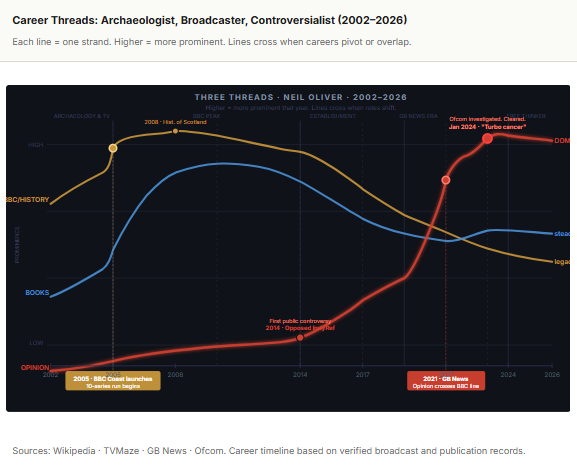
Coast first broadcast on BBC Two on 22 July 2005. Oliver joined as lead presenter from series two, walking the coastline of the British Isles and bringing an archaeologist’s eye to what the shoreline reveals about the people who lived on it. The show ran for ten series over a decade, ending in 2015, with international variants in Australia and New Zealand extending his involvement beyond the final UK series.
Ten series over ten years is unusual for a BBC factual programme. The show found a loyal audience — people who wanted something intelligent on a Sunday evening that didn’t assume they already knew things. Oliver’s on-screen manner worked: enthusiastic without being excitable, knowledgeable without being professorial, and physically comfortable enough on a cliff path that you believed he’d walked many of them before the cameras arrived.
Alongside Coast, he built one of the more substantial non-fiction careers in British popular history. A History of Scotland — the ten-part BBC One Scotland series that aired in 2008 — was the most significant. The book that accompanied it was a bestseller. He followed it with A History of Ancient Britain (BBC Two, 2011), Vikings (BBC Two, 2012), and Sacred Wonders of Britain (BBC Two, 2013). By 2024 he had published fourteen books in total, ranging from the Two Men in a Trench companion volumes to a 2023 title about ghosts and where to find them across twenty-five British locations.
Why did Neil Oliver leave the BBC?
He didn’t leave — the BBC work ran its natural course. Coast ended in 2015 after a decade. Oliver continued to appear in BBC productions and was appointed President of the National Trust for Scotland in 2017, which was an establishment recognition of where he stood in Scottish public life. The appointment lasted until September 2020.
What actually ended his relationship with the kind of television he had made at the BBC was the move to GB News in 2021. BBC factual presenting requires on-screen neutrality on anything outside the subject: you can have a view about Flodden Field, but you can’t have one about vaccine mandates. GB News requires the opposite. When Oliver moved from one format to the other, he didn’t change his views. He changed the room he was saying them in.
What did Neil Oliver say that caused controversy?
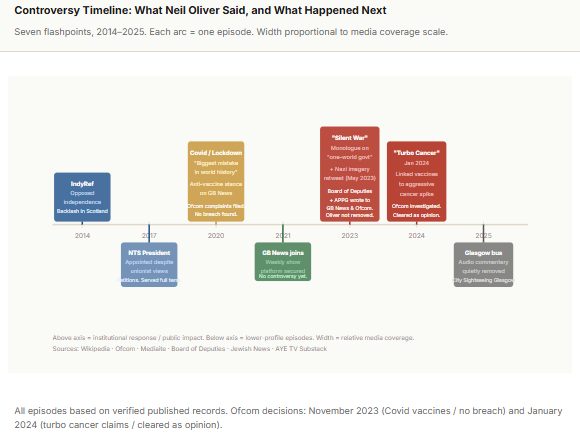
The first public controversy came in 2014, when Oliver stated before the Scottish independence referendum that he was proud of Britain and opposed independence. Glasgow voted majority Yes. Attaching that view to the presidency of the National Trust for Scotland — an organisation serving a membership with a significant pro-independence component — produced petitions calling for his removal. He served his full three-year term and stood down by mutual agreement in September 2020.
The bigger controversies came after he joined GB News. You can track them in order. He described Covid-19 lockdown as “the biggest single mistake in world history” and said he would “cheerfully risk catching Covid” rather than accept a vaccine. In February 2023, he delivered a monologue on-air referencing a “silent war” conducted by generations of politicians to achieve “total control of the people” and impose a “one-world government.” The Board of Deputies of British Jews and the All-Party Parliamentary Group Against Antisemitism wrote to both GB News and Ofcom, describing the language as connected to antisemitic conspiracy theories. In May 2023, he shared social media imagery containing symbols associated with Nazi iconography.
“Lockdown is the biggest single mistake in world history.”— Neil Oliver, GB News
In January 2024, he claimed on GB News that young and healthy people were being “harvested in hitherto unheard of numbers by heart disease and turbo cancer” — and linked the deaths to Covid vaccines, speculating about Pfizer’s corporate behaviour in terms that his critics called conspiratorial. Ofcom investigated.
On the Ofcom ruling
Ofcom cleared him, ruling his remarks were personal opinion rather than factual claims that materially misled viewers. We’d note that the distinction between “opinion” and “fact” was carrying a lot of weight in that ruling — particularly for a broadcaster describing specific physiological mechanisms causing deaths in specific numbers. But the regulator’s decision stands: no breach found.
Who is Neil Oliver married to, and does he have children?
Oliver married Trudi Oliver in 2009. They are reported to have known each other from school. They have three children together: Evie, Archie, and Teddy. Oliver has consistently said he wants to protect his family’s privacy, and he follows through on it — the children don’t appear on his social media, and he rarely mentions them in interviews beyond acknowledging they exist. The family lives in Stirling, Scotland.
On his height: various UK biography sites report him as approximately 6 feet 4 inches, or 1.93 metres. We looked for a primary source — an interview in which he confirms this figure — and didn’t find one. The number comes from celebrity aggregator sites. If you’ve found a primary source, we’d update this. For now, treat it as a reasonable estimate rather than anything he’s confirmed himself.
What is Neil Oliver’s net worth?
Third-party sources estimate his net worth at around £2.5 million. That figure is unverified — there’s no financial disclosure that supports it — but the income streams are real enough: BBC presenting fees across ten series of Coast and multiple other documentaries, royalties from fourteen books over two decades, a weekly slot at GB News, a Sunday Times column that ran from 2016 to 2022, speaking engagements, and his podcast Neil Oliver: News, Comment, History, available via Acast.
Aggregator sites report his GB News salary as somewhere between £65,000 and £120,000 a year. We have no way to verify that range. We’re telling you what the sources say and flagging that none of them are primary.
What actually happened to Neil Oliver?
In June 2025, City Sightseeing Glasgow quietly removed Neil Oliver’s audio commentary from their bus tour. No press release, no explanation. The city that had voted majority Yes in 2014 simply stopped playing his voice to tourists riding past its landmarks.
He still presents The Neil Oliver Show on GB News every Sunday. He still records his podcast. His audience in the second half of his career is entirely different from the one that watched him walk Northumberland beaches on Coast — different people, different concerns, different reasons for paying attention. Both audiences are real. The first one built his reputation. The second is why a city took his voice off a bus.
What happened to Neil Oliver is not a transformation story. His views didn’t shift. What shifted was the platform — and with it, the consequences of saying things out loud that BBC formats required him to keep quiet. The Glasgow bus decision was the clearest signal. No institution bothered to explain it. None needed to.