Andriy Yermak: The Man Who Ran Ukraine’s War From the Shadows
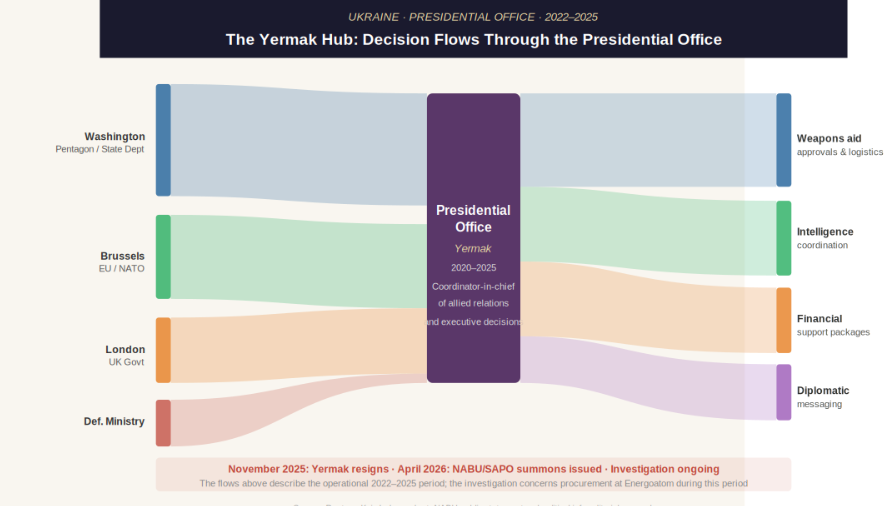
Spring 2022. Western officials trying to reach the Ukrainian government had learned one thing quickly: dial one number before any other. Not the foreign ministry. Not the defence ministry. The office of the head of the Presidential Administration, a lawyer-turned-fixer named Andriy Yermak. He was the man who had the president’s ear, the man whose sign-off made things move, the man whose door was always open to Washington, Brussels, and London at hours when every other door was shut. For five years, while Zelensky was the face of Ukraine’s war effort, Yermak was its operating system.
Then the allegations arrived. And then the court summons.
Who Is Andriy Yermak?
Andriy Yermak was born in 1971 in Kyiv. Before politics, he was an entertainment lawyer and film producer, operating in the intersection of Ukrainian and international media. That background is not incidental. He understood deals, relationships, and the gap between what people say publicly and what they want privately. These are skills that transfer well to politics, and they transferred completely when he entered Zelensky’s orbit.
He joined Zelensky’s team during the 2019 presidential campaign and rose quickly. By February 2020, he was appointed Head of the Office of the President, the most powerful unelected position in Ukrainian government. The appointment raised eyebrows among Ukraine’s more established political class, who saw a man with no government experience suddenly holding an office that had historically been used to concentrate executive power.
Those eyebrows raised further as the months passed and the scope of what Yermak controlled became clear. Diplomatic appointments, international negotiations, personnel decisions across the executive branch: significant decisions ran through his office. He became, in the assessment of multiple Western officials who dealt with him, one of the most consequential figures in Ukrainian wartime politics.
The Most Powerful Man You’d Never Heard Of
Before the full-scale invasion, Yermak’s name was unknown outside the specialist circles of Ukrainian political analysis and the diplomatic community. Zelensky was the personality. Yermak was the infrastructure.
After February 2022, that changed. Western governments needed to move fast. Weapons transfers, intelligence sharing, financial support, political coordination: all of it required a Ukrainian interlocutor who could commit on behalf of the president and deliver on those commitments. Yermak was that person. He took calls from senior officials that would normally route through ambassadors. He flew to Washington, London, and Berlin at moments of critical decision. He was described by one senior European official in 2023, in a quote that circulated among those who cover Ukraine closely, as “the person you need to know if you need to get anything done.”
Five years. That is how long Yermak ran the Presidential Office before his resignation in November 2025.
In Ukrainian political terms, five years in that role is an extraordinary tenure. Ukraine cycles through government figures quickly. The war accelerated that cycle. Yermak’s survival through Zelensky’s entire first presidential term and into the circumstances of the full-scale invasion said something about the president’s trust in him and about his own ability to manage competing interests.
And Here’s the Twist the Corruption Headlines Buried
The corruption probe. This is what the tidy biography leaves out, and it is the part that matters most if you want to understand where Andriy Yermak stands in 2026.
$100 million. That is the figure cited in connection with a corruption investigation involving Energoatom, Ukraine’s state nuclear energy company. The allegations, which NABU (Ukraine’s National Anti-Corruption Bureau) and SAPO (the Specialised Anti-Corruption Prosecutor’s Office) were investigating, concerned procurement irregularities and financial flows connected to the company’s operations.
The nickname “Ali Baba” appeared in leaked audio recordings that circulated in Ukrainian media. The recordings purported to show Yermak being referred to by that name in conversations touching on the distribution of government contracts and influence. He denied wrongdoing. His office initially dismissed the recordings.
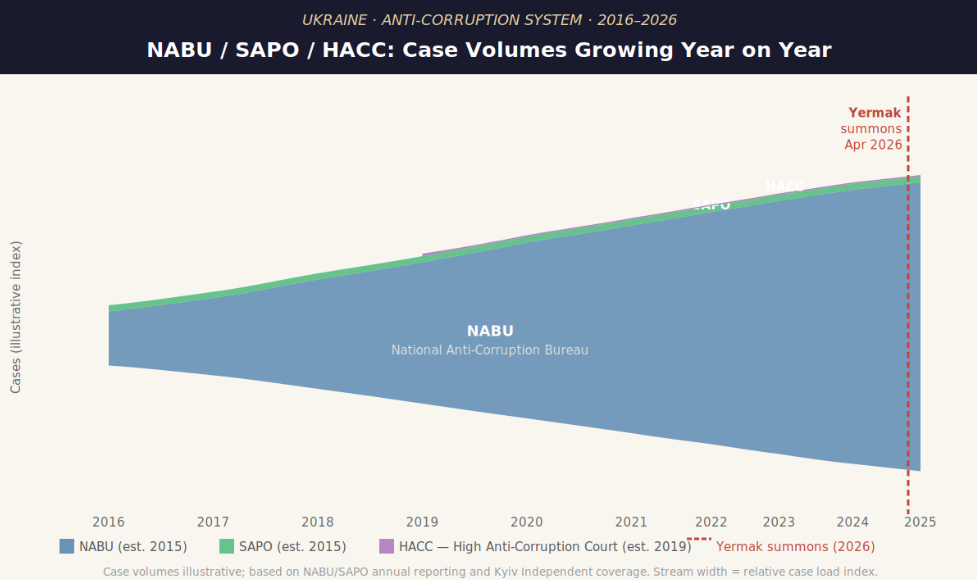
In April 2026, Yermak received a summons to appear before Ukraine’s anti-corruption court. This was not a leaked allegation or a political opponent’s press release. It was a formal judicial summons from the institution Ukraine’s Western partners have spent years and hundreds of millions of euros helping to build specifically to handle cases of this kind.
That matters because NABU and SAPO are the institutions the EU and IMF use to assess whether Ukraine is making genuine anti-corruption progress. When the most senior aide of the president of Ukraine receives a summons from those institutions, it is not a footnote. It is the story.
The Resignation and What It Means
Yermak resigned as Head of the Office of the President in November 2025. The official framing was that of a voluntary departure after a period of extraordinary service. The timing, coming as the investigation was intensifying, was noticed.
His resignation created a question that Ukrainian political watchers are still working through: how much of what the Presidential Office did under Yermak was a function of his personal relationships and methods, and how much was a function of the institutional design? If it was primarily the former, his departure changes things significantly. If it was the latter, the system continues regardless of who sits in the chair.
The yermak zelensky relationship after the resignation is not publicly clear. Zelensky has not publicly condemned his former aide. He has also not gone out of his way to defend him from the allegations. The space between those two positions is where Ukrainian political analysis is currently operating.
Yermak in 2026: Still in the Room?
Power in Ukrainian politics is not purely formal. A person who spent five years as the most consequential aide in the executive branch does not exit the room completely because they resign their official position. Relationships persist. Knowledge persists. The informal influence that comes from having been the person everyone needed to reach does not evaporate with a press release.
Whether Andriy Yermak retains meaningful influence over Ukrainian decision-making in 2026 depends partly on the outcome of the corruption proceedings and partly on his own choices. A successful prosecution would effectively end his political career. An acquittal or a case that collapses before trial would give him room to rebuild.
The anti-corruption court process moves on Ukrainian timelines, which are not fast. The ukraine corruption 2026 moment Yermak is living through is unlikely to resolve quickly. Meanwhile, the war continues, the government continues, and the Presidential Office he built continues to function under new leadership.
The ukraine presidential office he shaped for five years will outlast the investigation, whatever its outcome. Whether his own career outlasts it is the open question.
FAQ
Why did Andriy Yermak resign? Yermak resigned as Head of the Office of the President in November 2025. The resignation coincided with an intensifying corruption investigation involving Energoatom and financial irregularities connected to his period in office. He has denied wrongdoing.
What is the Yermak corruption case about? NABU and SAPO are investigating allegations connected to approximately $100 million in irregularities at Energoatom, Ukraine’s state nuclear energy company. Leaked recordings in which Yermak was reportedly referred to as “Ali Baba” circulated in Ukrainian media. He received a formal summons to Ukraine’s anti-corruption court in April 2026.
Is Andriy Yermak still in government? No. He resigned from the Office of the President in November 2025 and holds no official government position as of 2026.
Who replaced Andriy Yermak? His successor as Head of the Office of the President was announced following his November 2025 resignation. The Presidential Office continues to function as the central coordinating body of the executive branch under the new appointment.
Sources: NABU (National Anti-Corruption Bureau of Ukraine) public records; Kyiv Independent and Ukrainska Pravda reporting on the Energoatom investigation and court summons; Reuters coverage of the Presidential Office appointment and resignation; ukpolitical.info editorial research.