Rustem Umerov: Ukraine’s Defence Minister With a Point to Prove
In the summer of 2023, as Ukrainian troops pushed into minefields along the southern front and Western partners grew impatient with procurement scandals inside Kyiv’s defence ministry, Volodymyr Zelensky made a phone call. The man on the other end was not a general, not a career defence official, not a Soviet-era apparatchik who’d survived four governments. He was a 41-year-old Crimean Tatar businessman, a parliamentarian who had spent years negotiating hostage releases in Turkish-brokered backrooms, and a member of a people whose homeland Russia had already swallowed whole. Zelensky wanted him to run Ukraine’s defence ministry. Rustem Umerov said yes.
Who Is Rustem Umerov?
Born in 1982 in Crimea, Rustem Umerov grew up in a community that understood existential threat as a lived fact, not a geopolitical abstraction. The Crimean Tatars had been deported en masse by Stalin in 1944; they returned across the 1980s and 1990s to a peninsula being slowly repopulated. Umerov’s people carried that history in their marrow.
He pursued business before politics, working in finance and investment. That background shaped how he later approached government: he reads balance sheets, not just battle maps. He entered the Verkhovna Rada, Ukraine’s parliament, and built a reputation as a legislator willing to engage with difficult counterparts. He is a member of the Crimean Tatar Mejlis, the representative assembly of his people, and his Muslim faith is not incidental to his identity or his work.
His Crimean Tatar identity is the political story. It is not a footnote in his biography; it is the entire context for why his appointment carried weight beyond Kyiv.
From Parliament to the Front Line of Defence
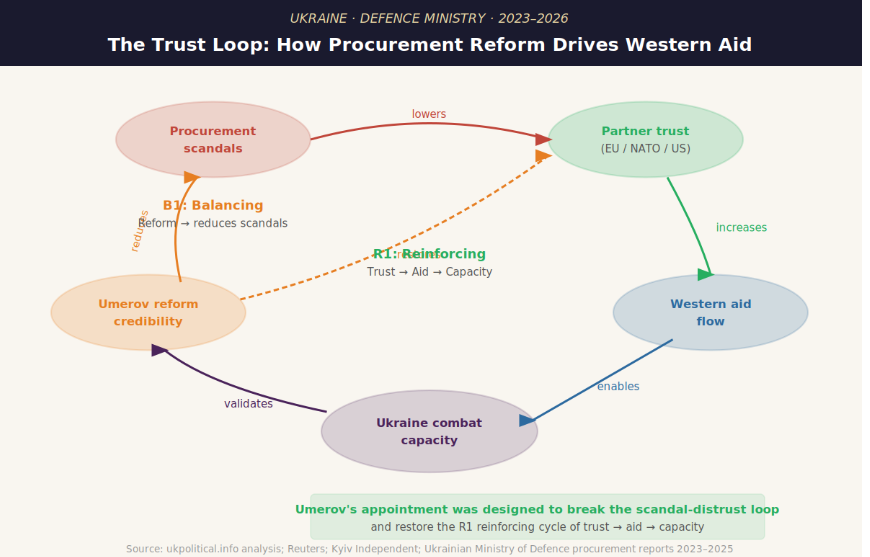
Zelensky replaced Oleksii Reznikov with Rustem Umerov in September 2023. Reznikov had led the ministry through the first 18 months of full-scale war. He coordinated the early flood of Western arms and kept Ukraine supplied through a period when the outcome was genuinely uncertain. But procurement irregularities and contracting scandals had accumulated. Ukraine’s partners, who were transferring billions in weapons and equipment, wanted to see the ministry run with tighter controls. Reznikov became politically unsustainable.
Umerov was the answer to a specific problem: credibility. He had no prior defence establishment ties to defend, no awkward relationships with the contractors under scrutiny, and a track record as a negotiator that impressed Western counterparts who had dealt with him in prisoner exchange talks. He represented the reformist, anti-corruption current that Zelensky periodically draws on when a ministry needs to be reset.
The appointment also carried a signal to the wider world. Putting a Crimean Tatar Muslim at the head of Ukraine’s defence ministry told NATO allies, Gulf states, and Muslim-majority nations watching the war that Ukraine’s cause was not narrowly ethnic or narrowly Christian. It was a strategic message as much as a personnel decision.
What This Appointment Really Means
Consider what this appointment actually means at the human level. Rustem Umerov is now running the armed forces of a country fighting to reclaim, among other territories, Crimea. His people are there. Crimean Tatars who remained after 2014 have faced detention, surveillance, pressure to collaborate, and in some cases disappearance. The Mejlis itself is banned in Russian-controlled Crimea, listed as an “extremist organisation.” Members of his community are held as political prisoners.
The man directing Ukraine’s war machine has a direct, personal stake in one of the war’s most contested territorial questions that goes beyond strategy or politics.
That is not a rhetorical flourish. That is the operational reality inside the ministry every day.
It also creates a different kind of pressure. Umerov cannot afford to fail, and he cannot afford to be seen as prioritising Crimea’s liberation above other operational priorities. He has to govern the whole war while carrying the weight of a specific grief.
What He’s Actually Done as Defence Minister
Procurement reform was the immediate task. Umerov moved to tighten contracting processes, increase transparency in purchasing, and address the irregularities that had made headlines before his appointment. This was not glamorous work, but it was the work that kept Western governments willing to keep signing transfer agreements.
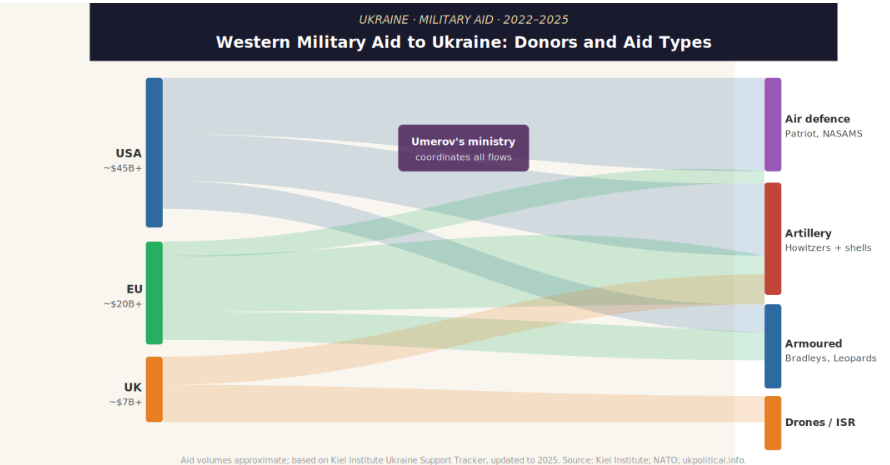
He has coordinated Ukraine’s relationships with NATO allies on military aid: weapons packages, ammunition supply chains, training programmes, and the increasingly complex question of which systems Ukraine can receive, deploy, and maintain. Ukraine’s defence budget for 2024 ran to hundreds of billions of hryvnias, with Western military aid forming the backbone of actual combat capability.
On prisoner exchanges, Umerov brought established expertise. He had been involved in negotiations before taking the ministry role, including talks related to American citizens held by Russian forces. That experience matters: prisoner exchanges are one of the few areas where Ukraine and Russia still communicate, however adversarially, and having a ukraine defence minister who knows how those conversations work is an operational asset.
Coordination with partners in Turkey, where Umerov’s community has significant diaspora ties, has also been a quiet advantage. The Crimean Tatar network across Turkish political and civil society gives him channels that career defence officials simply do not have.
Umerov in 2026: The War Continues
The war in 2026 is not the war of 2022. The front lines have stabilised in places and shifted in others. Western military aid remains the determinative variable in Ukraine’s capacity to fight. Umerov’s job is to keep that aid flowing, spend it effectively, and convince partners that Ukraine’s defence establishment is professional enough to be trusted with increasingly sophisticated systems.
He manages an institution under constant strain. Personnel, equipment, logistics, international diplomacy, and domestic politics all land on his desk simultaneously. Ukraine’s partners are not monolithic: different NATO members have different red lines, different public tolerances for continued involvement, and different assessments of how the war ends.
The question for rustem umerov ukraine is whether the reformist case he was brought in to make holds under pressure. Procurement scandals do not disappear because a new minister arrives; they require sustained institutional change. Western partners watch the ministry’s conduct closely, and any backsliding would damage relationships Ukraine cannot afford to damage.
Rustem Umerov entered this role as an argument that Ukraine could be trusted. Holding that argument together, while managing an active war, a complex budget, and the ongoing fight for a homeland he has personal reason to want back, is the task in front of him. Whether Ukraine’s ukraine minister of defence 2026 tenure results in a genuinely reformed institution, or whether the pressures of conflict overwhelm the reform agenda, will partly depend on how long he stays in post and what he builds while he’s there.
FAQ
Who is Rustem Umerov? Rustem Umerov is the Minister of Defence of Ukraine, appointed in September 2023. He is a crimean tatar politician ukraine, born in Crimea in 1982, with a background in business, parliamentary politics, and diplomatic negotiations.
Is Rustem Umerov Crimean Tatar? Yes. His Crimean Tatar identity is central to his political profile. He is a member of the Crimean Tatar Mejlis, and his appointment as ukraine defence minister carried significance for Crimean Tatar communities both inside Ukraine and in the diaspora.
What has Rustem Umerov achieved as defence minister? He has led procurement reform within the ministry, coordinated Western military aid flows to Ukraine, managed prisoner exchange negotiations including cases involving US citizens, and worked to restore credibility to a ministry that had faced corruption allegations before his appointment.
When did Rustem Umerov become defence minister? Rustem Umerov was appointed Ukraine’s Minister of Defence in September 2023, replacing Oleksii Reznikov.
Sources: Ukrainian government records; Verkhovna Rada official biography; Reuters, BBC, and Kyiv Independent reporting on the September 2023 ministerial appointment; Crimean Tatar Mejlis public statements; Kiel Institute for the World Economy Ukraine Support Tracker.