Oleksandr Syrskyi: Ukraine’s Most Controversial Commander
The date was 25 February 2022. Russian armoured columns were rolling south through Chernihiv Oblast toward Kyiv. Ukrainian command was improvising at speed. In the chaos of those first forty-eight hours, one general was ordered to hold the capital at whatever cost. He held it. That general was Oleksandr Syrskyi — and three years later he still commands the army that stopped the most powerful ground invasion in Europe since 1945.
But the story behind that defence is more complicated than a single headline allows. Syrskyi is the officer Zelensky trusts enough to make Ukraine’s Commander-in-Chief, and the officer Ukrainian troops have called “General 200” — military slang for body bags. Understanding him means holding both things at once.
Who Is Oleksandr Syrskyi?
Oleksandr Syrskyi was born in 1965 in Vladimir, a Russian city east of Moscow, then part of the Soviet Union. He trained at the Military Academy of the General Staff in Moscow. He is, by origin and education, a product of the Soviet military machine — the same machine Ukraine has spent thirty years dismantling from the inside.
He graduated, took a commission, and eventually transferred to the Ukrainian armed forces when the USSR collapsed in 1991. He rose through the officer class of an army that inherited Soviet doctrine, Soviet equipment, and Soviet habits of thought, and spent the following decades trying to reform itself in line with NATO standards.
By 2014, when Russia seized Crimea and ignited the Donbas conflict, Syrskyi was already a senior commander. He served in the east during those early years, gaining battlefield experience that most European army officers simply do not have. His reputation inside the professional military was that of a demanding, detail-obsessed commander who had little patience for excuses and less for failure.
That reputation hardened by February 2022.
The Kharkiv Offensive and the Making of a Commander
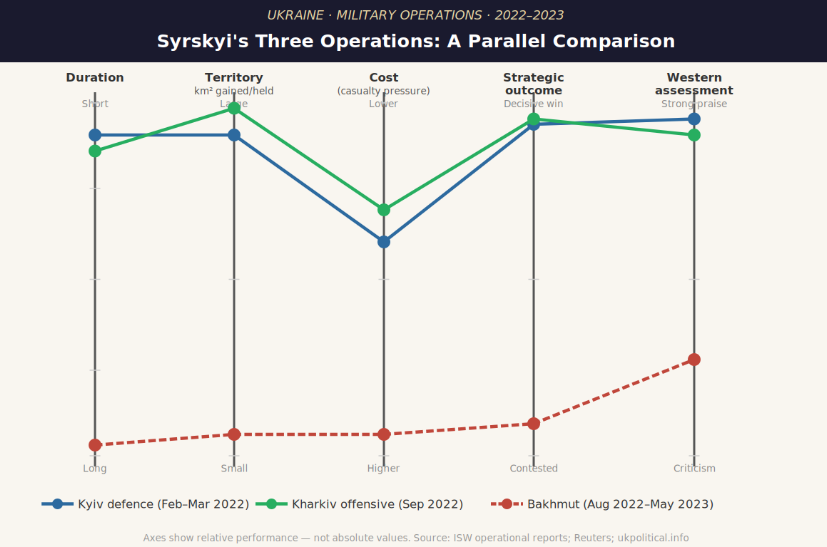
The defence of Kyiv in early 2022 is the achievement that defined Syrskyi in public consciousness. Russian forces had expected to encircle the capital within days. Ukrainian resistance, better supplied and better motivated than Russian intelligence had predicted, stopped them short. Syrskyi commanded the forces in that northern theatre. When Russia withdrew from the Kyiv region in late March 2022, admitting its northern offensive had failed, his name was attached to the result.
By September 2022, he was directing something more ambitious.
The Kharkiv counteroffensive saw Ukrainian forces advance over 8,000 square kilometres in less than ten days — one of the fastest large-scale territorial recoveries in modern European warfare. Russian forces were overextended and underequipped in the northeast; Syrskyi’s troops moved through gaps faster than the defenders could respond. It was a classic economy-of-force operation, and it worked.
In military terms, this was a serious professional achievement. Zelensky noticed. Western defence officials noticed. The Kharkiv operation gave the syrskyi commander narrative its most powerful argument: that he wins.
The Contradiction His Critics Return To
Born in Russia. Trained in Moscow. Now leading Ukraine’s army against Russia.
This is the contradiction critics return to repeatedly, and Syrskyi’s detractors inside Ukraine deploy it as if it settles something. It does not. Plenty of officers who built careers under Soviet command have proven themselves loyal to independent Ukraine — some gave their lives proving it. The test is not where you were born. The test is what you do with the authority you hold.
Syrskyi has spent three years under that test in live fire. His critics raise his birthplace precisely because his battlefield record is harder to attack directly. The personal detail substitutes for the military argument.
That said, the criticism points at something real: a military culture question about whether officers shaped by Soviet doctrine can fully internalise the decentralised, initiative-driven combat style that NATO doctrine demands. That is a legitimate debate. His birthplace is not.
Bakhmut: The Battle That Defined His Critics
The siege of Bakhmut lasted from August 2022 to May 2023. Ukrainian forces held the city against a Russian assault led by Wagner Group mercenaries for nine months. When Bakhmut finally fell, Ukraine had suffered casualties on a scale the country could not publicly quantify.
The handle “General 200” — referring to Cargo 200, the Soviet-era military code for soldiers returned home in zinc coffins — attached itself to Syrskyi during and after Bakhmut. Ukrainian soldiers and veterans who served there described orders that kept troops in exposed positions for tactical and political reasons they found unconvincing. Online forums and Telegram channels published accusations of command decisions that prioritised symbolic resistance over lives.
The honest assessment: Bakhmut was a genuine strategic dilemma. Zelensky and much of the political leadership wanted to hold the city for its symbolic value in maintaining domestic and international support. Military commanders, including Syrskyi, were implementing policy as much as formulating it. The casualties were real. The decision-making chain was longer than critics of one general acknowledge.
What is fair to say is that Syrskyi was the operational commander, his name was on the orders, and the losses happened on his watch. He owns that record. Whether the decision to fight for Bakhmut as long as Ukraine did was correct remains contested among serious military analysts. It is not a question with a clean answer.
Syrskyi vs Zaluzhnyi: Why the Change Was Made
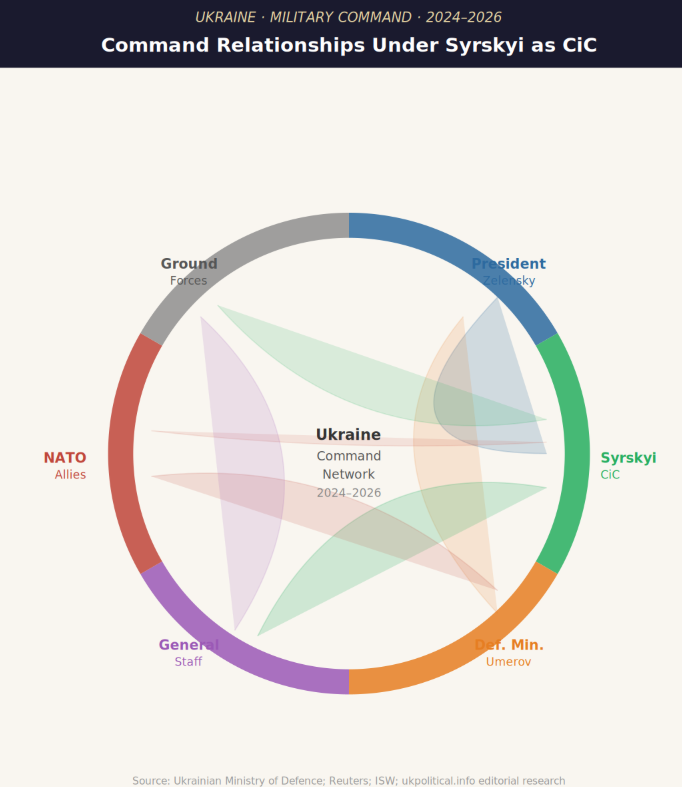
In February 2024, President Zelensky removed General Valery Zaluzhnyi and appointed Oleksandr Syrskyi Commander-in-Chief. The move was widely read in Western media as a shock. Inside Ukraine, anyone paying attention to civil-military relations had seen it coming for months.
Zaluzhnyi had become a political figure as much as a military one. His public profile rivalled Zelensky’s. An Economist interview in November 2023, in which Zaluzhnyi described the war as a stalemate, directly contradicted government messaging. The relationship between the president and his top general had deteriorated to the point where their strategic disagreements were no longer manageable through normal command structures.
Syrskyi was not Zelensky’s obvious first choice or the troops’ preferred candidate. He was the choice that made political and command sense to the president at that moment. He reports up the chain. He does not give interviews that reframe national strategy without authorisation. Whatever his flaws as a communicator or commander, he is controllable in the way that Zaluzhnyi had stopped being.
That calculation may prove wise or disastrous. In 2026, the war continues, and so does the argument.
Syrskyi in 2026: The War Continues
The front lines in 2026 remain in eastern and southeastern Ukraine. Russian forces hold parts of Donetsk and Zaporizhzhia oblasts. Ukrainians have made incremental gains in some sectors and lost ground in others. The war has settled into an attritional phase that no commander — Ukrainian or Russian — has found a clean exit from.
As ukraine army chief 2026, Syrskyi’s task is managing a military that has been at war for four years, absorbing casualties, rotating exhausted units, and integrating new Western weapons systems at a pace determined by politics in Washington, London, and Berlin as much as by conditions in the field. His relationship with Zelensky appears stable, which in the context of Ukrainian wartime politics is not nothing.
The ukraine military commander the war produces at the end will be shaped by events no one fully controls. Syrskyi is working with the army he has, in the political environment he operates in, against a Russian military that has adapted its own approach after early failures.
His record so far contains a genuine success at Kyiv, a spectacular operational result at Kharkiv, a brutal and contested campaign at Bakhmut, and a political appointment that remains divisive. By any standard, that is a complicated legacy for a commander still in post.
FAQ
Where was Oleksandr Syrskyi born? Syrskyi was born in 1965 in Vladimir, in the Russian SFSR. He trained at a Soviet military academy in Moscow before transitioning to the Ukrainian armed forces after independence in 1991.
Why did Syrskyi replace Zaluzhnyi? President Zelensky removed Valery Zaluzhnyi in February 2024 amid reported strategic disagreements and concerns about Zaluzhnyi’s independent political profile. Syrskyi, seen as a more reliable command partner for the president, was appointed in his place.
What is Syrskyi’s military record? He commanded the successful defence of Kyiv in February-March 2022, directed the Kharkiv counteroffensive that recovered over 8,000 square kilometres in September 2022, and led Ukrainian forces during the prolonged defence of Bakhmut from 2022 to 2023.
Why is Syrskyi controversial? His critics point to high casualties during the syrskyi bakhmut campaign, his demanding command style, and his origins — born in Russia and trained in Soviet military institutions. Supporters argue his battlefield record in the war’s opening phase justifies his position.
Sources: Ukrainian Ministry of Defence statements; The Economist, November 2023; Institute for the Study of War (ISW) operational reports 2022–2024; Reuters reporting on command changes, February 2024.