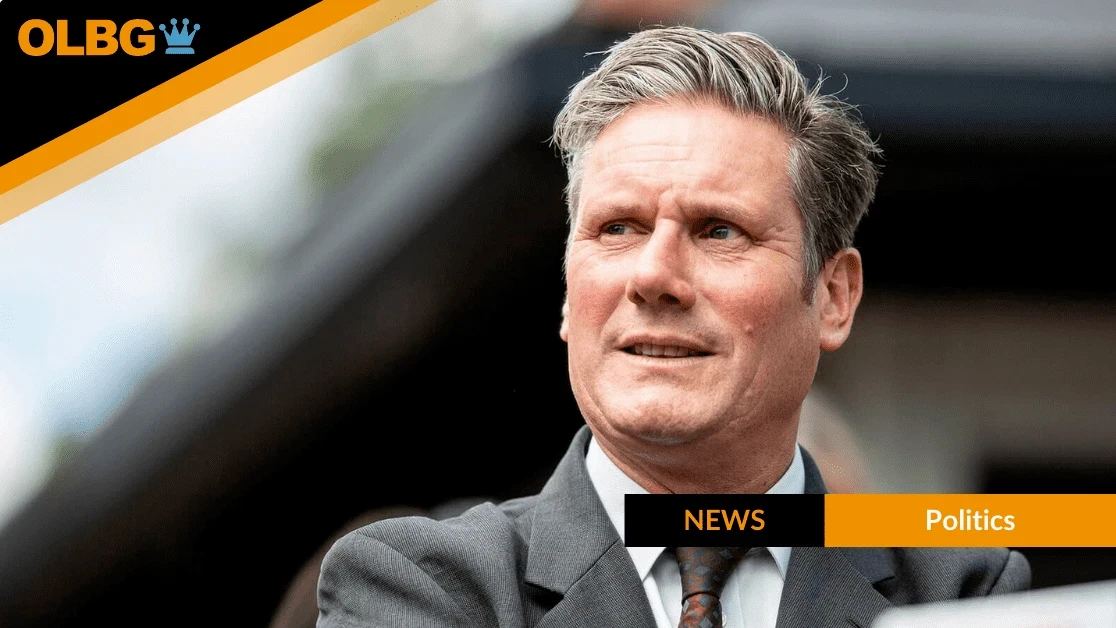
Profile · British Politics
Luke Tryl: The Pollster Who Reads Britain’s Mind — and Tells Politicians What It Says
Luke Tryl, executive director of More in Common UK, has become the most-cited interpreter of British public opinion. His Seven Segments framework shapes what Labour and the Tories say in every debate.
October 2026
The briefing document arrives early. It is a Sunday. It is just before eight in the morning, and inside the green rooms of BBC Broadcasting House in central London, politicians are doing what politicians do before television: reading and rehearsing, checking and adjusting, trying to turn whatever they know into something that sounds instinctive. On a table somewhere in that building — beside the coffee cups, the make-up brushes, the laminated running orders — there is, typically, a document carrying numbers. Some of those numbers come from More in Common. The politicians about to appear on Sunday with Laura Kuenssberg already know, before the cameras roll, which voter segments they are playing to. They know what Disengaged Battlers fear about energy bills. They know what Civic Pragmatists think about the state of the NHS. They know because a man who will not appear on that programme, who holds no elected office and whose name does not appear on any ballot, has spent the preceding months running focus groups in Derby and Doncaster, in Swindon and South Wales, systematically mapping the emotional terrain of British public opinion.
Luke Tryl is not in that green room. He is almost never in any room where political decisions are visibly made. That is precisely the point. Since becoming executive director of More in Common UK in 2021, Tryl has shaped the terms on which political arguments are conducted in Britain — not by advising campaigns directly, but by making his research so thorough, so available, and so compelling that it has become the shared vocabulary of British political discourse. In the twelve months before the 2024 general election, More in Common’s Seven Segments framework was cited in The Times, The Guardian, on Newsnight, and in briefing documents prepared for both Labour and Conservative party strategists. Seven distinct groups. One taxonomy of Britain. Before the election was called, its outcome had, in several meaningful ways, already been described.
The person reading that document before going on air has already internalized the segmentation. They know which slice of the electorate they are addressing. They are not acting on instinct. They are acting on Tryl’s research, processed and absorbed until it feels like their own judgment. That is how influence of this kind works. It does not announce itself.
More in Common UK · Seven Segments Framework
Elections in Britain are typically decided in the middle three segments — particularly among Disengaged Battlers and Loyal Nationals, the groups most likely to shift allegiance between Labour, Conservative and, increasingly, Reform UK. More in Common’s framework has been adopted by broadcasters, think tanks and party strategists as a working map of the British electorate.
What More in Common actually does
The organisation was founded in 2017, in the aftermath of Jo Cox’s murder and the Brexit referendum, with the explicit mission of studying what divides and unites people in democratic societies. The UK arm, where Tryl leads, is part of an international network with presences in the United States, Germany, France and beyond. The methodology is its distinguishing feature. Where conventional polling asks what people think — Vote intention? Approve or disapprove? — More in Common spends its time asking why. The qualitative work matters as much as the quantitative. The focus groups are long, probing, and deliberately located in the parts of Britain that London-based political culture tends to miss.
Tryl came to this role through a career that crossed several institutional worlds. He worked as a Special Adviser to Nicky Morgan at the Department for Education under David Cameron. He researched at the think tank Reform. He led work at Stonewall during its most prominent campaign years. He served as Director of Corporate Strategy at Ofsted between 2017 and 2019. None of these roles are obviously connected. Together, they describe someone who developed a particular skill: the ability to translate between institutions and publics, to explain what one world is doing to people who live in another. More in Common is, in a sense, the professionalisation of that skill — turned outward, toward Britain as a whole.
The Seven Segments are the clearest expression of that work. The framework divides the British electorate into seven broad groups, arranged from left to right but defined not only by political preference. They are defined by psychology. By what people fear and want and feel their lives contain. Civic Pragmatists are not simply moderate voters; they are people who believe in institutions while doubting politicians. Disengaged Battlers are not simply working-class non-voters; they are people who feel that political life was designed for someone else and cannot be persuaded otherwise by messaging alone. The taxonomy works because it describes the texture of British opinion, not just its surface. That is why it has been adopted so widely. It offers politicians something conventional polling cannot: an explanation of why their arguments land or fail.
The focus groups filmed for Sunday with Laura Kuenssberg made that work visible in an unusually direct way. Segments of real voters — labelled, as More in Common labels them, by type — watching political events and reacting in real time. The BBC audience watching those voters watching politics was, in effect, watching Tryl’s framework operate as a live instrument. Millions of people absorbed the taxonomy without necessarily registering whose taxonomy it was.
The structural tension in interpreting research
Here is where the profile of Luke Tryl becomes more complicated than a simple story of expertise rewarded.
More in Common presents itself as non-partisan. It takes no campaign funding. It publishes its research openly. It does not endorse parties or candidates. Tryl himself is careful to speak as an analyst rather than an advocate. When he appears in the media — and he appears regularly, on the Today programme, in newspaper profiles, at political events — he describes what the data shows. He does not tell people what to conclude from it. The organisation’s stated goal is to reduce polarisation, not to win elections.
But interpretation is not neutral. It cannot be. The choice of which findings to publish first, which segments to foreground, which voter anxieties to frame as the central story of a political moment — these are decisions, and decisions have consequences. When More in Common publishes a report saying that Disengaged Battlers feel “left behind by both main parties,” that framing is not a fact in the way that a polling number is a fact. It is a reading. A reading made by an organisation that is enormously well-connected, well-funded, and well-regarded — and whose executive director was once a Conservative Special Adviser and has worked across the centre-left liberal professional landscape that dominates British civic institutions.
He does not hold office. He does not appear on the ballot.
He has no Wikipedia page.
And yet the research he oversees shapes the questions that party leaders are asked on Sunday mornings, the language in which those leaders frame their answers, and the categories through which broadcasters, journalists, and strategists understand the British public. That is not an ordinary level of influence. It is influence of the quiet, structural kind — influence that is hardest to scrutinise precisely because it wears the clothes of objectivity.
The 2024 general election illustrated the stakes. Labour won 412 seats on 33.7 percent of the popular vote. Reform UK won 14.3 percent of the vote and returned four MPs. The disjunction between share of public opinion and parliamentary representation was extreme, and it was a disjunction that More in Common’s segmentation had, in some ways, anticipated — the Disengaged Battlers and Loyal Nationals whose economic anxieties drove them toward Nigel Farage’s party were segments the framework had identified and named. Whether the framework had helped parties understand those voters, or had helped them work around those voters by identifying which ones were winnable and which were not, is a question that deserves more scrutiny than it has received.
There is a version of this story in which Luke Tryl and More in Common are doing something genuinely valuable and genuinely difficult: making British politics legible to itself, offering a map of a country that its own governing class has repeatedly misread. The 2016 Brexit referendum, the 2017 election, the 2019 election — all were, in part, failures of political class imagination. More in Common exists because those failures happened. The Seven Segments framework is, in part, an answer to the question: how did so many politicians not see this coming?
But there is another version in which the framework, by providing a single shared vocabulary for describing the electorate, also narrows the range of political possibilities. When everyone is working from the same segmentation, the same insight about which voters matter most, the same taxonomy of what Civic Pragmatists and Loyal Nationals want — then political argument contracts toward a shared set of assumptions about what is winnable and what is not. The framework designed to reduce polarisation may, paradoxically, also reduce the field of what can be imagined. That is not a criticism of Tryl, exactly. It is a structural observation about what happens when one organisation’s conceptual model becomes hegemonic.
What is clear is this: no single person in British political life exercises more influence over the framing of public opinion — without a democratic mandate, without a party whip, without even a byline in the way journalists have bylines — than Luke Tryl. His power is real and largely unaccountable. It operates through the quality and accessibility of his research, not through any formal institutional lever. In that respect, it is more durable than most power in politics. Politicians come and go. Frameworks persist. On a Sunday morning in BBC Broadcasting House, someone is still reading that document. Luke Tryl is still not in the room. His work is doing the talking for him. And the cameras have not yet rolled.
- More in Common UK, Britain’s Choice (2020) and subsequent Seven Segments research — moreincommon.com
- BBC, Sunday with Laura Kuenssberg — focus group segments broadcast 2023–2024
- The Guardian, coverage of More in Common polling ahead of the 2024 UK general election
- The Times, analysis pieces referencing the Seven Segments framework, 2023–2024
- Electoral Commission, UK General Election 2024 results — Reform UK: 14.3% of vote, 4 seats; Labour: 33.7% of vote, 412 seats
- Tryl, Luke — career history: Special Adviser to Nicky Morgan (DfE, 2014–2016); Reform (think tank); Stonewall; Ofsted Director of Corporate Strategy (2017–2019); More in Common UK Executive Director (2021–present)
- Newsnight, BBC Two — references to More in Common segmentation research, 2023–2024
- More in Common, methodology note: mixed-methods approach (qualitative focus groups + quantitative polling), published methodology available at moreincommon.com