Davos 2026: World Leaders Convene Amid Geopolitical Rupture as Trump and Musk Dominate Global Economic Forum
Published: January 23, 2026 | Global Economics & Politics
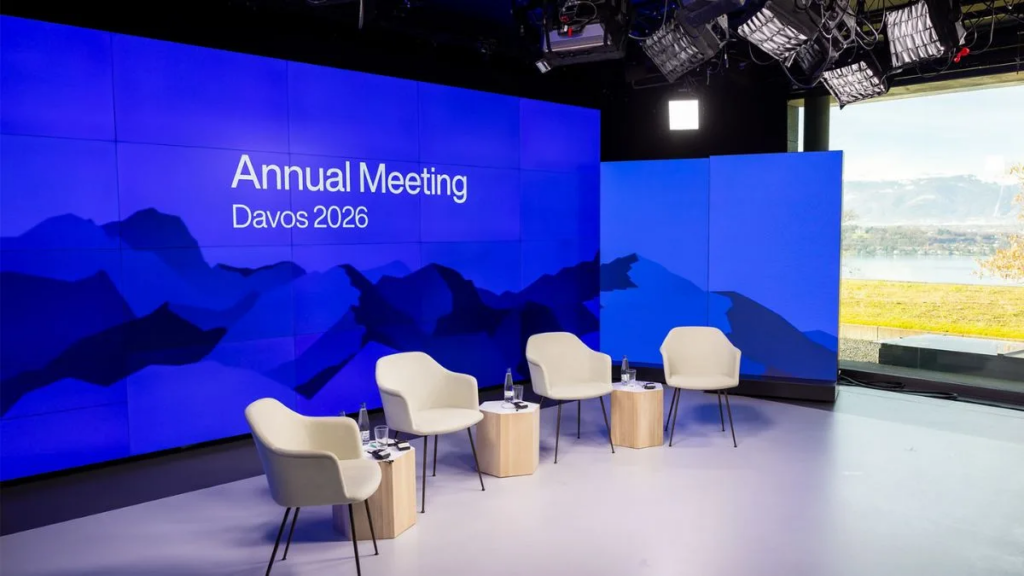
The 56th Annual Meeting of the World Economic Forum concluded in Davos-Klosters, Switzerland on January 23, 2026, after five days of intense dialogue that exposed deepening global divisions while attempting to forge new pathways for cooperation. Under the theme “A Spirit of Dialogue,” over 2,500 leaders from government, business, civil society, and technology sectors gathered in the Swiss Alps amid what Canadian Prime Minister Mark Carney described as “a rupture, not a transition” in the global order. The forum was dominated by geopolitical tensions, with unexpected appearances by Elon Musk and pointed exchanges between world leaders highlighting the fragile state of international relations.
The Davos Setting: A Spirit of Dialogue in Times of Division
The World Economic Forum’s choice of theme for 2026—”A Spirit of Dialogue”—proved both aspirational and necessary as attendees confronted profound shifts in global power dynamics. The Congress Hall in Davos hosted over 200 livestreamed sessions covering topics from artificial intelligence governance to climate action, economic resilience to geopolitical risk management.
WEF founder Klaus Schwab opened the forum acknowledging the challenging context: “We meet at a time when the assumptions that have guided international cooperation for decades are being questioned. Our task is not to defend an outdated order, but to shape a new one that serves humanity’s shared interests.”
| Metric | 2026 Forum | 2025 Forum | Change |
| Total Attendees | 2,500+ | 2,800+ | -10.7% |
| Heads of State/Government | 62 | 58 | +6.9% |
| CEOs Attending | 600+ | 700+ | -14.3% |
| Countries Represented | 120 | 115 | +4.3% |
| Live Streamed Sessions | 200+ | 175 | +14.3% |
| Media Outlets | 450+ | 400+ | +12.5% |
Elon Musk’s Surprise Appearance Steals Spotlight
Perhaps the forum’s most unexpected development came with Tesla and X CEO Elon Musk’s last-minute addition to the agenda. Added just days before the event to a Thursday afternoon session, Musk’s appearance generated enormous interest and drew capacity crowds to a discussion on technological innovation and its geopolitical implications.
Musk used the platform to discuss his vision for artificial intelligence governance, space exploration’s role in global cooperation, and his increasingly influential position in shaping technology policy. His presence underscored the growing power of tech billionaires in shaping global discourse, sometimes rivaling traditional political leaders in influence.
The Tesla CEO’s attendance was particularly notable given his complex relationship with international institutions and his recent roles advising various governments on technology policy. His session on “Agentic AI and the Future of Humanity” became one of the forum’s most-watched events, with overflow crowds and millions of online viewers.
Trump’s Virtual Address: Greenland and Protectionism
US President Donald Trump delivered a virtual address that reinforced his administration’s America First agenda while defending recent controversial statements about acquiring Greenland. Trump’s remarks came just one day after he publicly criticized Canadian PM Mark Carney’s Davos speech, saying “Canada lives because of the United States. Remember that, Mark.”
The President’s address focused on reshaping global trade relationships, demanding greater burden-sharing from NATO allies, and promoting American economic interests above multilateral cooperation. His tone represented a stark departure from the forum’s traditional emphasis on global collaboration and rules-based international order.
Attendees noted the symbolic power of Trump’s virtual rather than in-person attendance, with some interpreting it as emblematic of American disengagement from traditional multilateral forums. Others suggested it reflected the administration’s calculated approach to international engagement—participating when convenient but not committing to physical presence at forums it views skeptically.
Mark Carney’s Standing Ovation: Middle Powers Unite
Canadian Prime Minister Mark Carney delivered what many considered the forum’s most impactful speech, receiving a rare standing ovation for his address titled “Principled and Pragmatic: Canada’s Path.” Carney’s speech acknowledged the end of the rules-based international order while outlining how middle powers can navigate the emerging era of great power rivalry.
Drawing on Czech dissident Václav Havel’s essay “The Power of the Powerless,” Carney argued that middle powers must “live in truth” by acknowledging the new reality while refusing to accept subordination to great powers. His call for middle powers to combine forces and create a “third path” resonated strongly with leaders from nations caught between competing hegemonies.
“In a world of great power rivalry, the countries in between have a choice,” Carney declared. “To compete with each other for favour, or to combine to create a third path with impact. We should not allow the rise of hard power to blind us to the fact that the power of legitimacy, integrity, and rules will remain strong — if we choose to wield it together.”
Key Themes Dominating Discussions
Geopolitics and the New World Order
Sessions exploring geopolitical realignment proved among the most attended and contentious. Discussions focused on how cooperation can be renewed amid contested norms, strained alliances, and eroding trust. The war in Ukraine, tensions in the Taiwan Strait, and Middle East conflicts provided backdrop for debates about security, sovereignty, and the future of international law.
| Topic | Sessions | Key Speakers | Consensus Reached? |
| US-China Relations | 12 | Various trade ministers, economists | No – Deep divisions remain |
| Ukraine Conflict | 15 | Zelenskyy (virtual), European leaders | Limited – Support pledges but path unclear |
| Middle East Peace | 8 | Board of Peace members, regional leaders | Partial – Framework discussions ongoing |
| NATO Future | 6 | Secretary General, defense ministers | No – Spending debates unresolved |
| Trade Wars | 18 | WTO chief, finance ministers | No – Protectionism rising |
Artificial Intelligence and Technological Transformation
The rapid advancement of agentic AI dominated technology discussions, with leaders grappling with how to harness transformative technologies while managing risks. Sessions explored AI governance frameworks, the future of work in an AI-augmented economy, and the role of public-private partnerships in shaping technological development.
McKinsey senior partners leading sessions on “21st Century Leadership” emphasized that AI is making leadership more important than ever, requiring new approaches to developing future leaders at speed and scale. The consensus emerged that organizations unprepared for AI transformation risk being left behind, but that thoughtful implementation requires addressing ethical concerns and workforce displacement.
Climate and Sustainability: Momentum vs. Backsliding
Climate sessions revealed tensions between maintaining momentum on emissions targets and the reality that most countries are off track to meet Paris Agreement commitments. While corporate targets for nature have continued to grow beyond carbon, preserving momentum requires greater consistency and follow-through.
The forum highlighted successful examples of public-private collaboration on clean energy transitions, but also acknowledged that geopolitical fragmentation threatens coordinated climate action. The phrase “green national security” emerged as a theme, with countries increasingly viewing clean energy independence as strategic imperative rather than purely environmental concern.
Economic Outlook: Navigating Uncertainty
Economic sessions painted a picture of cautious pessimism, with forecasts suggesting moderate global growth amid high uncertainty. Trade fragmentation, technological disruption, and geopolitical tensions create a challenging environment for business planning and investment.
IMF and World Bank leaders participating in economic sessions emphasized the need for countries to focus on economic resilience and competitiveness rather than pursuing growth at all costs. The concept of “strategic autonomy” — countries developing capabilities to reduce dependencies on rivals — gained prominence across multiple discussions.
| Region | 2026 Growth Forecast | Main Risks | Opportunities |
| United States | 1.8% | Trade wars, political polarization | AI leadership, energy independence |
| European Union | 1.2% | Energy costs, competitiveness gaps | Green transition, single market depth |
| China | 4.5% | Property sector, demographics | EV leadership, tech innovation |
| India | 6.8% | Infrastructure needs, inequality | Demographics, digital economy |
| Emerging Markets | 4.2% | Dollar strength, debt levels | Commodity demand, diversification |
Notable Absences and Controversies
The forum was marked not just by who attended but who stayed away. Several major tech CEOs opted out compared to previous years, with some citing the increasingly political nature of the gathering. Russian representatives remained excluded following the invasion of Ukraine, while Chinese participation was more muted than in pre-pandemic years.
Controversy erupted when protesters erected a “No Kings” sign in Davos ahead of Trump’s virtual address, highlighting local resistance to what critics view as an elite gathering disconnected from ordinary citizens’ concerns. The sign became a viral symbol of growing skepticism toward both traditional political leaders and the billionaire class.
Side Events and Bilateral Meetings
As always, much of Davos’s real work occurred in side meetings and bilateral discussions away from formal sessions. Mark Carney held meetings with NATO Secretary General Mark Rutte, Swedish PM Ulf Kristersson, and numerous business leaders seeking investment partnerships with Canada.
The Canadian PM’s charm offensive seeking to diversify Canada’s economic relationships bore fruit, with preliminary agreements announced on technology partnerships, clean energy cooperation, and enhanced trade linkages with European and Asian partners. These deals represented concrete progress on Carney’s stated goal of reducing Canadian dependence on the United States.
Media Coverage and Digital Engagement
WEF’s digital strategy brought Davos to a global audience through extensive livestreaming and social media engagement. The forum’s #WEF26 hashtag trended globally multiple times, with Mark Carney’s speech, Elon Musk’s appearance, and various AI-related sessions generating particularly high engagement.
Critics noted that while digital accessibility has improved, the fundamental tension remains between Davos’s stated mission of improving the state of the world and its reality as a gathering of global elites. The conversation gap between forum participants and the populations they represent continues to widen, with populist movements worldwide viewing Davos skeptically.
Looking Ahead: From Davos to Action
As participants departed the Swiss Alps, the key question remained: Can dialogue translate into action? McKinsey planned a follow-up webinar for January 28 featuring senior partners Becca Coggins and Shelley Stewart to explore practical takeaways and themes rising to the top of 2026’s agenda.
The forum established several working groups to continue discussions on critical topics including AI governance, climate finance, and frameworks for middle power cooperation. Whether these initiatives produce meaningful results or fade into the background of competing national priorities will determine Davos 2026’s ultimate legacy.
Conclusion: Dialogue Amid Rupture
The 56th Annual Meeting of the World Economic Forum embodied its theme of dialogue while simultaneously exposing how difficult genuine dialogue has become in a fractured world. The contrast between Mark Carney’s vision of principled multilateralism and Donald Trump’s transactional nationalism encapsulated the fundamental tension facing global cooperation.
Elon Musk’s presence symbolized technology’s growing influence in shaping global affairs, sometimes superseding traditional diplomatic channels. The question of whether private sector innovation can compensate for retreating public sector cooperation remains unanswered.
As world leaders returned to their capitals, they carried both inspiration from successful dialogue and frustration at persistent divisions. The test of Davos 2026 will be measured not in the Alpine resort’s Congress Hall, but in policy decisions made in Washington, Beijing, Brussels, and capitals worldwide over the coming year. The spirit of dialogue must now prove itself through the hard work of compromise, cooperation, and collective action on challenges that respect no borders.