Mark Carney’s Davos Declaration: Canadian PM Joins Trump’s Board of Peace
Published: January 23, 2026 | Canadian Politics & International Relations
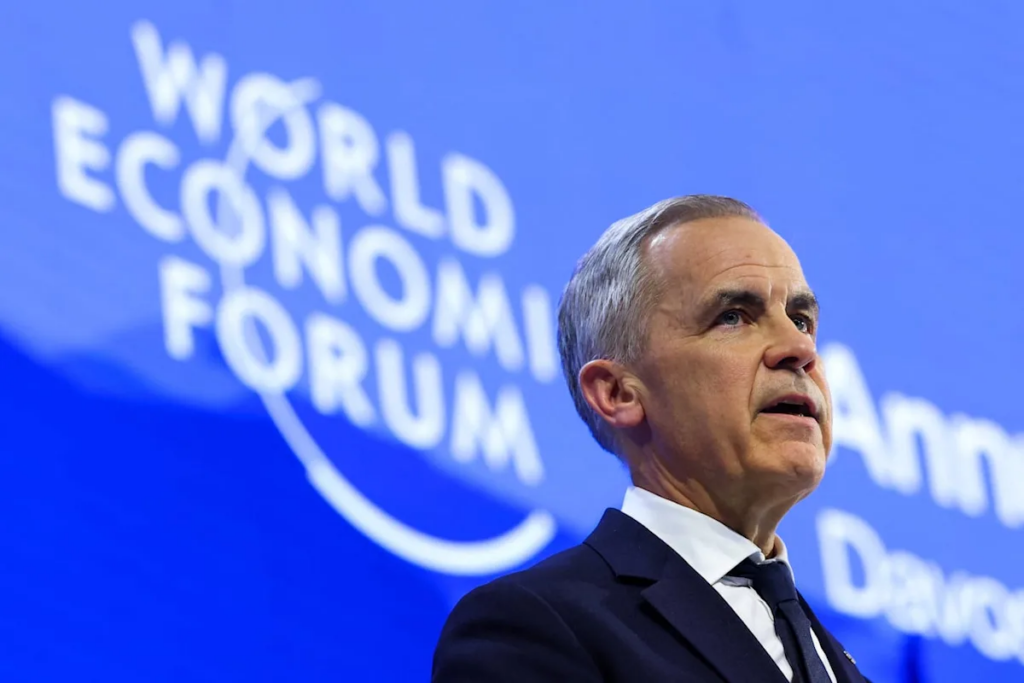
Canadian Prime Minister Mark Carney has emerged as one of 2026’s most consequential international voices after delivering a landmark speech at the World Economic Forum in Davos that declared the end of the rules-based international order while outlining a strategic vision for middle powers navigating great power rivalry. In an extraordinary moment rare for Davos gatherings, Carney received a standing ovation for his January 20 address titled “Principled and Pragmatic: Canada’s Path.” Days later, in a move that surprised observers, Carney announced he had accepted US President Donald Trump’s invitation to join the newly formed “Board of Peace” working toward Gaza resolution alongside controversial figures including Tony Blair, Jared Kushner, and World Bank President Ajay Banga.
The Davos Speech: ‘Living in Truth’
Speaking before global leaders at the Congress Hall in Davos-Klosters on January 20, Carney delivered what many observers described as the forum’s most impactful address. Drawing on Czech dissident Václav Havel’s 1978 essay “The Power of the Powerless,” Carney argued that the time for maintaining comfortable fictions about the international order has ended.
“It seems that every day we’re reminded that we live in an era of great power rivalry, that the rules based order is fading, that the strong can do what they can, and the weak must suffer what they must,” Carney began, invoking Thucydides’ ancient formulation while acknowledging its modern resonance.
The Canadian PM’s central thesis challenged middle powers to acknowledge reality while refusing to accept subordination: “We are in the midst of a rupture, not a transition. The rules-based international order as we knew it is over. But I also submit to you that other countries, particularly middle powers like Canada, are not powerless. They have the capacity to build a new order that embodies our values.”
| Topic | Quote | Significance |
| Rules-Based Order | “Stop invoking the ‘rules-based international order’ as though it still functions as advertised.” | Blunt acknowledgment of system breakdown |
| Great Powers vs Middle Powers | “Great powers can afford to go it alone. They have the market size, the military capacity, the leverage to dictate terms. Middle powers do not.” | Defining the strategic challenge |
| Sovereignty vs Subordination | “When we only negotiate bilaterally with a hegemon, we negotiate from weakness. This is not sovereignty. It is the performance of sovereignty while accepting subordination.” | Critique of bilateral-only approach |
| Coalition Strategy | “In a world of great power rivalry, the countries in between have a choice: to compete with each other for favour, or to combine to create a third path with impact.” | Call for middle power cooperation |
| Values in Realpolitik | “We take the world as it is, not as we wish it to be.” | Pragmatic approach to international relations |
Trump’s Immediate Response: ‘Canada Lives Because of the United States’
US President Donald Trump responded within 24 hours of Carney’s address, publicly rebuking the Canadian PM in characteristically blunt terms. Speaking to reporters on January 21, Trump said: “I watched your prime minister yesterday. He wasn’t so grateful. Canada lives because of the United States. Remember that, Mark, the next time you make your statements.”
Trump added: “Canada gets a lot of freebies from us. They should be more grateful instead of making speeches in Switzerland.” The President’s response highlighted the tension at the heart of Carney’s strategy: pursuing greater independence from the US while managing a relationship with an unpredictable and transactional American administration.
Rather than backing down, Carney doubled down on his message in a January 22 follow-up speech to his cabinet at the Citadelle in Quebec City. The location itself carried symbolism — the star-shaped fortress was built by the British army to fend off an American attack that never came, a reminder of Canada’s historical wariness of its southern neighbor.
The Board of Peace: Carney Joins Controversial Gaza Initiative
In what appeared to contradict his emphasis on values-based foreign policy, Carney announced on January 21 that he had accepted President Trump’s invitation to join the “Board of Peace” — a new initiative aimed at resolving the Gaza conflict and broader Israeli-Palestinian issues. The announcement came as a surprise to observers and drew immediate criticism from both left and right.
The Board of Peace brings together an eclectic mix of political, business, and diplomatic figures in what Trump described as “bringing the best deal-makers to solve the Middle East.” The composition reveals Trump’s transactional approach to diplomacy, combining political allies, business leaders, and figures with contested records on human rights and conflict resolution.
| Name | Current Position/Background | Role/Expertise | Controversies |
| Mark Carney | Prime Minister of Canada; Former Bank of England Governor | Economic development, international finance | Shift from human rights emphasis in rhetoric |
| Tony Blair | Former UK Prime Minister; Middle East Envoy | Peace process experience, regional relationships | Iraq War legacy; criticized for consulting work |
| Jared Kushner | Trump son-in-law; Former senior advisor | Abraham Accords architect, real estate development | Conflict of interest concerns; minimal diplomatic experience |
| Ajay Banga | World Bank President; Former Mastercard CEO | Economic reconstruction, development finance | Corporate background raises questions about priorities |
| Yvette Cooper | UK Home Secretary (Labour) | Security coordination, counter-terrorism | Labour participation in Trump initiative controversial domestically |
| Additional members expected | Regional leaders, business figures | Various | Full composition not yet revealed |
Criticism of the Board
The Board of Peace immediately drew skepticism from multiple directions. Palestinian advocates criticized it as lacking Palestinian representation in its initial composition, instead featuring figures they view as historically aligned with Israeli interests. Human rights organizations questioned the inclusion of individuals with controversial records on civilian protection and international law.
For Carney specifically, joining the board created apparent contradictions with his Davos rhetoric about values-based foreign policy and respect for international law. In his June 2025 remarks, Carney had compared Israel’s actions in Gaza to Russia’s invasion of Ukraine — a position that seemed at odds with participating in a Trump-led initiative that many view as unlikely to pressure Israel meaningfully.
When questioned about human rights concerns during his China visit, Carney’s response — “We take the world as it is, not as we wish it to be” — suggested a pragmatic shift from his earlier moral positioning, drawing criticism from those who expected consistency between rhetoric and action.
Canada’s Strategic Pivot: The China Breakthrough
Carney’s vision for middle power autonomy materialized dramatically through his January 2026 visit to China, where he met with President Xi Jinping and secured preliminary trade agreements that mark a significant shift in Canadian foreign policy. The agreements represent Carney’s strategy of diversifying Canada’s economic relationships to reduce vulnerability to US pressure.
The Canada-China trade deal includes:
Tariff Reductions: Canada committed to lowering tariffs on Chinese electric vehicles from 100% to 6.1%, while China agreed to reduce tariffs on Canadian canola oil from 85% to 15%.
Strategic Partnership: Both nations announced formation of a “new strategic partnership” covering trade, climate action, and artificial intelligence cooperation.
Energy and Technology: Memorandums of understanding on clean energy technology transfer and critical minerals supply chains.
| Initiative | Previous Policy | Carney Policy | Rationale |
| China Relations | Adversarial stance; aligned with US | Strategic partnership; major trade deal | Economic diversification from US |
| India Relations | Diplomatic crisis over allegations | Reset and pragmatic engagement | Commonwealth cooperation; clean energy |
| NATO Spending | Below 2% GDP; timeline flexible | Reach 2% by March 2026; 5% by 2035 | European partnerships; strategic autonomy |
| Palestinian Statehood | Supportive but delayed recognition | Will recognize at next UN General Assembly (July 2025 announcement) | Values-based foreign policy (claimed) |
| Energy Policy | Phase down oil production | Increase production with decarbonization commitment | Economic growth; Alberta partnership |
Domestic Response: Floor Crossings and Political Tensions
Carney’s international assertiveness has coincided with domestic political developments that strengthen his governing position. Since November 2025, four opposition MPs have crossed the floor to join the Liberals — two Conservatives and two New Democrats — bringing Carney within one seat of a parliamentary majority.
Conservative Leader Pierre Poilievre has accused Carney of “trying to manipulate his way through backroom deals to get that majority,” calling the defections “a problem of Mark Carney’s leadership.” However, Carney maintains MPs approached him voluntarily, attracted by his “brand of governing.”
Most recently, Ontario MP Michael Ma left the Conservatives in December 2025, stating that Carney offers the “steady, practical approach” Canada needs. The defections suggest Carney’s middle power strategy and technocratic appeal resonate with some politicians seeking alternatives to traditional party positioning.
The Quebec City Speech: Doubling Down
Carney’s January 22 follow-up address at the Citadelle in Quebec City, delivered to his cabinet during a two-day planning forum, reinforced the Davos message for a domestic audience. The speech emphasized Canada’s growing confidence and ambition on the world stage.
“We’re an increasingly confident nation that has ambition,” Carney declared. “So people want to deal with us now. That’s good for the economy, it’s good for jobs, it’s good for the future, it’s good for our independence from the United States. But it also brings an opportunity to help shape a world that is more dangerous, more divided.”
The Prime Minister framed Canada’s strategy as both pragmatic and principled: engaging with partners based on shared interests while maintaining independence of action. “I’m a politician, but I’m still a pragmatist,” he told reporters, defending his approach to critics who see contradictions between his rhetoric and relationships.
The CUSMA Review: High-Stakes Negotiations Ahead
Carney’s strategy of diversifying relationships gains urgency as the Canada-United States-Mexico Agreement (CUSMA) review approaches in July 2026. The Prime Minister insists Canada will not “rush into a bad deal,” expressing confidence that each week of delay strengthens Canada’s negotiating position as alternative relationships develop.
“Certainly a strategy is not to rush into a bad deal,” Carney told media in a year-end interview. “That’s what we’ve been very disciplined about. And every week that goes by, the more that we’re developing our economic strategy at home, the more we’re developing those relationships abroad, the stronger we get.”
This approach carries significant risks. Trump’s administration has shown willingness to use tariffs and economic pressure to extract concessions, and Canada’s economy remains deeply integrated with the United States. Whether Carney’s diversification strategy provides genuine alternatives or merely rhetorical positioning will be tested during CUSMA negotiations.
Bill C-5 and Domestic Reform
Carney’s government passed its first major legislation, Bill C-5 (the One Canadian Economy Act), with Conservative support in July 2025. The bill removes federal barriers to internal trade and expedites nation-building projects through Cabinet approval — a significant centralization of power that critics argue undermines provincial autonomy and Indigenous consultation.
The legislation reflects Carney’s technocratic approach: identifying perceived inefficiencies and pursuing rapid solutions, sometimes at the expense of traditional consultation processes. Indigenous advocacy groups opposed the bill, arguing it weakens their consultation rights on major projects.
Analysis: Carney’s High-Wire Act
Mark Carney’s first year as Prime Minister reveals a leader attempting to navigate multiple contradictions:
Values vs. Pragmatism: Carney’s rhetoric emphasizes human rights and international law, yet his relationships with China, participation in Trump’s Board of Peace, and oil production increases suggest pragmatism often trumps principles.
Independence vs. Integration: Pursuing diversification from the US while managing deep economic integration requires delicate balancing. Antagonizing Trump risks economic retaliation that alternative partnerships cannot quickly offset.
Middle Power Coalition vs. Bilateral Deals: While calling for middle powers to cooperate, much of Carney’s actual diplomacy involves bilateral negotiations with great powers (China, US), sometimes at cross-purposes with traditional allies.
Domestic Consensus vs. Controversial Choices: Floor crossings suggest growing support, but joining Trump’s Board of Peace and embracing China alienate portions of Carney’s political base and traditional Liberal constituencies.
| Category | Achievement | Challenge | Grade |
| Economic Management | Diversification strategy launched; China deal | Still deeply dependent on US; growth moderate | B+ |
| International Profile | Global attention; Davos standing ovation | Trump antagonism; unclear if influence translates | A- |
| Domestic Politics | Near-majority through defections | NDP weak; Poilievre remains threat | B |
| Climate Policy | International commitments maintained | Oil production increase contradicts rhetoric | C+ |
| Defense Policy | NATO commitments accelerated to 2% | 5% by 2035 target highly ambitious | B+ |
| Values Consistency | Palestinian recognition promised | China relationship; Board of Peace; oil expansion | C |
International Reception: Mixed Reviews
Carney’s Davos performance resonated strongly with middle power leaders facing similar dilemmas. Australian, South Korean, and various European officials privately praised his articulation of their shared challenge. The standing ovation at Davos — rare for the typically reserved forum — suggested his message struck a chord among global elites.
However, reactions from great powers proved predictably negative. Trump’s public rebuke made clear American expectations of Canadian deference. Chinese state media praised Carney’s “pragmatism” while noting Canada remains a “junior partner” in any relationship. Russian commentators mockingly welcomed Canada to the “realistic” camp of nations acknowledging American hegemony’s end.
Looking Ahead: Critical Tests Await
Several upcoming events will test whether Carney’s strategy delivers substantive results or remains largely rhetorical:
CUSMA Review (July 2026): The negotiation will reveal whether diversification provides real leverage or if Canada remains ultimately dependent on US goodwill.
Board of Peace Outcomes: If the Gaza initiative produces meaningful progress, Carney’s participation will be vindicated. If it becomes a fig leaf for continued conflict, his involvement will be criticized.
China Relationship Development: Whether the trade deal translates into broader strategic cooperation or remains limited to commercial transactions will indicate the partnership’s depth.
NATO Spending Trajectory: Actually reaching 2% by March 2026 would demonstrate commitment; failure would confirm skeptics’ view that Carney over-promises.
Conclusion: A Leader Defining a New Era or Caught Between Powers?
Mark Carney’s emergence as an international voice articulating middle power strategy represents either visionary leadership or wishful thinking, depending on one’s perspective. His Davos speech captured a moment when many nations feel caught between great powers, searching for autonomy without isolation.
The contradictions in Carney’s approach reflect genuine dilemmas facing middle powers: How to maintain values while pursuing interests? How to diversify relationships without antagonizing essential partners? How to project strength from positions of relative weakness?
Trump’s dismissive response — “Canada lives because of the United States” — captures the hard reality Carney confronts. Geographic proximity, economic integration, and security dependence mean Canada cannot fully escape American influence, no matter how many speeches receive standing ovations in Switzerland.
Yet Carney’s willingness to articulate an alternative vision, pursue relationships previously considered politically impossible, and publicly challenge assumptions about Canada’s role marks a departure from traditional Canadian caution. Whether his pragmatic idealism creates genuine strategic space or merely generates friction without fundamentally altering power dynamics will define his prime ministership.
As Carney told his cabinet in Quebec City: “We’re in a stronger position than we were nine months ago and at the start of this year, but we’ve got to keep going. And we will keep going.” The world will watch whether momentum translates into meaningful independence or whether middle powers remain ultimately subject to great power dictates, regardless of how eloquently they articulate alternatives.