Green Party Wins Historic First By-Election – Is UK Two-Party Politics Collapsing in 2026?
On the evening of February 27 2026, Hannah Spencer of the Green Party stood at a podium in Manchester and became the answer to a question that had been asked for decades: can a minor party actually win a Westminster by-election?
Spencer took 40.7% of the vote in Gorton and Denton – a constituency that Labour had dominated since the 1930s. At the 2024 general election, just eighteen months earlier, Labour won the seat with 51% of the vote. The swing was not a crack in the dam. It was the dam breaking.
The result was the Green Party’s first ever by-election victory. It was also the latest – and perhaps most significant – evidence that Britain’s traditional two-party system is fracturing along multiple lines simultaneously. Reform UK is eating into Conservative support from the right. The Greens are consuming Labour from the left. And both main parties appear unable to stop it.
Thinking of putting money where your mouth is on politics? These trusted bookmakers offer odds on political events worldwide:

BetPortal
- Lucky Friday: 50% Friday Reload Bonus
- Wild Wednesday: 250 Free Spins
- Riskfree Weekend: 10% Cashback

Amunbet
- Lucky Amun Monday: 50% up to £450
- First Deposit Highroller Bonus: 250% up to £4,500 + 250 FS
- Pharaoh’s Wins Weekend: Up to £450

Fortunica
- 5,000+ games from 40+ providers
- Fast payouts available via Visa and Mastercard, e-wallets (PayPal, Skrill, Neteller), bank transfers, and cryptocurrencies

VegasNova
- Promo Code - WELCOME200
- Sports Welcome Bonus - 150% up to €200–$200

Highspin
- Tuesday Reload Bonus 50% Up To £250
- Secial Bonus - HIGHSPIN LOTTERY
- Weekly Cashback - Every Monday Up To £500

West Ace
- Crypto Casino Bonus - 200% up to 3,000 USDT
- Crypto Sports Bonus - 100% up to 200 USDT






The Numbers Behind the Collapse
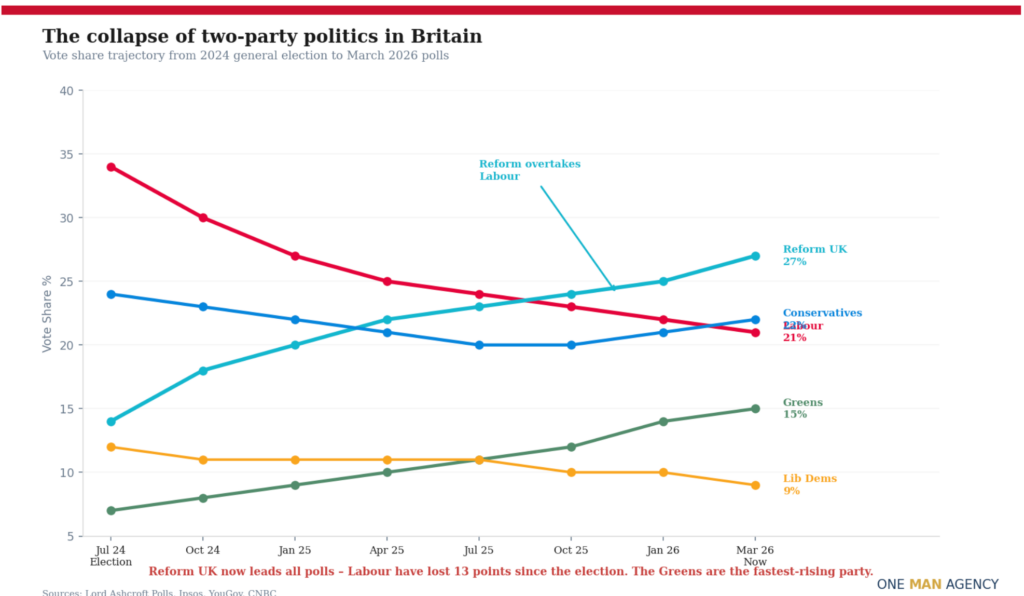
The trajectory is striking. In July 2024 Labour won the general election with approximately 34% of the national vote – the lowest share for a winning party in modern British history. By March 2026, polling aggregates put Labour at roughly 21%. That is a 13-point drop in eighteen months while in government.
Reform UK has risen from 14% at the election to approximately 27% in current polls – now the leading party nationally. The Greens have doubled from 7% to around 15%. The Conservatives have held roughly steady at 22%, though that stability masks a party whose base is being eroded from the right.
The Gorton result was not an anomaly. It was the visible expression of trends that have been building for months. Lord Ashcroft’s polling shows that only 37% of voters are now prepared to back Labour as either their first choice or tactical alternative. Among Green voters, just 72% would consider voting Labour even to prevent a Conservative or Reform government. Green supporters prefer both Nigel Farage and Kemi Badenoch to Keir Starmer – a remarkable finding that reflects deep disillusionment rather than ideological alignment.
Why Gorton Matters More Than a Single Seat
By-elections are imperfect indicators of national trends. Turnout is lower, protest votes are easier and local factors can distort the picture. But Gorton and Denton is significant for three reasons.
First, it was a Labour heartland seat – not a marginal. Losing a marginal to the Greens would be concerning. Losing a seat held for nearly a century is a crisis.
Second, the Green candidate won outright with a substantial margin. This was not a three-way split where the Greens squeezed through. Spencer dominated the field.
Third, the result came during the Mandelson scandal – a reminder that political crises have tangible electoral consequences. Voters in Gorton cited disillusionment with Labour’s handling of the affair as a factor in their choice.
The Three-Way Squeeze
Professor John Curtice of Strathclyde University captured the dynamics precisely: “We are getting an unprecedented challenge by Reform, as it were from the right, challenging the Conservative party. And now, the Greens apparently now serious competitors with Labour for voters on the left.”
This creates a structural problem for both major parties that cannot be solved by messaging or leadership changes alone. The issues driving voters to Reform – immigration, cultural identity, anti-establishment sentiment – are fundamentally different from those driving voters to the Greens – climate, social justice, disillusionment with centrist politics. Neither Labour nor the Conservatives can simultaneously address both flanks without alienating their own base.
The May 2026 local elections across England, Scotland and Wales will test whether the fragmentation continues. Labour fears a devastating night. The Conservatives fear the same from the Reform direction. Both fears may be justified.
What Comes Next for British Democracy
If current polling holds, no single party would win a majority at the next general election. Britain would face coalition government for the first time since 2015 – and potentially a much more complex arrangement involving three or four parties.
Lord Ashcroft’s research suggests the public is not inherently opposed to coalition government. When asked whether they would prefer a Conservative-Reform coalition or a Labour-Liberal Democrat-Green coalition, voters split roughly evenly. But the internal contradictions within each potential coalition are enormous. Labour and the Greens disagree on defence, immigration and economic policy. Conservatives and Reform disagree on institutions, trade and the NHS.
The two-party system served Britain for most of the twentieth century. Whether it survives the 2020s is now a genuine question.
Frequently Asked Questions
Did the Green Party win a by-election in 2026? Yes. Hannah Spencer won the Gorton and Denton by-election on February 27 2026 with 40.7% of the vote – the Green Party’s first ever by-election victory at Westminster.
Is Reform UK leading in the polls? Yes. As of March 2026, Reform UK leads most national polls at approximately 27%, ahead of Labour on roughly 21% and the Conservatives on around 22%.
When are the next UK elections? Local elections take place across England, Scotland and Wales in May 2026. These will be the first major electoral test since the Gorton by-election result.