Hungary’s Election Observers Are Fighting Each Other – and Orbán’s Team Is Winning That Battle Too
The Hungarian general election on April 12 is ten days away, and the fight over who gets to watch it is already uglier than anything on the ballot. Viktor Orbán is facing the hardest political battle of his sixteen years in power. His opponents say he enters it with rigged maps, state-controlled media, and cash payments to voters. Now they can add one more structural advantage: a rival observation team, built by his own allies, designed to produce a competing version of events on election night.

BetPortal
- Lucky Friday: 50% Friday Reload Bonus
- Wild Wednesday: 250 Free Spins
- Riskfree Weekend: 10% Cashback

Amunbet
- Lucky Amun Monday: 50% up to £450
- First Deposit Highroller Bonus: 250% up to £4,500 + 250 FS
- Pharaoh’s Wins Weekend: Up to £450

Fortunica
- 5,000+ games from 40+ providers
- Fast payouts available via Visa and Mastercard, e-wallets (PayPal, Skrill, Neteller), bank transfers, and cryptocurrencies

VegasNova
- Promo Code - WELCOME200
- Sports Welcome Bonus - 150% up to €200–$200

West Ace
- Crypto Casino Bonus - 200% up to 3,000 USDT
- Crypto Sports Bonus - 100% up to 200 USDT

Highspin
- Tuesday Reload Bonus 50% Up To £250
- Secial Bonus - HIGHSPIN LOTTERY
- Weekly Cashback - Every Monday Up To £500






The Organisation for Security and Co-operation in Europe has been sending OSCE election observers into more than thirty countries for four decades. In Hungary it has issued reports alleging the vote is “undermined by the absence of a level playing field” at three consecutive elections. Orbán’s government has never found those reports flattering. This year his conservative allies found something better than arguing with the results: they created their own mission.
The problem that gave them the opening was real. Hungarian journalists and rights groups identified Daria Boyarskaya, a senior adviser at the OSCE parliamentary assembly coordinating election monitoring for the April vote, as a former employee of the Russian foreign ministry who had worked as an interpreter at meetings involving Vladimir Putin. In a country where Orbán holds the title of the EU leader closest to the Kremlin, this landed badly.
The OSCE defended her. Spokesperson Nat Parry said Boyarskaya had never served as Putin’s personal interpreter and had carried out standard professional duties assigned to foreign ministry employees. Civil society groups including the Hungarian Helsinki Committee and Transparency International Hungary were not persuaded. Transparency International announced a boycott of the OSCE parliamentary assembly’s mission entirely.
Orbán’s allies moved into the gap. Conservative groups with ties to Fidesz announced their own observation team, with their own criteria and their own conclusions ready to deliver when the polls close. Election observer Péter Kramer, who has worked OSCE missions in multiple countries and is training monitors for this year’s Viktor Orbán election, described the result plainly: “If there are pro-government missions deployed, the outcome could be a clash of narratives that would cloud the result of the election.”
The concern is not that the competing mission will change votes. It is that it will change the story after the votes are counted. In a Hungary vote fraud dispute, what matters is not only what happened but which account reaches international audiences first. Orbán has governed for sixteen years with exactly this understanding of how information moves.
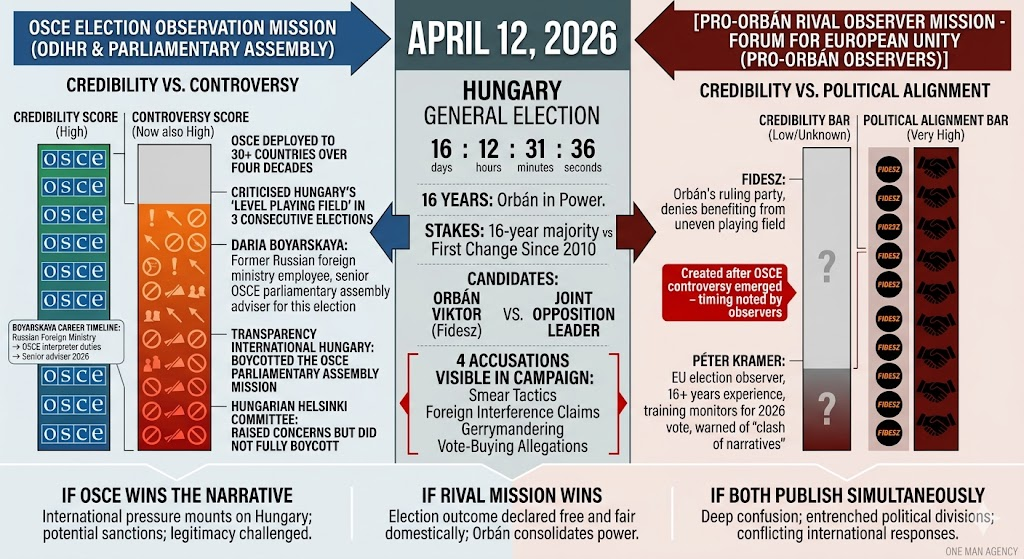
His party, Fidesz, denies it benefits from an uneven playing field. The campaign has featured accusations from both sides of foreign interference, smear operations, and deliberate confusion about who is funding what. The opposition entered the race arguing Orbán holds structural advantages that make a fair fight impossible. He entered it knowing that even if he loses, the apparatus exists to dispute the result.
Whether the OSCE Hungary 2026 mission can deliver a credible verdict through all of that noise is the actual question hanging over April 12. The answer depends partly on Boyarskaya, partly on which observation accounts reach international audiences first, and partly on whether a sixteen-year incumbent who has spent those years rewriting the rules will accept a result he did not produce.