Trump’s Tariff Revolution: How “One Big Beautiful Bill” Could Reshape Global Trade
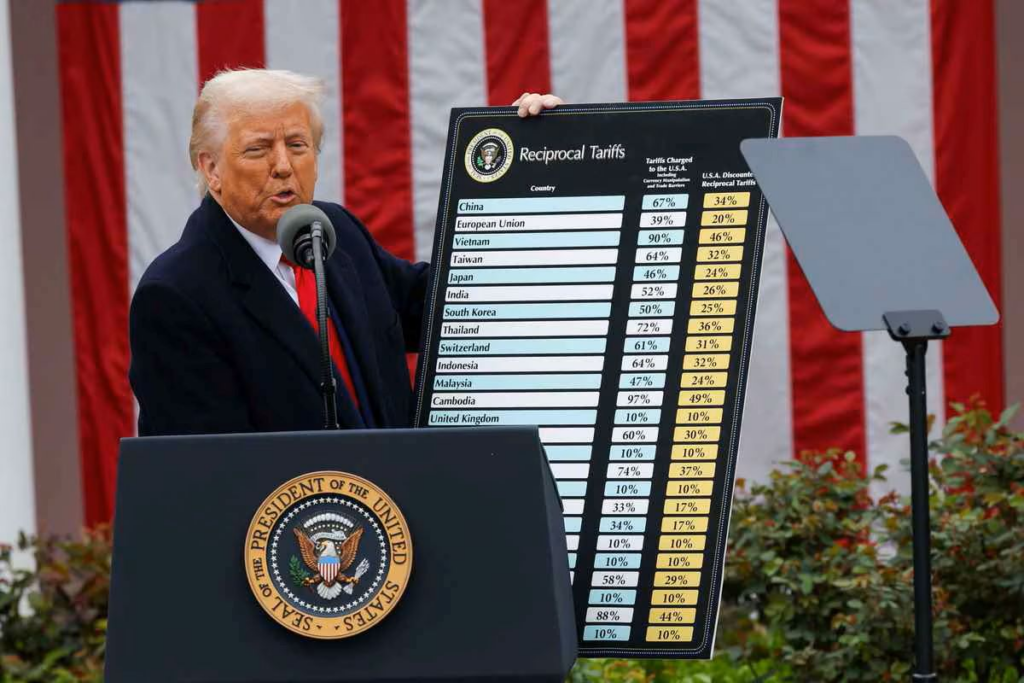
President Donald Trump’s trade policy agenda has emerged as one of the defining economic issues of his second term, with his proposed “One Big Beautiful Bill Act” promising to fundamentally restructure America’s trade relationships and potentially trigger the most significant realignment of global commerce since the post-World War II Bretton Woods system. As markets digest the implications of Trump’s tariff-centric approach, economists, business leaders, and foreign governments are scrambling to understand how these policies will affect supply chains, consumer prices, international relations, and economic growth.
The “One Big Beautiful Bill” represents an ambitious consolidation of Trump’s trade agenda into a single piece of legislation currently working its way through Congress. The bill encompasses broad authority for the president to impose tariffs on imports from virtually any country, expansive definitions of “national security” that could justify trade restrictions, incentives for reshoring manufacturing operations to the United States, and significant penalties for countries that impose retaliatory tariffs on American goods.
Proposed Tariff Structure
| Country/Region | Current Average Tariff | Proposed Tariff | Sectors Most Affected | Estimated Revenue (Annual) |
| China | 19.3% | 60% | Electronics, machinery, textiles | $187 billion |
| European Union | 3.1% | 10% | Automotive, pharmaceuticals, luxury goods | $43 billion |
| Mexico | 0% (USMCA) | 10% | Automotive parts, agriculture, electronics | $39 billion |
| Canada | 0% (USMCA) | 10% | Lumber, energy, automotive | $27 billion |
| Japan | 2.5% | 10% | Automotive, electronics, machinery | $18 billion |
| South Korea | 2.7% | 10% | Electronics, automotive, steel | $15 billion |
| Vietnam | 12.4% | 25% | Textiles, electronics, footwear | $22 billion |
| India | 5.6% | 10% | Pharmaceuticals, textiles, IT services | $12 billion |
The scale of these proposed increases represents the most dramatic shift in US trade policy since the Smoot-Hawley Tariff Act of 1930—a comparison that troubles many economists who view that Depression-era legislation as having worsened rather than ameliorated economic conditions. Trump administration officials counter that the current global trading system has systematically disadvantaged American workers and manufacturers, necessitating corrective action regardless of historical precedents or theoretical economic models.
Economic Rationale and Historical Context
Trump’s enthusiasm for tariffs stems from his view—consistently held over decades—that trade deficits represent American economic weakness and that foreign countries have systematically exploited US openness to flood American markets with cheap goods while protecting their own domestic industries. In Trump’s formulation, tariffs serve multiple purposes: raising government revenue, protecting domestic industries, incentivizing reshoring of manufacturing, and providing leverage in trade negotiations.
“Tariff is the most beautiful word in the dictionary,” Trump stated during a recent campaign event, encapsulating his conviction that import duties represent a simple, powerful tool for advancing American economic interests. This perspective contrasts sharply with the free trade consensus that dominated both Republican and Democratic economic thinking from the 1990s through the mid-2010s, which held that reducing trade barriers maximized overall economic efficiency and consumer welfare.
| Historical US Tariff Era | Average Tariff Rate | Economic Context |
| 1790-1815 | 12.5% | Early Republic revenue generation |
| 1816-1860 | 23% | “American System” protectionism |
| 1861-1934 | 25-50% | Civil War through Great Depression |
| 1935-1970 | 10-15% (declining) | Post-Smoot-Hawley reduction |
| 1971-2016 | 5% (avg) | Bretton Woods era free trade |
| 2017-2025 | 8% (avg) | Trump’s first term increases |
| 2026 (proposed) | 15-20% | “One Big Beautiful Bill” implementation |
The proposed tariff levels would return the United States to trade barrier rates not seen since before World War II, representing a fundamental rejection of seven decades of trade liberalization policy pursued by administrations of both political parties.
Business Community Response
Reaction from the American business community has been decidedly mixed, with sharp divisions emerging based on sector, company size, and supply chain structure. Manufacturing industries competing with imports—particularly steel, aluminum, textile, and certain electronics producers—have generally welcomed the tariff proposals as providing protection from what they characterize as unfair foreign competition.
The American Iron and Steel Institute praised the administration’s focus on “leveling the playing field,” with President Kevin Dempsey stating, “For too long, American steel producers have competed against foreign state-subsidized industries dumping product below cost in our markets. These tariffs will restore market discipline and protect American jobs.”
However, industries reliant on imported components or those concerned about retaliatory tariffs have expressed deep reservations. The National Retail Federation, representing major retailers including Walmart, Target, and Best Buy, released analysis suggesting that the proposed tariffs would increase consumer prices by $1,200-$1,900 annually for a typical American household. The Auto Alliance, representing major automotive manufacturers, warned that tariffs on imported components could increase vehicle prices by $3,000-$5,000 per unit, potentially pricing millions of Americans out of new car purchases.
Supply Chain Disruption Analysis
Perhaps the most significant concern regarding the proposed tariff regime involves potential disruption to highly integrated global supply chains that have developed over decades. Modern manufacturing increasingly relies on complex networks spanning multiple countries, with components crossing borders multiple times during production processes.
| Industry | Supply Chain Complexity (Avg Border Crossings) | Potential Cost Increase | Reshoring Timeline |
| Automotive | 7-8 border crossings | 12-18% | 5-8 years |
| Consumer Electronics | 5-6 border crossings | 15-22% | 7-10 years |
| Pharmaceuticals | 4-5 border crossings | 8-12% | 4-7 years |
| Apparel & Textiles | 3-4 border crossings | 20-30% | 3-5 years |
| Machinery & Equipment | 6-7 border crossings | 10-15% | 5-7 years |
The automotive industry provides a particularly instructive example of supply chain complexity. A typical vehicle assembled in the United States contains components sourced from Mexico, Canada, South Korea, Japan, and multiple European countries. Engine components might be manufactured in Japan, shipped to Mexico for assembly into complete engines, returned to the United States for installation into vehicles, and then exported to global markets. Each border crossing under the new tariff regime would add costs that accumulate throughout the production process.
Apple CEO Tim Cook has repeatedly met with Trump administration officials to discuss concerns about tariffs on electronics imported from China, where most iPhones, iPads, and Mac computers are assembled. While Apple has initiated efforts to diversify production to Vietnam and India, the company acknowledges that fully transitioning away from Chinese manufacturing would require many years and billions of dollars in investment. In the interim, tariffs would either reduce Apple’s profit margins or force price increases that could reduce sales.
Estimated Economic Impact
Economic modeling of the proposed tariff package reveals widely divergent predictions depending on methodological assumptions and response variables. Administration officials, citing analysis from trade hawks at the Coalition for a Prosperous America, project that the tariffs will generate $400 billion annually in new government revenue, create 2-3 million manufacturing jobs over five years, and strengthen national security by reducing dependence on adversarial nations for critical goods.
| Economic Metric | Trump Administration Projection | Independent Economist Projection | Congressional Budget Office Estimate |
| Annual Revenue | $400 billion | $280-320 billion | $295 billion |
| Manufacturing Jobs Created | 2-3 million | 300,000-500,000 | 425,000 |
| Job Losses (Other Sectors) | Minimal | 800,000-1.2 million | 950,000 |
| GDP Impact (% Change) | +0.5% to +1.0% | -0.3% to -0.8% | -0.4% |
| Consumer Price Increase | <1% | 2.5-3.5% | 2.8% |
| Retaliatory Tariff Impact | Manageable | Significant | Moderate to Significant |
Independent economists at institutions including the Peterson Institute for International Economics, Brookings Institution, and Tax Foundation have produced more pessimistic assessments. These analyses suggest that while tariffs would indeed generate substantial government revenue and potentially create some manufacturing jobs, they would simultaneously increase consumer prices, reduce purchasing power, trigger job losses in retail and service sectors, and potentially provoke retaliatory tariffs that harm American exporters.
The Peterson Institute estimates that the net effect would be a reduction in US GDP of 0.3-0.8% compared to baseline projections—equivalent to $75-200 billion in lost economic output annually. Their analysis incorporates several factors often overlooked in simpler models: reduced productivity from less efficient domestic production replacing more efficient foreign production, deadweight losses from distorted resource allocation, reduced competition leading to higher domestic prices even beyond tariff effects, and negative impacts on industries dependent on exports as trading partners retaliate.
International Response and Retaliation Risk
Foreign governments have begun preparing responses to potential US tariff increases, with the European Union, China, Mexico, and Canada all developing retaliatory measures that would target politically sensitive American exports. These countries learned from Trump’s first-term trade wars that strategic retaliation focusing on exports from politically competitive states can create domestic pressure for trade deal negotiations.
| Country/Region | Proposed Retaliatory Targets | Economic Impact on US | Political Impact |
| European Union | Agricultural products, bourbon, motorcycles, steel | $22-30 billion annually | Targets swing states (WI, KY, PA) |
| China | Soybeans, aircraft, automobiles, semiconductors | $40-55 billion annually | Impacts major exporters across US |
| Mexico | Corn, pork, dairy products, machinery | $18-24 billion annually | Targets farm states (IA, NE, MN) |
| Canada | Various agricultural, forest products | $12-16 billion annually | Impacts border states |
| Japan | Agricultural products, automotive | $8-11 billion annually | Impacts specific sectors |
China, as America’s largest trading partner and primary tariff target, has both the most to lose from US tariffs and the greatest capacity to respond with economically and politically damaging countermeasures. Chinese officials have indicated that retaliatory tariffs would focus on American agricultural exports—soybeans, pork, corn, and wheat particularly—as well as Boeing aircraft, heavy machinery, and semiconductors.
The agricultural sector represents a particularly vulnerable target for retaliation. American farmers heavily depend on exports to absorb production that exceeds domestic consumption. China alone purchases approximately $20-24 billion in US agricultural products annually, making it an indispensable market for maintaining farm profitability. During Trump’s first term, farm bankruptcies increased significantly as retaliatory Chinese tariffs devastated soybean and pork markets, forcing the administration to provide $28 billion in emergency agricultural subsidies over two years.
American agricultural groups have expressed alarm about the potential for history repeating itself. The American Soybean Association, National Pork Producers Council, and National Corn Growers Association have all warned that another trade war could prove financially devastating, potentially triggering a wave of farm bankruptcies and rural economic collapse that would require tens of billions in government assistance.
Legislative Path and Political Dynamics
The “One Big Beautiful Bill” faces a complex path through Congress, with Republicans holding narrow majorities in both chambers but featuring internal divisions on trade policy that could complicate passage. Traditional Republican free-trade advocates, particularly senators from agricultural states concerned about export markets, have expressed reservations about blanket tariff increases. However, populist Republicans elected in Trump-aligned districts generally support the protectionist turn.
Senate Majority Leader John Thune (R-SD) has acknowledged the challenge of uniting Republican caucuses around the legislation: “There’s no question we have members with different perspectives on trade policy, reflecting different economic realities in their states. Our job is finding common ground that advances American interests.” Translation: agriculture-dependent states worry about retaliation, while manufacturing states support protection.
Democratic opposition is equally complex. The party’s free-trade wing, concentrated among representatives from urban and suburban districts with service-based economies, opposes tariffs as economically counterproductive and harmful to consumers. However, Democrats from industrial Midwest districts—representing constituencies that Trump carried in his electoral victories—face political pressure to support manufacturing protection, creating potential for crossover votes.
Federal Reserve Response Expectations
Federal Reserve officials have carefully monitored trade policy developments, recognizing that significant tariff increases could complicate their inflation-fighting mandate. If tariffs substantially increase import prices, the Fed may face the difficult choice between tightening monetary policy to combat inflation (risking recession) or accepting higher inflation to support growth and employment.
Fed Chair Jerome Powell addressed these concerns obliquely in recent testimony: “Trade policy represents one of several factors we monitor as we calibrate monetary policy to achieve our dual mandate of maximum employment and price stability. Significant changes to the trading regime would certainly factor into our economic forecasts and policy deliberations.” This carefully worded statement suggests the Fed would likely offset some inflationary pressure from tariffs through tighter monetary policy, potentially raising interest rates or slowing balance sheet reduction.
Long-Term Structural Implications
Beyond immediate economic effects, Trump’s tariff agenda could reshape global economic structures for decades. Several potential long-term outcomes deserve consideration:
Accelerated decoupling of the American and Chinese economies, with supply chains fundamentally reorganizing around geopolitical rather than pure efficiency considerations. This “friend-shoring” approach prioritizes reliable allies over lowest-cost producers.
Regional trade bloc formation as other countries respond to US protectionism by strengthening alternative trading arrangements. The Regional Comprehensive Economic Partnership (RCEP) in Asia, led by China, and European-Asian trade corridors could gain significance.
Reshoring and near-shoring of manufacturing operations to the United States or nearby allied countries (particularly Mexico under USMCA provisions), potentially creating manufacturing jobs but at the cost of higher consumer prices and reduced overall economic efficiency.
Inflationary pressure becoming structurally embedded as efficient foreign production is replaced by more expensive domestic alternatives, reducing real incomes and purchasing power for American households.
National security benefits from reduced dependence on potential adversaries for critical goods, though at significant economic cost and with uncertain security benefits depending on execution.
As Trump’s tariff revolution moves from proposal to implementation, the profound uncertainties and risks involved ensure that global trade policy will remain among the most consequential and controversial aspects of his second presidency. Whether history will judge this experiment as visionary correction of an unbalanced trading system or as economically damaging protectionism likely depends on outcomes that won’t be clear for years—long after the political debates have moved to other issues.