Kaleb from Harvard: The 22-Year-Old Explainer Who Gets More Views Than CNN
There is a specific type of political content that has quietly become the most watched format in America over the past two years, and Kaleb Robertson — known online as Kaleb from Harvard — essentially invented the modern version of it. He takes a document that no ordinary person would read. A two-thousand-page federal budget. A bill written in legislative language designed to be incomprehensible to anyone without a law degree. A foreign policy decision buried in a State Department memo. He sits in front of a camera in a regular t-shirt, not a suit, and explains what it actually says in sixty seconds or less, in language that a high school student could follow.
The numbers that have resulted from this approach are difficult to reconcile with the fact that Wikipedia has no page for him. His videos have been cited in congressional debates. The White House has invited him to press briefings. His TikTok following runs into millions of accounts, and his reach on any given news day comfortably exceeds the audience of legacy cable networks covering the same story. Yet search his name in Wikipedia in 2026 and you find nothing — because the platform’s editorial process categorises him as a blogger rather than a public figure of sufficient note.
This article is the biography that the gap demands.
| Kaleb Robertson — Profile Summary | Details |
| Full Name | Kaleb Robertson |
| Known As | Kaleb from Harvard |
| Age (2026) | Approximately 22–23 (born approx. 2003–2004) |
| Hometown | Ohio (middle-class background, frequently referenced) |
| University | Harvard University |
| Major | Government / Political Science |
| Expected Graduation | Class of 2026 |
| Main Platform | TikTok: @kalebfromharvard |
| Also active on | X: @kaleb_robertson / Instagram |
| Wikipedia | No dedicated page as of 2026 |
| Political alignment | Publicly non-partisan, accused of centre-left lean by critics |
The Ohio Kid at Harvard
Kaleb Robertson was born around 2003 or 2004 in Ohio, which makes him one of the younger prominent voices in American political commentary in 2026. He grew up in what he describes as a middle-class household in a state that sits at the geographic and political centre of American electoral politics — Ohio has voted for the winning presidential candidate in most modern elections, and growing up there gave Robertson an instinct for political communication that reaches across the usual partisan divide.
He was admitted to Harvard University, where he enrolled in the Government faculty to study political science, a degree program that at Harvard includes courses in international relations, American politics, constitutional law, and public policy. His expected graduation date places him in the class of 2026, meaning that as his online following was reaching its peak audience, he was simultaneously finishing one of the most academically demanding undergraduate programmes in the world.
The combination is part of what makes him interesting to his audience and uncomfortable for his critics. He is simultaneously the Harvard student — which carries all the connotations of elite access and institutional credibility — and the guy from Ohio in a t-shirt who talks about politics the way you would explain it to a friend. He has been deliberate about maintaining both identities rather than choosing between them, and the tension between them is visible in how different audiences receive him.
The Format That Built the Following
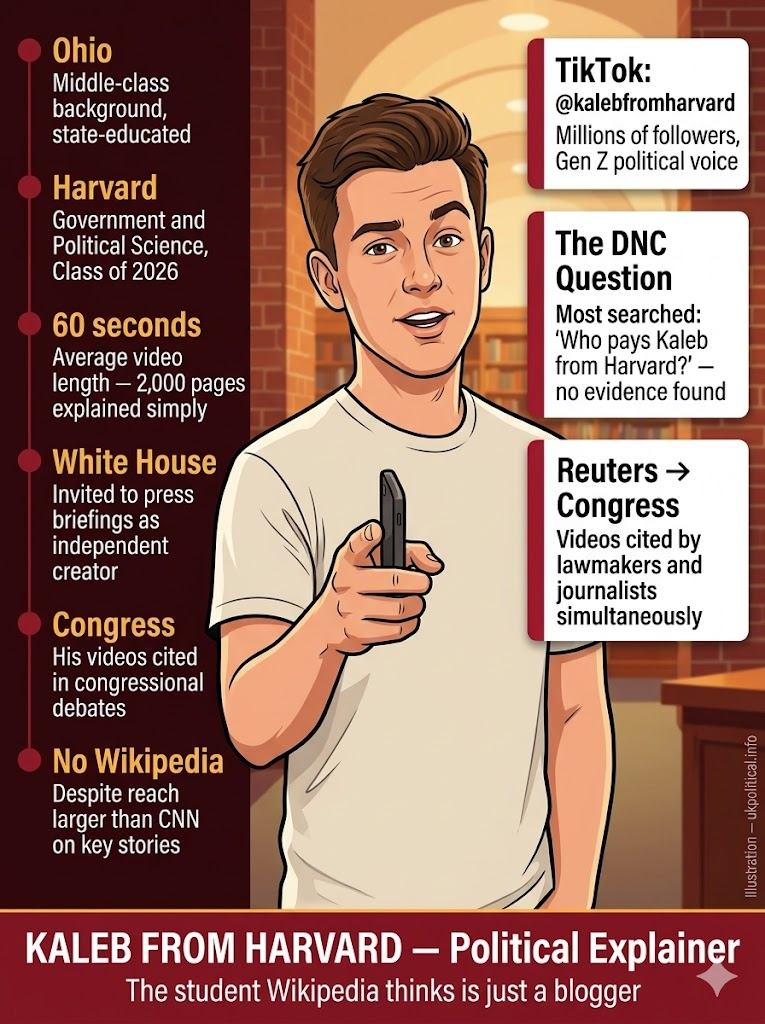
Robertson’s method is precise and consistent. He identifies a political document, policy decision, or news event that is being discussed in complex or misleading terms by mainstream coverage. He reads the primary source material himself. He then films a short video — typically between forty-five seconds and two minutes — in which he explains what the document actually says, what politicians are claiming it says, and where the two differ.
He does this without a script in the traditional sense, speaking directly to camera with enough fluency that the videos feel conversational rather than rehearsed, but with enough structure that viewers can follow the argument. The format scales across platforms: the full version goes on TikTok, clips go to Instagram, and extended responses to pushback go on X where he engages directly with politicians, journalists, and critics who challenge his interpretations.
The audience this format reached is genuinely unusual. Robertson’s viewership is not a single demographic. His comments sections include people who identify as conservative and people who identify as progressive, united by the specific appeal of watching someone explain what a law actually says rather than what a party wants you to believe it says. Whether Robertson always succeeds in that neutrality is contested, but the attempt is central to the brand.
| Kaleb from Harvard — Fact vs Rumour | |
| Claim | What the Evidence Shows |
| “He is paid by the Democratic Party” | No evidence. No documented funding relationship exists. Robertson has denied it. |
| “He is a White House plant” | He has attended White House briefings — as have many journalists and influencers. Attending a briefing is not evidence of employment or coordination. |
| “His Harvard degree is fake or unfinished” | He is enrolled at Harvard, class of 2026. The university has not disputed his enrolment. |
| “He only covers stories that help Democrats” | He has covered stories unfavourably for both parties. Critics from the left have also accused him of insufficient progressivism. |
| “He is secretly wealthy / has elite backers” | His income sources are typical for a creator at his level — platform revenue, sponsorships, and speaking fees. No hidden backers have been identified. |
| “His content is too simplified to be accurate” | Some critics argue he oversimplifies. Others, including academics and journalists, have cited his summaries approvingly. The accuracy of specific videos is debated on their individual merits. |
The Controversy That Generates the Most Searches
The single most searched question about Kaleb Robertson in 2026 is some version of “who is paying him.” The accusation that he is a covert project of the Democratic National Committee or some adjacent organisation has circulated since his following first grew to significant size, and it generates more search traffic than any other aspect of his biography.
The accusation has no documented basis. There is no financial disclosure, no leaked correspondence, no whistleblower account, and no investigative report from any outlet — left, right, or centre — that has identified a funding relationship between Robertson and the Democratic Party or any political organisation. Robertson has addressed the accusation directly in multiple videos and interviews, stating that he is an independent creator whose income comes from platform monetisation and partnerships.
The durability of the accusation despite the absence of evidence reflects something specific about the moment in American political media. An articulate young person who explains political information in a way that is perceived as favouring one party — even without intending to — will attract the assumption that the favouring is deliberate and paid for, because that is what audiences now expect from political media. Robertson’s case is notable precisely because the accusation has outlasted every attempt to substantiate it.
The Harvard Protests (2024–2025)
During the student protest movements at Harvard in 2024 and 2025, which centred on the university’s investments and its position on the conflict in Gaza, Robertson occupied an unusual position. He covered the protests as a journalist and commentator rather than participating in them as a student. He reported on what was happening, explained the arguments on different sides, and declined to take a public position on the political demands of the protesters.
This made him unpopular with both camps simultaneously. Students involved in the protests criticised him for what they characterised as false neutrality — that covering a moral issue as if it had two equally valid sides was itself a political choice. Conservative commentators criticised him for giving attention and perceived legitimacy to protest movements they opposed. Robertson navigated both sets of criticism without significantly changing his approach, which is itself a data point about his editorial instincts.
What People Search For
The searches around Robertson follow the standard pattern for public figures without a Wikipedia biography. His real name — Kaleb Robertson, which he has used publicly and which appears in various platform registrations — is searched because “Kaleb from Harvard” is a personal brand rather than a legal name, and viewers want to know the person behind the handle.
His age is searched because he appears young even by the standards of a generation of young political commentators, and the combination of his Harvard affiliation and his online reach makes people question whether he could actually be as young as he appears. The answer is yes — he was born around 2003 or 2004, making him genuinely 22 or 23 in 2026.
His parents are searched by people looking for evidence of the elite background that they assume anyone at Harvard must have. Robertson himself has been consistent about describing his upbringing as ordinary and middle-class, from Ohio rather than from the coastal cities that produce most Ivy League students. Whether that description is accurate in its entirety is not publicly verifiable, but it is consistent across years of his content.
As American Gen Z political voices reshape the conversation ahead of the 2026 midterms, the political betting markets are tracking the same trends. If you want to follow US political odds or place bets on election outcomes, these are the top-rated licensed bookmakers currently operating:

BetPortal
- Lucky Friday: 50% Friday Reload Bonus
- Wild Wednesday: 250 Free Spins
- Riskfree Weekend: 10% Cashback

Amunbet
- Lucky Amun Monday: 50% up to £450
- First Deposit Highroller Bonus: 250% up to £4,500 + 250 FS
- Pharaoh’s Wins Weekend: Up to £450

Fortunica
- 5,000+ games from 40+ providers
- Fast payouts available via Visa and Mastercard, e-wallets (PayPal, Skrill, Neteller), bank transfers, and cryptocurrencies

VegasNova
- Promo Code - WELCOME200
- Sports Welcome Bonus - 150% up to €200–$200

West Ace
- Crypto Casino Bonus - 200% up to 3,000 USDT
- Crypto Sports Bonus - 100% up to 200 USDT

Highspin
- Tuesday Reload Bonus 50% Up To £250
- Secial Bonus - HIGHSPIN LOTTERY
- Weekly Cashback - Every Monday Up To £500






Where He Goes From Here
The question that Robertson’s audience and critics alike are asking in April 2026 is what he does after Harvard. The options being discussed — sometimes by Robertson himself, more often by people speculating about him — include a role in media or journalism, a position in a political or policy organisation, or a continuation and expansion of his independent platform.
The White House briefing invitations suggest that his access to official Washington is already established. The scale of his online audience means that an independent media operation would have a ready base. His academic background means that a policy or think-tank role would be credible in a way that it might not be for a creator without the institutional affiliation.
Whatever direction he takes, the trajectory from Ohio to Harvard to millions of TikTok followers is already complete, and it will be the first line of his biography regardless of what comes next.
Net Worth
Robertson’s income as a content creator comes from platform monetisation across TikTok and YouTube, brand partnerships and sponsorships, and speaking fees. Creators at his level of following and engagement typically earn from several hundred thousand to low seven figures annually, though Robertson has not disclosed specific figures. His net worth in 2026 is estimated by industry observers at between $500,000 and $2 million, though no verified figure has been published.
Kaleb Robertson — Kaleb from Harvard — is the 22-year-old Ohio-born Harvard political science student whose sixty-second explainer videos have built an audience larger than most cable news networks, and whose Wikipedia page, as of today, does not exist.