India-EU Free Trade Agreement Accelerates: Major Economic Partnership Takes Shape
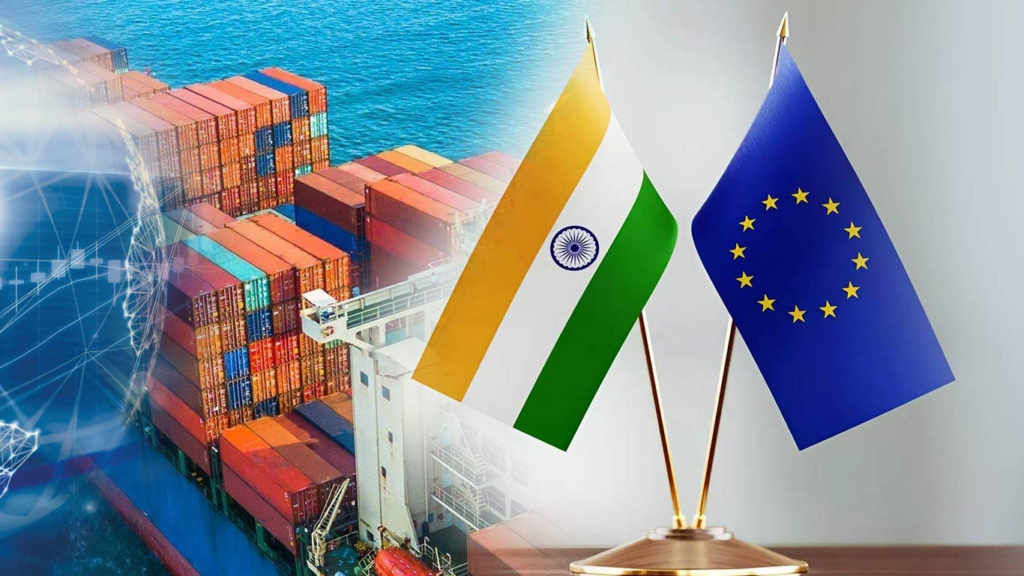
Negotiations for a comprehensive India-European Union Free Trade Agreement accelerated dramatically following high-level meetings in Brussels between Indian Commerce Minister Piyush Goyal and EU Trade Commissioner Valdis Dombrovskis on January 10-11, 2026. Officials from both sides expressed optimism about concluding an agreement within 2026 that would create one of the world’s largest trading relationships and reshape economic dynamics across Asia and Europe.
The proposed FTA would connect India’s economy, valued at approximately $4.2 trillion with 1.45 billion consumers, with the European Union’s economy of $19 trillion serving 450 million people. Combined, these economies represent nearly one-third of global GDP and offer enormous potential for trade expansion, investment flows, and technological collaboration that could drive growth for both regions while providing alternatives to economic dependence on China.
Economic Scale and Trade Potential
Current India-EU trade stands at approximately $138 billion annually, making the EU India’s second-largest trading partner after the United States, and India the EU’s tenth-largest partner. However, both sides recognize this significantly underperforms the relationship’s potential given economic size, complementary strengths, and growing strategic alignment.
| Trade Category | Current Value (Billions USD) | Post-FTA Potential (Est.) | Growth Opportunity |
| EU Exports to India | $68 | $105-120 | 54-76% increase |
| India Exports to EU | $70 | $110-130 | 57-86% increase |
| Services Trade | $42 | $85-100 | 102-138% increase |
| Investment Flows (Annual) | $15 | $40-50 | 167-233% increase |
| Total Bilateral Trade | $138 | $215-250 | 56-81% increase |
European exports to India center on high-value manufactured goods including automotive components, machinery, pharmaceuticals, and chemicals. Germany alone accounts for approximately 22% of EU exports to India, followed by Belgium, France, Italy, and Netherlands. These countries view the Indian market as critical for sustaining their advanced manufacturing sectors, particularly as Chinese demand moderates and other emerging markets face economic headwinds.
Indian exports to the European Union focus on information technology services, pharmaceuticals, textiles, agricultural products, and increasingly, automotive components. The EU represents India’s largest destination for IT services exports, with approximately $35 billion annually flowing from Indian software firms and outsourcing providers to European clients. This service trade relationship has proven particularly resilient and growth-oriented.
Key Negotiation Issues and Compromises
The India-EU FTA negotiations have progressed through thirteen rounds of formal talks since resuming in 2022 following a nine-year hiatus from 2007-2016. Earlier attempts foundered on several contentious issues, but both sides have shown greater flexibility in the current round, motivated by shifting geopolitical dynamics and mutual strategic interests.
| Negotiation Area | EU Position | Indian Position | Compromise Framework |
| Agricultural Market Access | Seek greater access for dairy, wine, spirits | Protect sensitive sectors (dairy, etc.) | Phase-in periods, quotas for sensitive items |
| Automotive Tariffs | Reduce India’s high tariffs (100% on many vehicles) | Protect developing industry | Gradual reduction over 10-12 years |
| Pharmaceutical IP | Strong IP protection, data exclusivity | Generic medicine access, health priority | Balance originator rights with generic access |
| Services Liberalization | Greater Mode 4 (worker movement) access | Professional mobility for IT workers | Enhanced visa facilitation, mutual recognition |
| Sustainability Provisions | Strong labor, environment standards | Concerns about green protectionism | Capacity building, transitional measures |
| Geographic Indications | Protect EU designations (Champagne, etc.) | Recognize Indian products (Darjeeling, etc.) | Reciprocal recognition framework |
| Government Procurement | Market access reciprocity | Buy Indian preference policies | Gradual opening with thresholds |
The agricultural sector represents perhaps the most sensitive area, with EU negotiators pushing for greater access to India’s large and growing food market, while India seeks to protect millions of small farmers from sudden import competition. The compromise framework emerging from Brussels discussions involves phased tariff reductions over 10-15 years for sensitive agricultural products, allowing Indian agriculture time to adapt, while providing immediate or accelerated access for products where Indian concerns are minimal.
Automotive trade has similarly required creative solutions. India currently imposes tariffs up to 100% on imported vehicles, effectively pricing most European cars out of the mass market while protecting domestic manufacturers. European automakers, particularly German brands, have pressed for significant reductions to make their vehicles more competitive in India. The likely compromise involves gradual tariff reductions from current levels to perhaps 30-40% over a decade, with faster reductions for electric vehicles to align with India’s clean energy goals.
Strategic Drivers and Geopolitical Context
Beyond pure economic calculation, several strategic factors are accelerating India-EU FTA momentum:
China +1 strategy: Both India and the EU seek to reduce economic dependence on China by developing alternative partnerships. European firms increasingly view India as a viable manufacturing alternative for relocating production out of China, particularly in sectors like electronics, pharmaceuticals, and automotive components.
Technology cooperation: India and the EU share concerns about China’s technological rise and seek greater collaboration in critical technologies including semiconductors, artificial intelligence, quantum computing, and clean energy. The FTA can facilitate technology partnerships and supply chain integration.
Democratic values alignment: Unlike China’s authoritarian system, India’s democratic governance structure, despite imperfections, aligns more closely with European values, making the partnership easier to justify domestically and strategically sustainable over the long term.
Russian energy pivot: Europe’s effort to reduce Russian energy dependence creates opportunities for Indian companies in renewable energy, while India’s need for energy diversification creates markets for European clean technology.
Global south leadership: The EU views partnership with India as key to engaging the broader Global South and countering Chinese influence in developing countries. India’s leadership in forums like the G20 and its credibility in the developing world make it an important partner for European diplomacy.
| Strategic Priority | EU Interest | Indian Interest | Partnership Potential |
| Supply chain resilience | Reduce China dependence | Manufacturing hub development | High – complementary |
| Technology development | Critical tech sovereignty | Innovation capacity building | High – mutual benefit |
| Climate transition | Green technology markets | Financing, technology access | High – aligned goals |
| Rules-based order | Multilateral system preservation | Multi-polar world influence | Moderate – different emphasis |
| Regional stability | Indo-Pacific engagement | Security in Indian Ocean | Moderate – shared concerns |
Sectoral Impact Analysis
Different sectors within both economies will experience varying impacts from an FTA, with some clear winners and others facing adjustment challenges:
European Winners:
- Automotive manufacturers gain access to world’s third-largest and fastest-growing vehicle market
- Wine and spirits producers access 450 million middle-class Indian consumers
- High-end manufacturing benefits from reduced tariffs and streamlined customs
- Service providers gain easier access to massive Indian market
European Challenges:
- Generic pharmaceutical manufacturers face competition from low-cost Indian producers
- Some agricultural producers concerned about competition in sensitive products
- Labor-intensive manufacturing may continue shifting to lower-cost India
Indian Winners:
- IT services companies gain more secure market access and visa facilitation
- Pharmaceutical manufacturers access large European generic medicine market
- Textile industry expands exports with tariff elimination
- Agricultural exporters gain access for speciality products
Indian Challenges:
- Automotive sector faces increased import competition
- Dairy farmers concerned about subsidized European imports
- Some manufacturing sectors face adjustment pressures
- Regulatory compliance costs increase to meet European standards
Implementation Timeline and Phasing
If negotiations conclude successfully in 2026 as hoped, implementation would follow a carefully phased schedule to allow both economies time to adjust and to sequence liberalization in politically sustainable ways:
| Phase | Timeline | Key Provisions | Strategic Focus |
| Phase 1 | 2027-2029 | Initial tariff cuts (30-40%), services framework | Build confidence, quick wins |
| Phase 2 | 2030-2034 | Major tariff reductions (60-70%), regulatory alignment | Core liberalization |
| Phase 3 | 2035-2037 | Final tariff elimination (sensitive products), deep integration | Comprehensive FTA |
| Phase 4 | 2038+ | Review, update, potential expansion | Sustained evolution |
This phased approach reflects lessons learned from other major FTAs that attempted too much too quickly and faced political backlash or implementation challenges. By allowing 10-12 years for full implementation of the most sensitive provisions, both sides create adjustment time that makes the agreement more politically sustainable.
Comparative Analysis with Other Indian FTAs
India has pursued bilateral and regional FTAs with varying success over the past two decades. The India-EU agreement would be significantly more ambitious than most previous Indian trade agreements:
| Agreement | Partners | Trade Value | Implementation Status | Depth of Integration |
| India-EU FTA | EU (27 countries) | $138 billion | Under negotiation | Comprehensive (planned) |
| RCEP | 15 Asia-Pacific countries | India withdrew 2019 | Not applicable | Would have been deep |
| India-UAE CEPA | United Arab Emirates | $85 billion | Implemented 2022 | Moderate |
| India-Australia ECTA | Australia | $28 billion | Implemented 2022 | Moderate-High |
| India-ASEAN FTA | 10 ASEAN countries | $131 billion | Implemented 2010 | Limited |
| India-South Korea CEPA | South Korea | $28 billion | Implemented 2010 | Moderate |
| India-Japan CEPA | Japan | $34 billion | Implemented 2011 | Moderate |
India’s controversial decision to withdraw from the Regional Comprehensive Economic Partnership (RCEP) in 2019 reflected concerns that the agreement insufficiently protected Indian manufacturing and agriculture from Chinese competition. That withdrawal left India outside Asia’s largest trade bloc but created space for India to pursue bilateral agreements with specific partners on terms more acceptable to Indian interests. The EU FTA represents an opportunity to secure major market access without the complications of including China in the arrangement.
Business Community and Civil Society Responses
European and Indian business communities have generally welcomed FTA negotiations, though with sector-specific caveats:
The Confederation of Indian Industry (CII) and Federation of Indian Chambers of Commerce and Industry (FICCI) have endorsed the FTA as essential for India’s economic development and global integration. They emphasize that tariff protection alone cannot build competitive industries and that exposure to European competition and investment will drive productivity improvements.
BusinessEurope, the EU’s largest business organization, similarly supports the agreement while pressing negotiators to secure strong market access commitments and IP protection. German automotive associations have been particularly vocal in demanding significant tariff reductions to make European vehicles competitive in India.
Civil society perspectives are more divided. Environmental and labor organizations in both regions have pressed for strong sustainability provisions ensuring that increased trade does not come at the cost of environmental degradation or labor rights. Indian farmer organizations have organized protests against perceived threats from European agricultural imports, while European animal welfare groups have raised concerns about Indian animal product standards.
Investment Provisions and Economic Corridors
Beyond traditional trade in goods and services, the FTA negotiations include substantial provisions for investment protection and facilitation. European firms currently maintain approximately $105 billion in foreign direct investment in India, while Indian firms have invested roughly $18 billion in the EU. Both sides seek to grow these flows substantially.
| Investment Sector | Current EU Investment in India | Growth Potential | Key Barriers to Address |
| Automotive Manufacturing | $32 billion | High | Local content requirements |
| Financial Services | $18 billion | High | Ownership restrictions |
| Pharmaceuticals | $15 billion | Moderate-High | Regulatory unpredictability |
| Technology & IT | $12 billion | High | Data localization rules |
| Renewable Energy | $11 billion | Very High | Grid access, payments |
| Consumer Goods | $8 billion | Moderate | Distribution restrictions |
| Infrastructure | $9 billion | High | Contract enforcement |
Proposed investment provisions include stronger investor-state dispute settlement mechanisms, guarantees against expropriation, commitment to regulatory stability, and facilitated repatriation of profits. However, India has grown warier of investor-state dispute settlement after several high-profile cases where foreign investors successfully challenged Indian policy measures, creating political sensitivity around investment provisions that some critics characterize as limiting policy sovereignty.
The FTA framework also envisions development of economic corridors connecting European and Indian commercial hubs. The India-Middle East-Europe Economic Corridor (IMEC), announced at the 2023 G20 summit, would provide infrastructure backbone for expanded trade by creating streamlined transportation routes from Indian ports through the Middle East to European markets, reducing shipping times and costs compared to traditional routes through the Suez Canal.
Regulatory Cooperation and Standards Harmonization
One of the most significant but least visible aspects of the India-EU FTA involves regulatory cooperation and standards alignment. Modern FTAs increasingly focus on non-tariff measures that can impede trade as much or more than tariffs themselves. Divergent standards, testing requirements, certification processes, and regulatory approvals create costs and delays that undermine the benefits of tariff elimination.
The proposed FTA includes provisions for:
- Mutual recognition of conformity assessment for industrial products
- Regulatory cooperation mechanisms for pharmaceuticals and medical devices
- Harmonization of food safety and sanitary standards where possible
- Alignment of technical standards with international norms
- Streamlined customs procedures and digitalization
- Recognition of professional qualifications for certain occupations
These “deep integration” provisions can generate substantial trade facilitation benefits but also require significant administrative effort and political will to implement. Success requires sustained engagement between regulatory agencies, industry stakeholders, and standards bodies in both regions—a complex, technical process that extends well beyond FTA signing ceremonies.
Political Economy and Domestic Constituencies
The India-EU FTA’s ultimate success depends not just on negotiations between governments but on building domestic political support in both regions to sustain implementation through inevitable challenges and adjustment costs.
In India, Prime Minister Modi’s government commands strong parliamentary majorities, providing political capacity to advance the agreement. However, Modi must balance support from urban, service-sector, and manufacturing constituencies that benefit from liberalization against concerns from agricultural communities and small-scale manufacturers that fear competition. India’s political system also grants significant power to state governments, some controlled by opposition parties, who can complicate implementation through state-level regulations and policies.
In the European Union, the FTA must clear multiple hurdles including European Commission negotiation, European Parliament ratification, and potentially ratification by all 27 member state parliaments depending on specific provisions. This creates numerous veto points where opposition can derail the agreement. Previous EU trade agreements have faced unexpected obstacles from individual member states or regions with specific concerns—CETA (Canada) was nearly derailed by the Walloon parliament of Belgium; the EU-Mercosur agreement has faced sustained opposition from French agricultural interests.
As negotiations accelerate toward conclusion, both sides are investing in public diplomacy and stakeholder engagement to build support coalitions and address concerns before they crystallize into opposition capable of blocking implementation. The outcome of these domestic political processes may prove as important as the substantive agreement terms in determining whether the India-EU FTA delivers on its substantial economic promise.