Operation Absolute Resolve: Inside the Audacious US Military Strike That Captured Venezuela’s Maduro
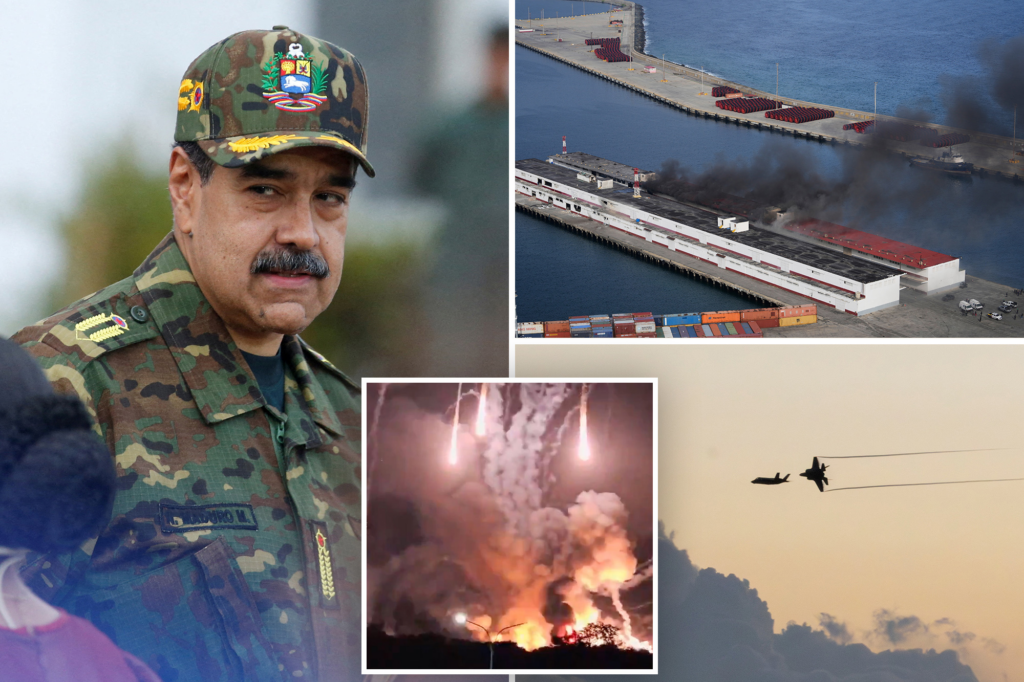
In what military analysts are calling one of the most daring operations in recent US history, President Donald Trump authorized a complex military strike on Venezuela that resulted in the capture of President Nicolás Maduro and his wife, Cilia Flores. The operation, codenamed “Absolute Resolve,” unfolded in the early hours of January 3, 2026, fundamentally altering the geopolitical landscape of Latin America and raising profound questions about international law, executive power, and America’s role on the world stage.
The operation began at precisely 2:01 AM Caracas time, when Delta Force operators descended upon Maduro’s fortified compound at Fort Tiuna military complex. According to Chairman of the Joint Chiefs of Staff General Dan Caine, the mission involved more than 150 military aircraft launching from 20 different airbases across the Caribbean, including F-22 and F-35 stealth fighters, B-1 bombers, EA-18 Growler electronic warfare aircraft, and multiple helicopter assault teams. The operation lasted just 2 hours and 28 minutes from touchdown to exfiltration, yet its ramifications will echo for decades.
Operation Timeline and Military Assets
| Time (EST) | Event | Forces Involved |
| 11:46 PM (Jan 2) | Trump gives final authorization | Presidential command |
| 1:01 AM | Assault helicopters depart carrier groups | Delta Force, SEAL teams |
| 2:01 AM | Touch down at Fort Tiuna compound | 200+ special operations forces |
| 2:15 AM | Maduro and Flores taken into custody | Delta Force primary assault team |
| 4:29 AM | Exfiltration complete, over water | Multi-service air support |
| 4:30 PM | Landing at Stewart Air National Guard Base NY | Federal law enforcement |
The scale of military coordination was unprecedented. Space Command and Cyber Command created what military officials called a “digital pathway” through Venezuela’s air defense network, while overhead protection included some of America’s most advanced combat aircraft. One helicopter took fire during the operation but remained flyable, and seven US service members sustained injuries, with two still recovering as of January 12.
Casualty Assessment and International Response
The human cost of the operation remains a source of intense debate and controversy. Venezuelan Interior Minister Diosdado Cabello announced on January 7 that at least 100 people were killed during the strikes, with a similar number injured. Cuba revealed that 32 of its citizens—military and intelligence personnel operating in Venezuela at the request of Maduro’s government—were killed in combat during the operation. Two civilian casualties have been independently verified by journalists on the ground.
| Country/Entity | Position on Operation | Key Statement |
| United States | Justified law enforcement action | “Perfectly executed” – Trump |
| United Kingdom | Not involved, but supports transition | Maduro “illegitimate” due to fraudulent 2024 election |
| China | Strong condemnation | “Blatant use of force against sovereign state” |
| Russia | Severe criticism | Rodriguez (VP) reportedly in Moscow during strike |
| Cuba | Mourning and defiance | 32 personnel “died heroically in combat” |
| Rep. Jim Himes (D) | Legal concerns | “Clearly illegal under international law” |
President Trump watched the operation unfold in real-time from a specially prepared room at his Mar-a-Lago residence, where military officials had set up secure communications and video feeds. In subsequent interviews, Trump described the experience as “like watching television” and praised the operation as demonstrating American military superiority. A controversial photograph posted to Trump’s Truth Social account showed Maduro blindfolded and wearing sound-canceling headphones aboard the USS Iwo Jima, holding a plastic water bottle—an image that drew immediate comparisons to controversial detention practices from previous conflicts.
Legal and Constitutional Dimensions
The legal framework surrounding Operation Absolute Resolve presents extraordinary complexity. Maduro and Flores were indicted in 2020 by a Manhattan federal court on narcoterrorism, drug trafficking, and weapons charges, with the US government offering a $15 million reward for information leading to Maduro’s capture. The Trump administration argues that the president possesses “inherent constitutional authority” to conduct what it characterized as a law enforcement operation with military support.
However, legal scholars and opposition politicians have challenged this interpretation. The operation bears striking similarity to the 1989 invasion of Panama and capture of Manuel Noriega, who similarly faced drug trafficking charges in US courts. Noriega challenged the legality of his seizure on grounds that it violated international law, that Panama’s invasion was unlawful, and that he enjoyed head-of-state immunity. He lost on all counts and served 40 years in prison. Whether Maduro’s legal team—which is attracting interest from top criminal defense attorneys due to the case’s high profile and potential for “novel constitutional and international law arguments,” according to CNN legal analyst Elie Honig—will fare any differently remains to be seen.
Intelligence Preparation and Planning
Perhaps the most remarkable aspect of Operation Absolute Resolve was the extensive intelligence preparation that made it possible. According to sources briefed on the operation, the CIA covertly installed a small team inside Venezuela beginning in August 2025—five months before the strike. This team tracked Maduro’s patterns, movements, locations, dining habits, clothing preferences, and even information about his pets. A CIA source operating within the Venezuelan government provided critical assistance in pinpointing Maduro’s exact location on the night of the operation.
| Intelligence Component | Duration | Key Objectives |
| CIA covert team deployment | August 2025 – January 2026 | Pattern of life analysis |
| Asset cultivation within Venezuelan government | Several months | Real-time location tracking |
| Full-scale rehearsal facility construction | Weeks prior to operation | Exact replica of Maduro compound |
| Weather window identification | Days before strike | Optimal conditions for stealth approach |
| Cyberspace and electronic warfare prep | Hours before operation | Air defense suppression pathway |
Trump personally participated in months of planning discussions, reportedly offering Maduro “multiple, very, very, very generous” opportunities to step down voluntarily and leave Venezuela. During a November 2025 phone call, Trump stressed to Maduro that “it would be in his best interest” to depart—language one official characterized as “pretty much an ultimatum.” Secretary of State Marco Rubio echoed this in his post-operation press conference: “I want to be clear about one thing: Nicolás Maduro had multiple opportunities to avoid this.”
Political Aftermath and Power Transition
In the immediate aftermath of Maduro’s capture, Venezuela’s Supreme Court ordered Vice President Delcy Rodriguez to assume the role of acting president for 90 days. Rodriguez, who served as Maduro’s vice president since 2018 and oversaw much of Venezuela’s oil-dependent economy as well as its intelligence services, was reportedly in Russia when the operation occurred—a detail that has fueled speculation about advanced warning and international dimensions of the crisis.
Defense Minister Vladimir Padrino López issued a statement recognizing Rodriguez as acting leader, indicating that Venezuela’s military command structure remained intact despite the dramatic removal of its commander-in-chief. President Trump stated that the United States would “run the country” until a “safe, proper and judicious transition” could be arranged, though the exact nature and extent of US involvement in Venezuela’s governance remains unclear.
Congressional and Public Reaction
Congressional response has split along predictable partisan lines, though with notable exceptions. Republican lawmakers largely praised the operation as decisive action against a narco-dictator. However, several Democrats and some libertarian-leaning Republicans have expressed grave concerns about the lack of congressional authorization. Representative Jim Himes, the top Democrat on the House Intelligence Committee, argued that the operation was “clearly illegal under international law” and warned of the message sent to adversaries: “Think of what Russia and China just learned.”
| Congressional Action | Status | Key Provisions |
| S.J.Res. 83 / H.Con.Res. 61 | Considered, not approved | Terminate use of military against FTOs without authorization |
| S.J.Res. 90 / H.Con.Res. 64 | Considered, not approved | Terminate operations with Venezuela without authorization |
| S.J.Res. 98 | Under Senate consideration | Remove US forces from Venezuela hostilities |
Both the Senate and House considered but did not approve resolutions pursuant to the War Powers Resolution that would have directed President Trump to terminate military operations. The Senate is currently considering S.J.Res. 98, which would require removal of US forces from hostilities in Venezuela not authorized by Congress. The Congressional Research Service has prepared detailed briefings on the operation’s legal implications, precedents, and potential consequences for executive-legislative balance.
Regional and Global Implications
The capture of Maduro has triggered celebrations among Venezuelan diaspora communities worldwide, particularly in Doral, Florida (home to the largest Venezuelan population in the United States), Madrid, Cúcuta, Buenos Aires, Lima, Quito, and Santiago. Streets filled with flag-waving crowds chanting “freedom” and “virtue,” expressing hope that Maduro’s removal might finally enable Venezuela’s return to democratic governance and economic recovery.
However, initial euphoria has given way to more complex emotions as questions mount about what comes next. Many Venezuelans express caution about US intentions and worry about whether genuine democracy or merely a US-friendly autocracy will emerge from the current power vacuum. Inside Venezuela itself, the mood is tense and uncertain. Caracas remained unusually quiet in the days following the operation, with most businesses closed and residents stocking up on supplies in case of civil unrest.
Strategic Analysis and Future Outlook
From a strategic perspective, Operation Absolute Resolve represents a dramatic escalation of Trump’s aggressive approach to what he calls “America First” foreign policy. The administration justified the operation primarily on law enforcement grounds—Maduro faces serious drug trafficking charges—but the use of overwhelming military force, including bombing of Venezuelan air defense installations and infrastructure, clearly exceeded traditional law enforcement parameters.
The operation also highlights Venezuela’s substantial oil reserves, which Trump explicitly referenced in his post-operation comments: “Venezuela unilaterally seized and stole American oil, American assets and American platforms, costing us billions and billions of dollars. We built Venezuela oil industry with American talent, drive and skill. And the socialist regime stole it from us.” Whether economic interests played a significant role in the decision-making process remains a matter of heated debate.
The Maduro capture sets a precedent that may embolden the Trump administration to take similar action against other adversaries, particularly those facing US indictments. It also sends a clear message to autocrats worldwide: proximity to the United States and possession of natural resources may no longer provide immunity from forceful US intervention, regardless of international law conventions.
As Maduro and Flores await their March 17 court date in Manhattan, the case will test fundamental questions about sovereignty, executive power, and the application of US law beyond American borders. The outcome will shape not only Venezuela’s future but also the boundaries of American power in an increasingly multipolar world.