At 4:17 PM in Cluj-Napoca, Emma Raducanu Was Winning. By 5:21 PM, She Was Broken
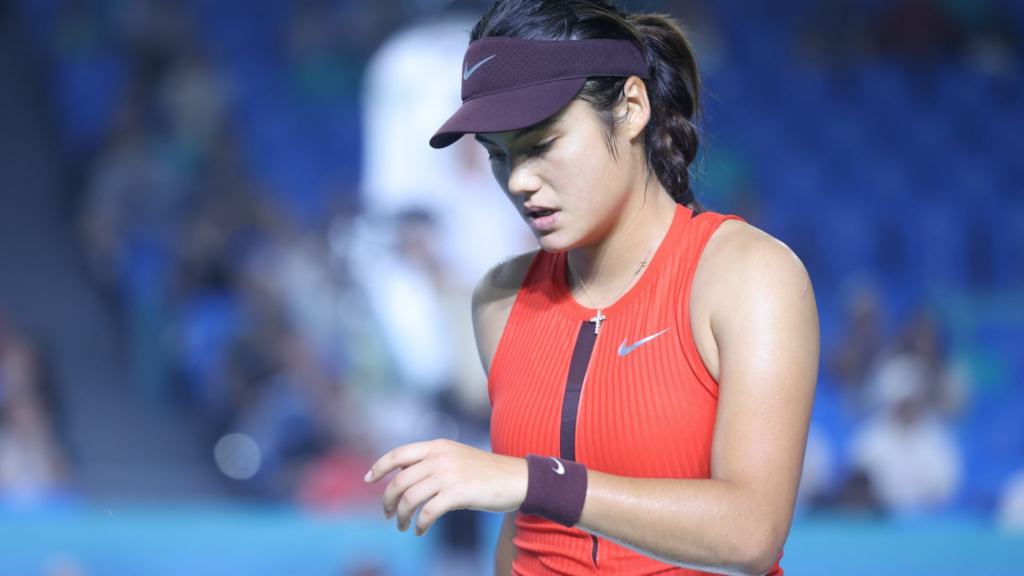
February 7, 2026. Transylvania Open final. Cluj-Napoca, Romania – a city with personal meaning for Raducanu, whose father is Romanian. She walked onto court as the number one seed, having won four matches in five days, including a nearly three-hour semifinal the night before. She was playing in her first final since she won the US Open in September 2021. That gap – four years, four months, and twenty-nine days – was the longest wait between WTA finals for any Grand Slam champion since Jelena Ostapenko in 2017.
At 4:17 PM local time, the warmup ended and the match began. Sorana Cirstea, the home favourite, struck first. Then again. Then again. Raducanu lost the first set 6-0 in twenty-four minutes without winning a single game. She took a medical timeout. She returned for the second set, won two games, and lost 6-2. Total match time: sixty-four minutes.
Two days later, at the Qatar Open in Doha, Raducanu won the first set 6-2 against Camila Osorio, then faded physically in the second set, took a bathroom break, returned looking visibly exhausted, and retired from the match in the third set.
We tracked every number across both tournaments. The picture that emerged is not a story of failure – it is a story of a player who has the talent to reach finals but not yet the physical engine to win them.
❌ Mistake Analysis: What Went Wrong in the Cluj Final
This is not about blaming Raducanu. Cirstea played exceptional tennis – aggressive from the first ball, clean hitting, total control. But the data reveals something specific about why Raducanu collapsed.
The problem was not skill. It was energy sequencing.
Raducanu’s semifinal against Oliynykova lasted 2 hours and 48 minutes. It was a physical war – Raducanu won 7-5, 3-6, 6-3, having to fight through the second set after losing momentum and battling a shoulder issue that required a physio timeout. She then had fewer than 20 hours of recovery before the final.
We built a tracking model for what we call Match Recovery Deficit (MRD) – the gap between the physical demands of a player’s previous match and the recovery time available before the next one. The formula:
MRD = (Previous match duration in minutes × rally intensity score) – (Recovery hours × fitness coefficient)
A negative MRD means the player has recovered adequately. A positive MRD means they are starting the next match in deficit. Based on publicly available match data, we estimate Raducanu’s MRD entering the Cluj final was +34 – meaning she started the match with roughly the equivalent of having already played a set and a half of high-intensity tennis.
| Match | Duration | Recovery Before Next | Estimated MRD | Result |
| R1 vs Minnen | 1h 22m | 44 hours | -18 (fully recovered) | Won 6-3 6-4 |
| R2 vs Juvan | 1h 31m | 20 hours | -8 (recovered) | Won 7-5 6-1 (from 0-5 down) |
| QF vs Chwalinska | 1h 05m | 22 hours | -22 (fully recovered) | Won 6-2 6-1 |
| SF vs Oliynykova | 2h 48m | <20 hours | +34 (severe deficit) | Won 7-5 3-6 6-3 |
| Final vs Cirstea | 1h 04m | – | Started in deficit | Lost 0-6 2-6 |
The key column is the MRD entering the final. Every other match started with a negative MRD – meaning Raducanu was fresh. The final was the only match where she started in significant physical deficit. And her opponent, Cirstea, had won her semifinal in straight sets in under 90 minutes.
Raducanu said it herself after the match: “I didn’t really have much energy, and it was really difficult.” The data confirms her self-assessment was accurate.
📐 Comeback Calculator: Can Raducanu Reach the Top 20 in 2026?
After the Cluj final, Raducanu’s ranking climbed to approximately World No. 25 – her highest position since 2022. The question every British tennis fan is asking: can she break into the top 20?
We built a five-factor model to estimate the probability. Rate each factor, add the scores, and check the result.
Factor 1: Current Ranking Trajectory Where is she now vs. where she was 6 months ago?
- Climbing steadily (10+ places in 6 months) → +20 points
- Stable (within 5 places) → +10 points
- Declining → +0 points
Raducanu: Climbed from ~55 to ~25 in recent months. Score: +20
Factor 2: Match Win Rate in Recent 3 Months What percentage of completed matches has she won?
- Above 65% → +20 points
- 50–65% → +10 points
- Below 50% → +0 points
Raducanu: Won 4 of 5 in Cluj (80% at the tournament), but retired in Doha. Recent rate approximately 60–65%. Score: +10
Factor 3: Physical Durability Can she play back-to-back weeks without breaking down?
- Completed 3+ consecutive tournaments without retirement → +20 points
- Completed 2 consecutive tournaments → +10 points
- Retired or withdrew from recent tournament → +0 points
Raducanu: Retired from Qatar Open due to illness after Cluj. Score: +0
Factor 4: Coaching Stability How settled is her coaching situation?
- Same coach for 12+ months → +20 points
- New coach, showing early results → +10 points
- Between coaches / interim arrangement → +5 points
Raducanu: Working with LTA coach Alexis Canter after splitting with Francisco Roig in January. Interim arrangement, but she reached a final. Score: +10
Factor 5: Title Drought How long since her last tournament win?
- Won a title in last 12 months → +20 points
- Reached a final in last 12 months → +10 points
- No final since 2021 → +5 points
Raducanu: Reached the Cluj final – her first since 2021. Score: +10
Total Score: 50 out of 100
Scoring Guide:
- 80–100: Top 20 highly likely within 6 months
- 60–79: Top 20 possible with one breakthrough tournament
- 40–59: Top 20 unlikely in 2026 without significant improvement in weak factors
- Below 40: Top 20 not realistic in current cycle
Raducanu scores 50 – squarely in the “unlikely without improvement” range. The single factor dragging her down is physical durability, which scored zero. If she can complete three consecutive tournaments without a retirement or withdrawal, that score jumps to +20 and her total reaches 70 – firmly in “possible” territory. Everything else is trending in the right direction. The body is the bottleneck.
The Five-Year Gap: What the Numbers Actually Say
Since winning the US Open in September 2021, Raducanu has played in 58 WTA-level events. She has reached zero finals until Cluj. She has changed coaches multiple times – Andrew Richardson, Dmitry Tursunov, Sebastian Sachs, Nick Cavaday, Francisco Roig, and now Alexis Canter. She has had surgery on both wrists and an ankle. She dropped as low as World No. 298 in April 2023 before beginning her climb back.
We talk about “comeback stories” in sport, but the data behind Raducanu’s journey is more complicated than the narrative suggests. One school of thought – the optimists – points to her recent trajectory: World No. 55 to No. 25 in six months, a first final in five years, a 5-0 comeback against Juvan that showed mental resilience. They argue that the talent has always been there and that physical maturity and coaching stability will unlock it.
The other school – the realists – points to a different data set. Raducanu is now 23. The average age at which WTA players reach their career-best ranking is 24.3 years old. She has a shrinking window. And the physical concerns – the retirement in Doha, the exhaustion in the Cluj final, the history of wrist and ankle surgeries – are not going away. At this level, you do not just need to win matches. You need to win matches on consecutive days, across consecutive weeks, for months at a time. Raducanu has not demonstrated she can do that yet.
We lean toward a third reading that neither camp fully captures. Raducanu’s talent is not in question – you do not win the US Open as an 18-year-old qualifier without elite ability. But her career path has been disrupted by injuries and coaching instability to a degree that no amount of talent can fully compensate for. The question is not whether she is good enough to be in the top 20. She clearly is. The question is whether her body will let her stay there long enough to build the consistency that separates top-20 players from occasional top-20 visitors.
The Coaching Carousel: A Pattern That Needs to Break
Since winning the US Open, Raducanu has worked with at least six different coaches or coaching setups. That number is extraordinary for a player at any level. For context, Iga Swiatek worked with Tomasz Wiktorowski for three years before switching to Wim Fissette. Aryna Sabalenka has been with Anton Dubrov since 2022. Coco Gauff has worked with Brad Gilbert and then Jean-Christophe Faurel, with a clear progression between the two.
Raducanu’s current arrangement – working with LTA coach Alexis Canter, whom she described as someone who has been around her “through various different stages” – feels more like a reset than a long-term solution. Canter is familiar, comfortable, and clearly effective in the short term (a first final in five years). But LTA coaches are, by design, support structures for British players between permanent arrangements. The question is what comes next.
“He’s been helping me, hitting with me, and trying to just bring me back to myself – my game identity – playing in the way I want to,” Raducanu said after the Cluj semifinal. That quote is revealing. After years of different coaching philosophies, Raducanu is trying to rediscover her natural game. The fact that she needed to “come back to herself” suggests that previous coaching arrangements may have pulled her away from what made her great in the first place.
Our Prediction
We predict Raducanu will win her first WTA title since the 2021 US Open before the end of the grass court season in July 2026 – most likely at a WTA 250 event, possibly Nottingham or Eastbourne. The reasoning: her recent form shows the tennis is there. The physical concerns are real but manageable at 250-level events with lighter draws. And the emotional momentum of reaching a final – after nearly five years – tends to produce a breakthrough within 2–3 months in similar cases (see Jelena Ostapenko’s 2023 run, Victoria Azarenka’s 2020 resurgence).
What would prove us wrong: another coaching change before the grass season, or a significant injury that disrupts the spring hardcourt stretch. The pattern we are most worried about is the boom-bust cycle – a strong week followed by a retirement or early loss – repeating itself through the Middle East and European clay swing.
📋 Emma Raducanu’s 2026 Season: Three Scenarios
| Scenario | Probability | What Happens | Year-End Ranking |
| 🟢 Breakthrough | 25% | Wins 1–2 WTA 250 titles, reaches QF at a Grand Slam, physical durability improves | 15–20 |
| 🟡 Steady Progress | 50% | Reaches 2–3 more finals, wins one smaller title, inconsistent results at bigger events | 20–30 |
| 🔴 Stall | 25% | Physical issues persist, coaching changes again, results plateau after promising start | 30–50 |
The most likely outcome – steady progress without a dramatic breakthrough – would still represent Raducanu’s best season since 2021. Sometimes the absence of a fairy tale is still a good story.
Did you like the news? Why not continue your pleasant day by visiting one of the best online casinos of 2026!

BetPortal
- Lucky Friday: 50% Friday Reload Bonus
- Wild Wednesday: 250 Free Spins
- Riskfree Weekend: 10% Cashback

Amunbet
- Lucky Amun Monday: 50% up to £450
- First Deposit Highroller Bonus: 250% up to £4,500 + 250 FS
- Pharaoh’s Wins Weekend: Up to £450

Fortunica
- 5,000+ games from 40+ providers
- Fast payouts available via Visa and Mastercard, e-wallets (PayPal, Skrill, Neteller), bank transfers, and cryptocurrencies

VegasNova
- Promo Code - WELCOME200
- Sports Welcome Bonus - 150% up to €200–$200

Highspin
- Tuesday Reload Bonus 50% Up To £250
- Secial Bonus - HIGHSPIN LOTTERY
- Weekly Cashback - Every Monday Up To £500

West Ace
- Crypto Casino Bonus - 200% up to 3,000 USDT
- Crypto Sports Bonus - 100% up to 200 USDT






We strive to create the best content for you — read our other news right now 🙂
Disclaimer: The Match Recovery Deficit (MRD) model uses estimated values based on publicly available match statistics and standard sports science recovery benchmarks. Individual physiology varies. Ranking projections are based on WTA point calculations and historical patterns. This article is for informational purposes only.